Window mode follows your eyes with your camera, in this browser only: no picture or position leaves your device.
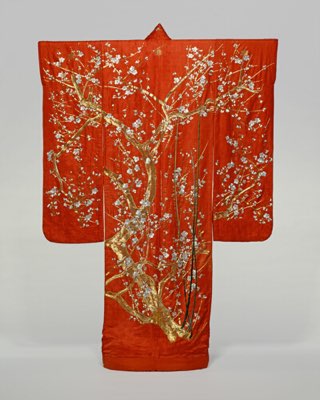
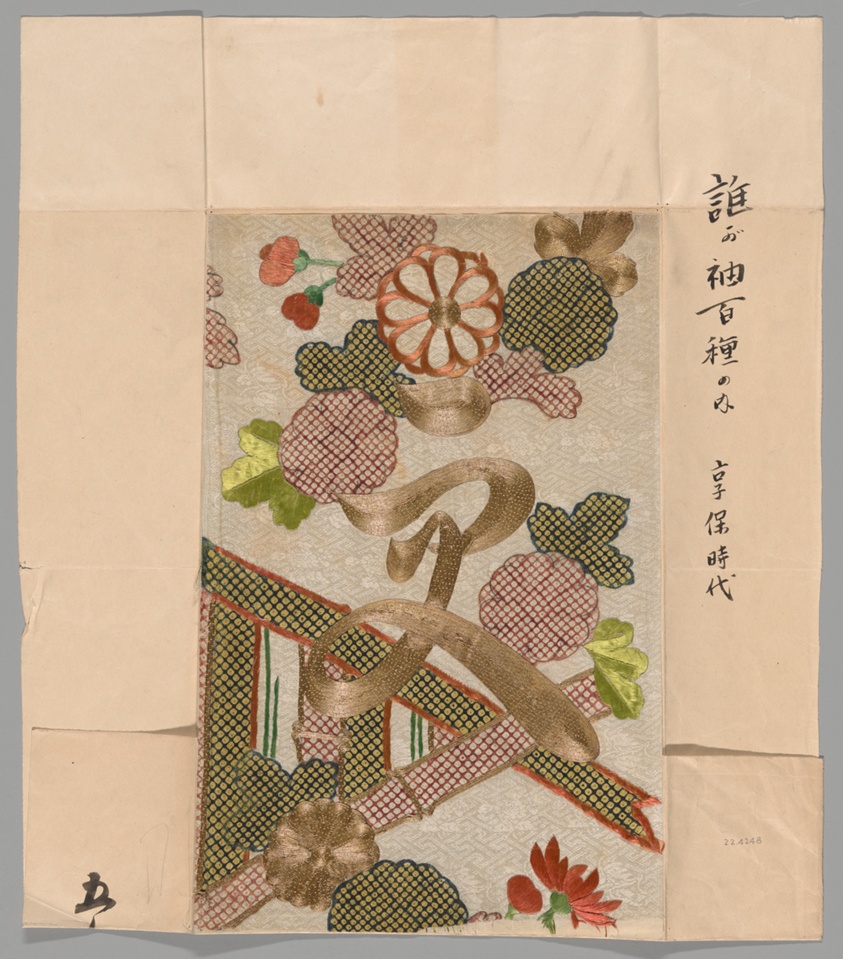
Fragment of a Kimono
Edo period (1615–1868), 1675-1725
- Medium
- Silk, twill damask weave; embroidered with silk and gilded-lacquered-paper-strip-wrapped cotton in satin stitches and laid work and couching; stenciled; mounted on paper, inscribed in ink
- Classification
- Textile
- Dimensions
- 36.8 × 23.5 cm (14 1/2 × 9 1/4 in.)
- Culture
- Japan
- Museum
- Art Institute of Chicago, Textiles
- Credit line
- Gift of Martin A. Ryerson
- Rights
- Public domain (CC0), as the museum states it.
- Who can see it
- Tweens profiles and older: its subjects are known and suit older children. How works are placed
View at the Art Institute of Chicago
About this work
This fragment combines three different methods of patterning: weaving, dyeing, and embroidery. No single technique overpowers the others, creating a harmonious whole. While the beauty of the decoration and colors can still be appreciated in the textile’s fragmentary state, the precise meaning of the embroidered character in the center has been lost: It cannot be interpreted because it has been separated from the rest of the textile and, therefore, the rest of the text.
Description © Art Institute of Chicago, CC BY 4.0