Oribe-Type Ewer
early 17th century
- Medium
- Glazed stoneware
- Classification
- Vessel
- Dimensions
- 26.7 × 21.6 cm (10 1/2 × 8 1/2 in.)
- Culture
- Japan
- Museum
- Art Institute of Chicago, Arts of Asia
- Credit line
- Gift of Robert Allerton
- Rights
- Public domain (CC0), as the museum states it.
- Who can see it
- Little Ones profiles and older: it shows gentle subjects for the very young. How works are placed
View at the Art Institute of Chicago
About this work
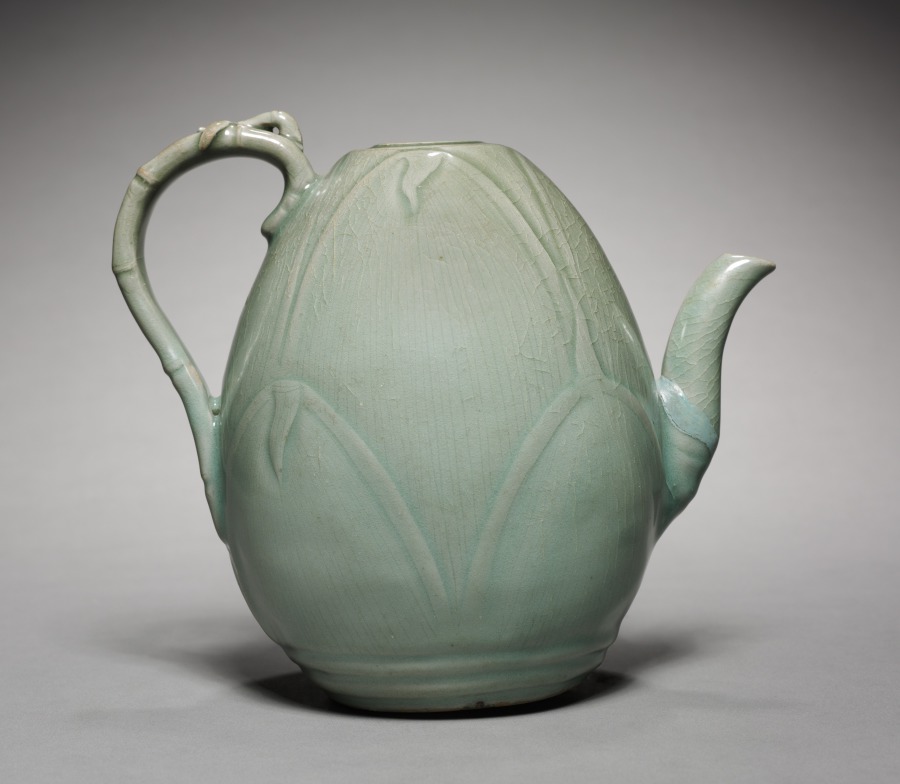
Furuta Oribe (1544–1615) was a military general–turned–tea aesthete whose style of presentation at tea gatherings catered to the samurai class and rulers of seventeenth-century Japan. In contrast to his predecessors, Oribe preferred tea wares that were bold and eccentric rather than subtle and rustic. He was the first to recognize the beauty of artfully misshapen ceramics for use in tea gatherings. Ewers such as this were employed as water containers during the meal that preceded the tea service. Their distinctive glaze contains copper, which turned green in the firing process. This glaze, along with slightly off-kilter or distorted shapes, became trademarks of Oribe ware produced in the Mino region (now Gifu Prefecture) of Japan.
This vessel features drawings of plum blossoms, wheels, a hexagonal tortoiseshell pattern, and a lattice, all done in an underglaze iron wash. This is typical of such wares, which most often do not have a single decorative theme, but rather depict a mélange of almost abstract motifs akin to the popular patterning on textiles of the period.
Description © Art Institute of Chicago, CC BY 4.0