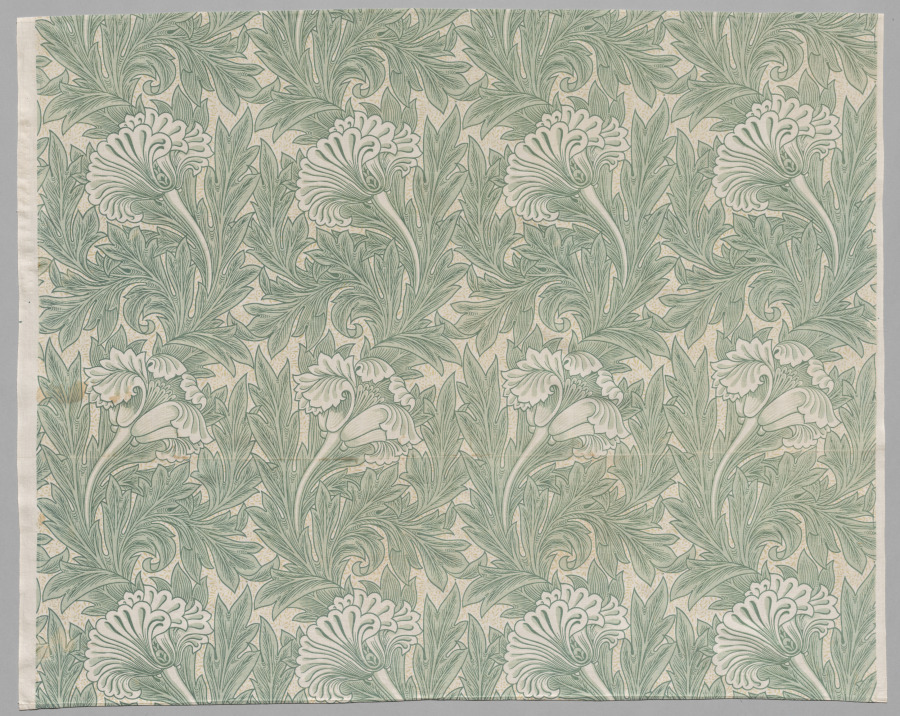
Mohnköpfe (Poppyheads) (Dress or Furnishing Fabric)
Koloman (Kolo) Moser (Produced by Johan Backhausen und Söhne (Austrian, founded 1849); Austria, Vienna)
1900
- Medium
- Silk, wild silk, and cotton, warp-float faced 15:1 satin weave self-patterned by ground weft floats; woven on loom with Jacquard attachment; right selvage present
- Classification
- Textile
- Dimensions
- 182.9 × 113 cm (72 × 44 1/2 in.); Repeat: 45.5 × 29.8 cm (17 7/8 × 11 3/4 in.)
- Culture
- Vienna
- Museum
- Art Institute of Chicago, Textiles
- Credit line
- Purchased with funds provided by Mrs. Julian Armstrong, Jr.
- Rights
- Public domain (CC0), as the museum states it.
- Who can see it
- Tweens profiles and older: its subjects are known and suit older children. How works are placed
View at the Art Institute of Chicago
About this work
Koloman Moser, a prominent Viennese designer, cofounded the Wiener Werkstatte (1903–32), a forward-looking Viennese design workshop. Prior to 1903 he was an influential member of the Moderne Movement in Vienna. Moser was also a founder of the Vienna Secession, the association of young artists who had broken away from the Wiener Künstlerhaus, the accepted artistic forum of the time. Poppyheads, designed by Moser three years before the Wiener Werkstätte was formed, foreshadowed the kind of elegant textile designs he would produce at the Werkstätte. The attenuated lines coupled with the simplification and abstraction of organic forms demonstrate a new aesthetic vision of the time shared by artists and designers in Vienna and Glasgow. Moser’s design was produced in various colors by the Viennese firm of Johann Backhausen und Söhne, which was closely linked to the Werkstätte and is still in business today. The textile was intended for upholstery or curtain fabric, ideally for rooms whose design and furnishings would be produced as total environments by Werkstätte artists.
Description © Art Institute of Chicago, CC BY 4.0