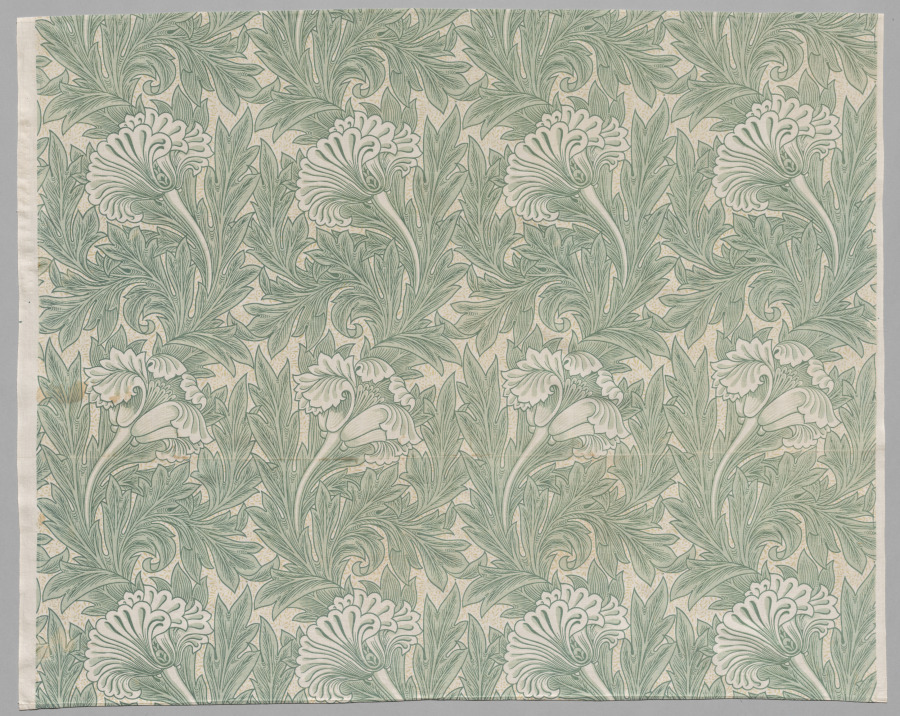
Tulip
designed by William Morris (British, 1834–1896)
1875
- Medium
- roller printed cotton
- Classification
- Textile
- Dimensions
- Overall: 76.1 x 95.3 cm (29 15/16 x 37 1/2 in.)
- Culture
- England, 19th century
- Museum
- Cleveland Museum of Art, Textiles
- Credit line
- Gift of Mrs. Philip White
- Rights
- Public domain (CC0), as the museum states it.
- Who can see it
- Little Ones profiles and older: it shows gentle subjects for the very young. How works are placed
View at the Cleveland Museum of Art
About this work
William Morris was a designer, craftsman, poet, novelist, businessman, and social activist. A doctor attributed his cause of death at age 62 to “simply being William Morris, and having done more work than most ten men.” His decorative arts firm Morris, Marshall, Faulkner & Co., known simply as Morris & Co. after 1875, designed and sold household furnishings that were sought after for their elegant, colorful patterns and high-quality materials. Morris insisted on producing goods under fair labor conditions, which set him apart from many Victorian manufacturers for whom industrialism meant imposing grueling hours for low wages in dangerous factories. During an age when rooms were stuffed with mass-produced objects and teeming with ornament, Morris challenged consumers to embrace harmony and restraint in decoration: “Have nothing in your houses that you do not know to be useful or believe to be beautiful.” Textiles were among the most profitable of the company’s merchandise and included embroidery, printed cotton, woven fabrics, tapestries, and carpets. Morris’s designs and working philosophy combined a vast knowledge of the past with a vision for the future. His final labor of…