Window mode follows your eyes with your camera, in this browser only: no picture or position leaves your device.
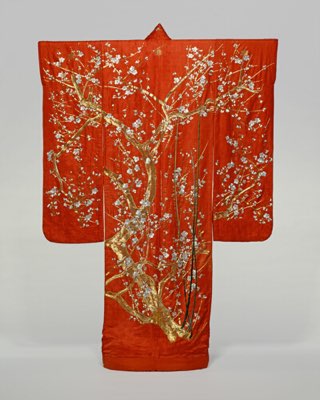
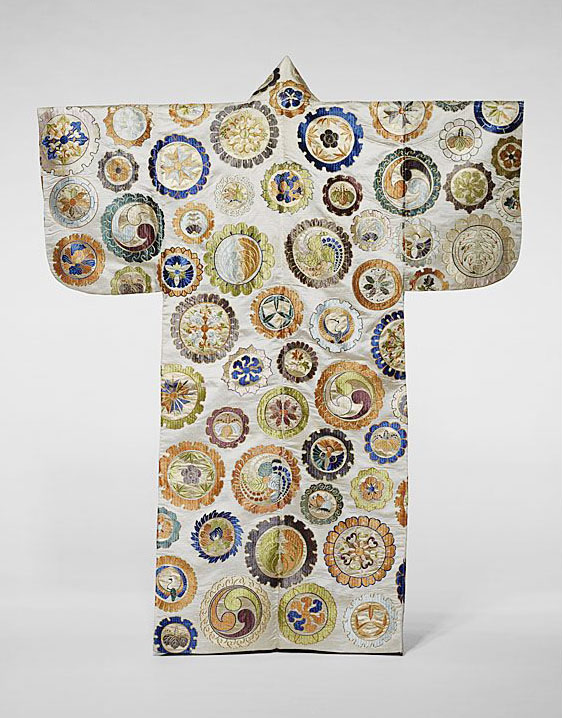
Nuihaku (Noh Costume)
Late Edo period (1789–1868), 1801-25
- Medium
- Silk, warp-float faced 7:1 satin weave; patterned with impressed gold leaf; embroidered with silk and gold-leaf-over-lacquered-paper-strip-wrapped cotton in satin and single satin stitches; laid work and couching; lined with silk, plain…
- Classification
- Textile
- Dimensions
- 175.1 × 137.5 cm (68 7/8 × 54 1/8 in.)
- Culture
- Japan
- Museum
- Art Institute of Chicago, Textiles
- Credit line
- Purchased with funds provided by Mrs. Clyde M. Carr
- Rights
- Public domain (CC0), as the museum states it.
- Who can see it
- Tweens profiles and older: its subjects are known and suit older children. How works are placed
View at the Art Institute of Chicago
About this work
Many of the elaborately embroidered round crests (mon) on this costume are similar to known personal crests of real actors, but others are imaginary designs. Collectively, they are meant to give this garment graphic impact when worn onstage. In Noh dramas, actors wear stylized masks and use methodical movements to portray narratives based on classical literature or Buddhist beliefs.
Description © Art Institute of Chicago, CC BY 4.0