Window mode follows your eyes with your camera, in this browser only: no picture or position leaves your device.
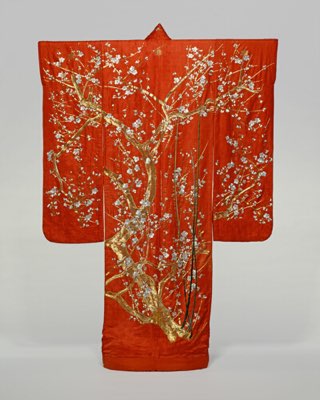
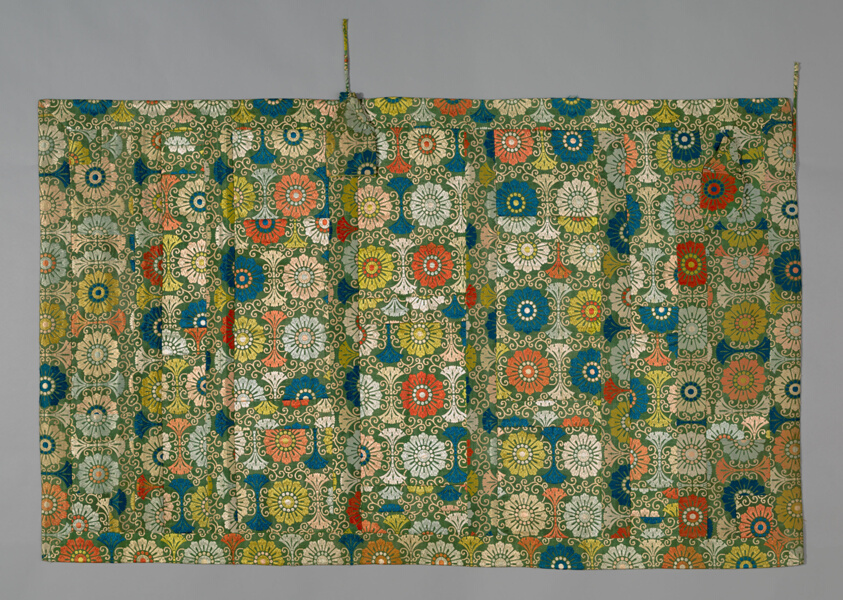
Kesa (Formerly Nō Costume)
18th century, Edo period (1615–1868)
- Medium
- Silk; twill weave with supplementary patterning wefts
- Classification
- Textile
- Dimensions
- 109.2 × 178.1 cm (43 × 70 1/8 in.)
- Culture
- Japan
- Museum
- Art Institute of Chicago, Textiles
- Credit line
- Bequest of Henry C. Schwab
- Rights
- Public domain (CC0), as the museum states it.
- Who can see it
- Tweens profiles and older: its subjects are known and suit older children. How works are placed
View at the Art Institute of Chicago
About this work
The fabric of this kesa was made from N̄ costume material probably woven at Nishijin, in Kyoto, for a wealthy samurai for a private theater. The allover pattern of colorful chrysanthemums was created in the kara-ori technique favored for N̄ costume fabrics, in which the long silk weft floats forming the pattern resemble embroidery. As with this kesa, upon the death of the owner the garment would have been donated by the family to her temple as a prayer offering to protect the deceased's soul, thus also bringing honor to the family for making the gift.
Description © Art Institute of Chicago, CC BY 4.0