Window mode follows your eyes with your camera, in this browser only: no picture or position leaves your device.
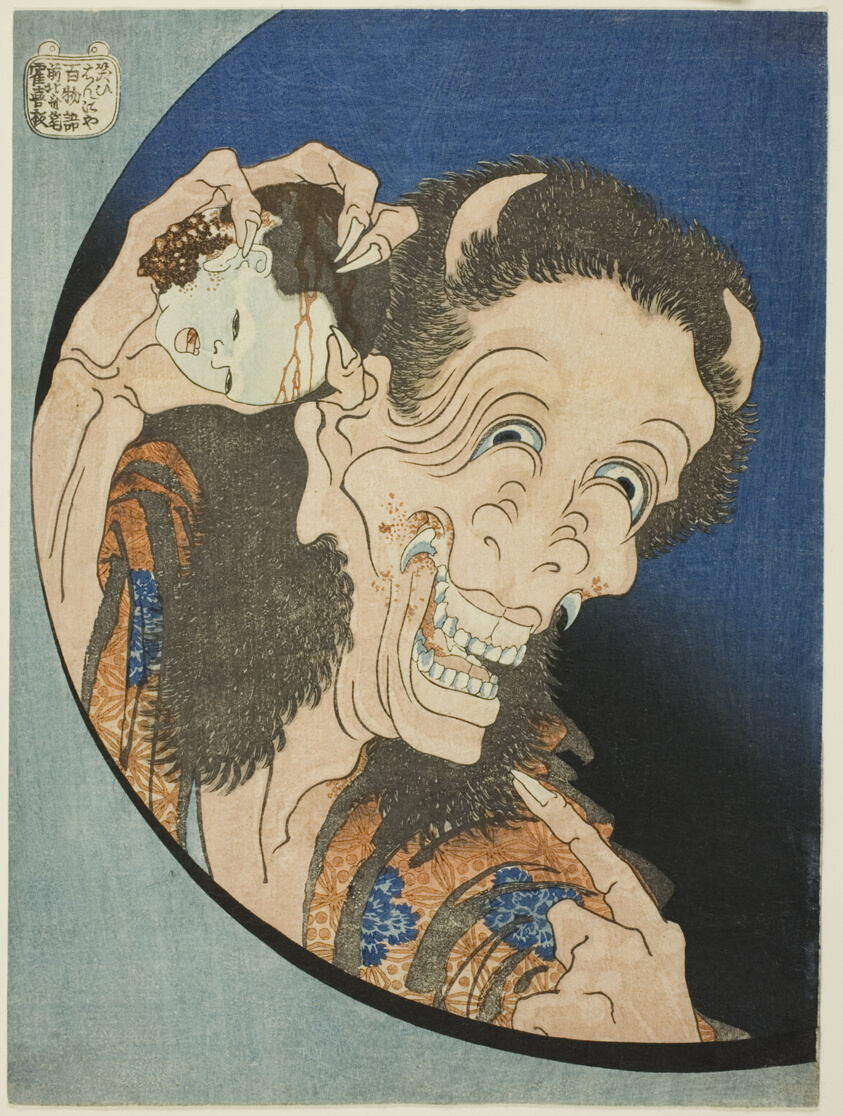
The Laughing Demoness (Warai Hannya), from the series "One Hundred Ghost Tales (Hyaku monogatari)"
Katsushika Hokusai (Japanese, 1760-1849)
1831-32
- Medium
- Color woodblock print; chuban
- Classification
- Dimensions
- 25.3 × 18 cm (9 15/16 × 7 1/16 in.)
- Culture
- Japan
- Museum
- Art Institute of Chicago, Arts of Asia
- Credit line
- Clarence Buckingham Collection
- Rights
- Public domain (CC0), as the museum states it.
- Who can see it
- Teens profiles and older: its subject is for older viewers (war, death, the Passion, drink or the like). How works are placed
View at the Art Institute of Chicago
About this work
Here, a female demon (hannya) with horns holds the decap-itated head of a child; blood oozes from the wounds caused by her long fingernails. This image references the legend of Kishimojin, a goddess from early Buddhism known in Sanskrit as Hariti. Originally, this goddess was a terri-fying ogress who was determined to eat all of the babies in the town of Rajgir, India. The Buddha heard the pleas of the townspeople and hid one of Hariti’s own children, leading her to understand the grief she had caused. She then converted to Buddhism and was eventually accepted as a goddess and a protector of children.
The Art Institute’s collection boasts one of the most well-preserved and appreciated editions of Katsushika Hok usa i’s One Hundred Ghost Tales series (1831–32). The artist apparently planned to produce a full hundred images, but the series was not completed and only five prints are known. The title refers to a game in which people would gather at night to tell scary stories, putting out a candle after each tale until the room was completely dark. These small-format works feature a bright-blue color made possible by Berlin blue pigment (often called “Prussian blue”), which had…
Description © Art Institute of Chicago, CC BY 4.0