Window mode follows your eyes with your camera, in this browser only: no picture or position leaves your device.
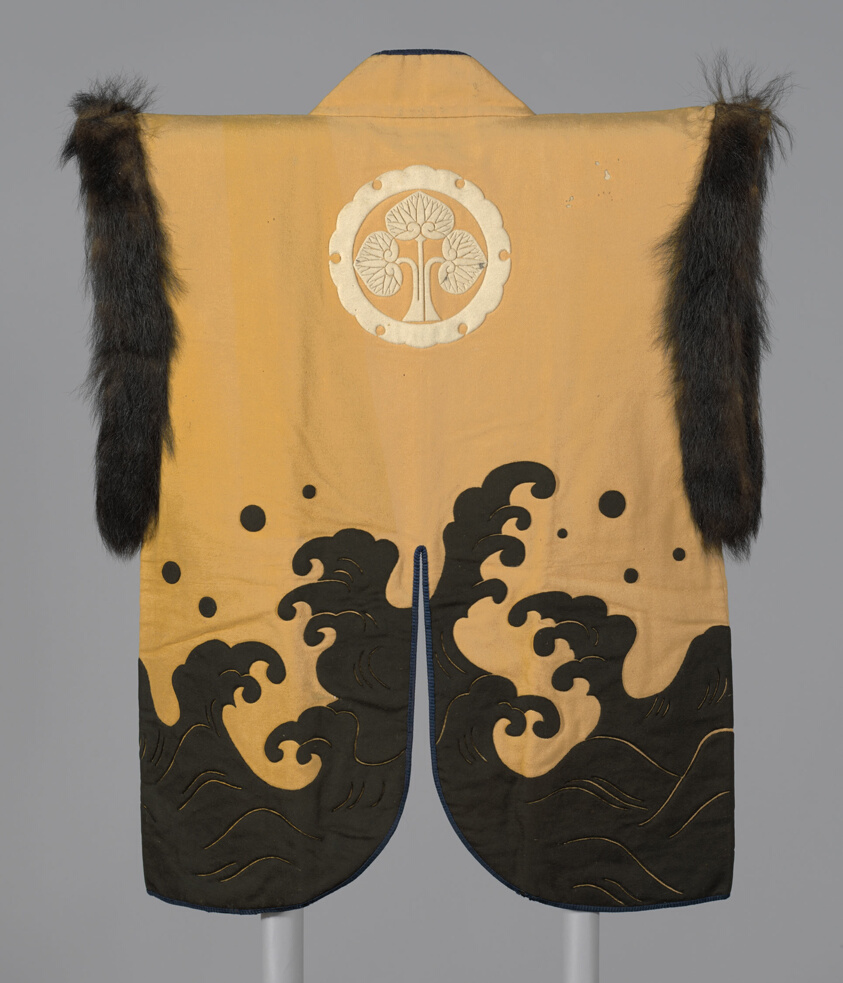
Jinbaori
Early 18th century
- Medium
- Wool, plain weave; fulled (gorofukuren); appliqué; edged with fur and silk, plain weave with secondary plain interlacings; lined with silk and gilt-paper strips, satin weave with plain interlacings of secondary binding warps and…
- Classification
- Costume and Accessories
- Dimensions
- 85.7 × 69.8 cm (33 3/4 × 27 1/2 in.)
- Culture
- Japan
- Museum
- Art Institute of Chicago, Textiles
- Credit line
- Grace R. Smith Textile Endowment
- Rights
- Public domain (CC0), as the museum states it.
- Who can see it
- Tweens profiles and older: its subjects are known and suit older children. How works are placed
View at the Art Institute of Chicago
About this work
Jinbaori were special coats worn by samurai, members of the Japanese warrior class. The garments were sleeveless and had a tall rear vent—to accommodate being layered over armor, while the wearer was on horseback. The potent graphics and high-contrast colors were meant to convey a message of strength from a distance. This striking example sends a powerful visual message in its depiction of breaking waves and flying spray, dramatically presented in silhouette in black and yellow, as well as in its use of bear fur lining the armholes. On the back of the coat is the circular crest of the Honda family, an important warrior clan loyal to the ruling Tokugawa family (ruled 1615-1868).
Description © Art Institute of Chicago, CC BY 4.0