Window mode follows your eyes with your camera, in this browser only: no picture or position leaves your device.
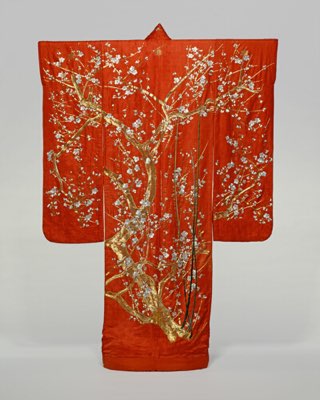
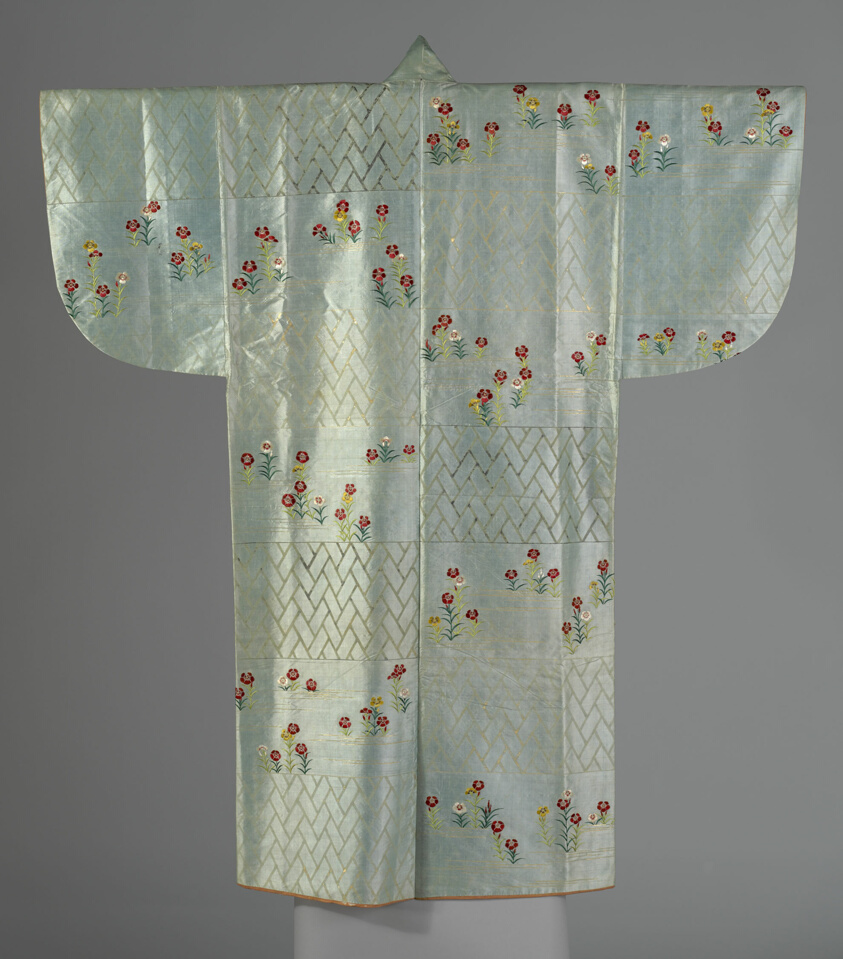
Nuihaku (Noh Costume)
late 17th/ early 18th century
- Medium
- Silk, plain weave; stamped with gold and silver leaf over adhesive (inkin); emroidered with silk in satin and couching stitches; lined with silk, plain weave
- Classification
- Costume and Accessories
- Dimensions
- 160.6 × 140.3 cm (63 1/4 × 55 1/4 in.)
- Culture
- Japan
- Museum
- Art Institute of Chicago, Textiles
- Credit line
- Louise A. Lutz Estate
- Rights
- Public domain (CC0), as the museum states it.
- Who can see it
- Tweens profiles and older: its subjects are known and suit older children. How works are placed
View at the Art Institute of Chicago
About this work
Nō is a Japanese form of theater that combines music, dance, and drama. This elegant nuihaku kimono has a pattern and technique traditionally associated with female roles (and occasionally male roles of very high rank) in Nō theater. The pattern consists of alternating panels of finely embroidered carnations ("pinks") and a braided fence created by stenciled impressed gold and silver lines. The garment once belonged to the So family, a warrior clan that prospered by controlling the trade between Japan and Korea. -A Global View: Recent Acquisitions of Textiles, 2012-2016, April 7-September 5, 2016
Description © Art Institute of Chicago, CC BY 4.0