Window mode follows your eyes with your camera, in this browser only: no picture or position leaves your device.
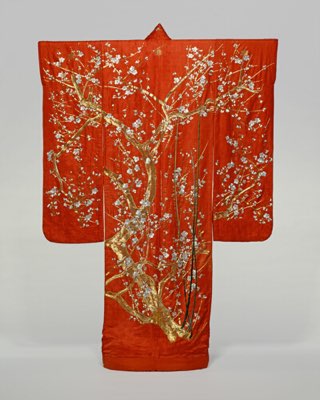
Nuihaku (Noh Costume)
18th century , Edo period (1615–1868) (additional patterning added early 19th century)
- Medium
- Silk, warp-float faced 4:1 satin weave; patterned with impressed gold and silver leaf; embroidered with silk in satin, single satin, and stem stitches; laid work and couching; lined with silk, plain weave
- Classification
- Textile
- Dimensions
- 169.6 × 136.1 cm (66 3/4 × 53 5/8 in.); Repeat: 12.3 × 12.7 cm (4 7/8 × 5 in.)
- Culture
- Japan
- Museum
- Art Institute of Chicago, Textiles
- Credit line
- Samuel M. Nickerson Fund
- Rights
- Public domain (CC0), as the museum states it.
- Who can see it
- Tweens profiles and older: its subjects are known and suit older children. How works are placed
View at the Art Institute of Chicago
About this work
The pattern on this robe for the Nō theater refers to the well-known Tales of Ise, which describes the travels of the famous courtier poet Ariwara no Narihira. One episode of the stories concerns Yatsuhashi (Eight-Planked Bridge). Here, the robe's pattern features the planks of the bridge that are floating in space, disconnected from one another with multicolored iries, and the water currents were added in the 19th century. When the robe was first made, the pattern had no reference to Tales of Ise.
Description © Art Institute of Chicago, CC BY 4.0