Window mode follows your eyes with your camera, in this browser only: no picture or position leaves your device.
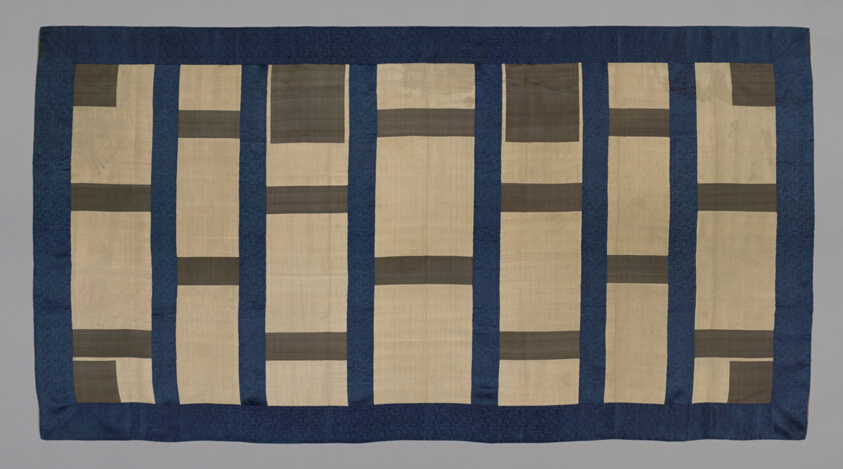
Kesa
Early or mid–19th century, Late Edo period (1789–1868)
- Medium
- Silk, satin damask and plain weaves
- Classification
- Textile
- Culture
- Japan
- Museum
- Art Institute of Chicago, Textiles
- Credit line
- Gift of Ralph E. Hays in memory of Mary Van Artsdalen Hays
- Rights
- Public domain (CC0), as the museum states it.
- Who can see it
- Tweens profiles and older: its subjects are known and suit older children. How works are placed
View at the Art Institute of Chicago
About this work
Three sectsShingon, Shin, and Tendaifavored the use of this particular type of kesa. Two or three fabrics were typically employed, none with the colorful patterning that tends to be preferred by collectors. The blue damask fabric used in the borders and column dividers, patterned (in one color) with floral motifs, may be Chinese in origin or it may be of Japanese manufacture made in the Chinese style. The kesa is accompanied by its matching stole, or ohi, which was draped over the wearer's tight shoulder as a complement to the kesa covering the left.
Description © Art Institute of Chicago, CC BY 4.0