Window mode follows your eyes with your camera, in this browser only: no picture or position leaves your device.
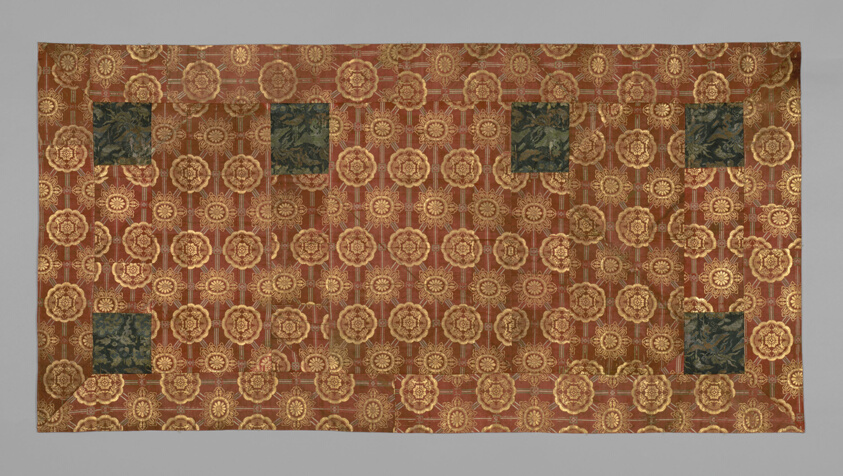
Kesa
Early or mid–19th century, Edo period (1789–1868)
- Medium
- Silk and gilt-paper strip; twill and satin weaves with secondary binding warps and supplementary patterning wefts
- Classification
- Textile
- Dimensions
- 96.8 × 191.8 cm (38 1/8 × 75 1/4 in.); Repeat: 19 × 13.3 cm (7 1/2 × 3 1/4 in.)
- Culture
- Japan
- Museum
- Art Institute of Chicago, Textiles
- Credit line
- Gift of Ralph E. Hays in memory of Mary Van Artsdalen Hays
- Rights
- Public domain (CC0), as the museum states it.
- Who can see it
- Tweens profiles and older: its subjects are known and suit older children. How works are placed
View at the Art Institute of Chicago
About this work
This attractive vestment is a good example of adaptive reuse. The pattern of the main fabric was originally used for hangings and furniture covers, and the presence of soil lines and mended areas suggests that this piece had been used as a cover. Multiple seams in the border fabric as well as the incorporation of the six squares in different material in place ofrather than on top ofthe main fabric indicate that the principal fabric was in short supply and had to be pieced judiciously.
Description © Art Institute of Chicago, CC BY 4.0