Window mode follows your eyes with your camera, in this browser only: no picture or position leaves your device.
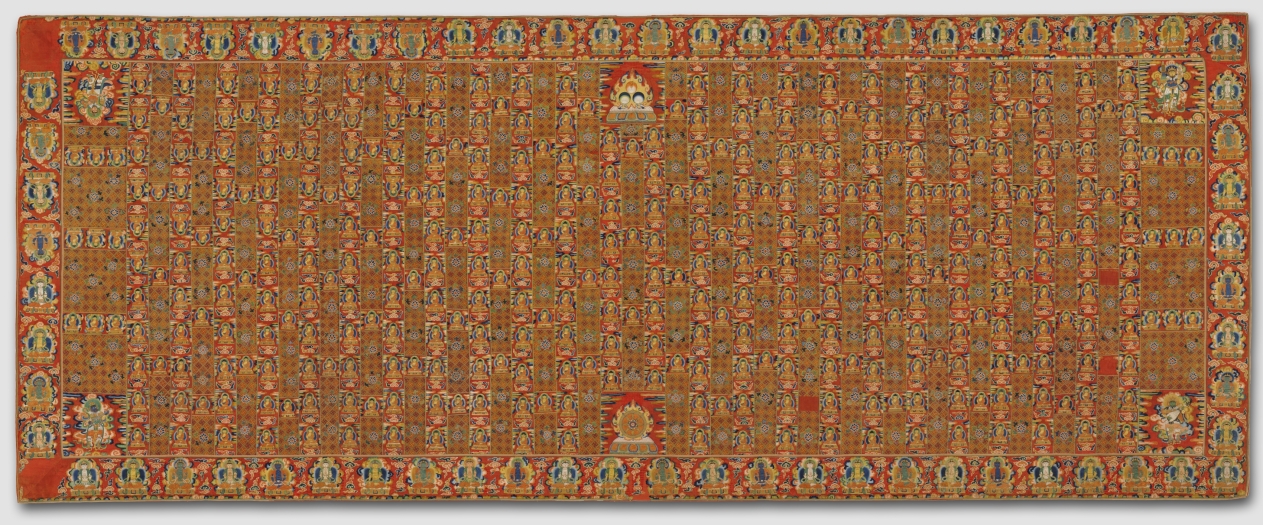
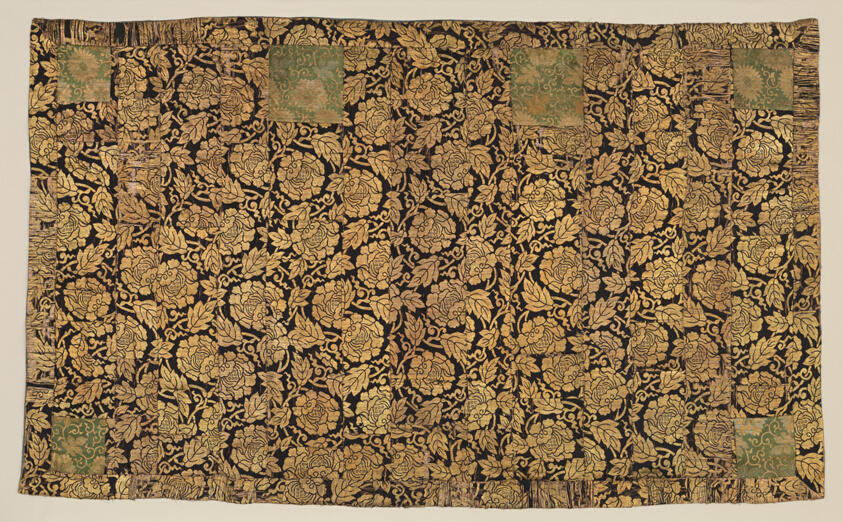
Kesa
17th century, Edo period (1615–1868)
- Medium
- Silk and gilt-paper strip; twill and satin weaves with secondary binding warps and supplementary patterning wefts
- Classification
- Textile
- Dimensions
- 99.2 × 165.1 cm (39 × 65 in.); Warp repeat: H.: 44.2 cm (17 3/8 in.)
- Culture
- Japan
- Museum
- Art Institute of Chicago, Textiles
- Credit line
- Gift of Ralph E. Hays in memory of Mary Van Artsdalen Hays
- Rights
- Public domain (CC0), as the museum states it.
- Who can see it
- Tweens profiles and older: its subjects are known and suit older children. How works are placed
View at the Art Institute of Chicago
About this work
The Chinese method for making gold "thread" out of paper coated with lacquer, finished with a layer of gold leaf, and cut into very fine strips was admired greatly by the Japanese but wasn't adopted in Japan until the late 16th century. Until then, and even after, Chinese textiles utilizing this kinran thread were imported into Japan. The term kinran is also applied to a specific type of textile made in Japan, usually at Nishijin, in Kyoto, that typically displays floral patterns in gold against silk in a dark color. This example features peony blossoms with a lotus pod in the center.
Description © Art Institute of Chicago, CC BY 4.0