Window mode follows your eyes with your camera, in this browser only: no picture or position leaves your device.
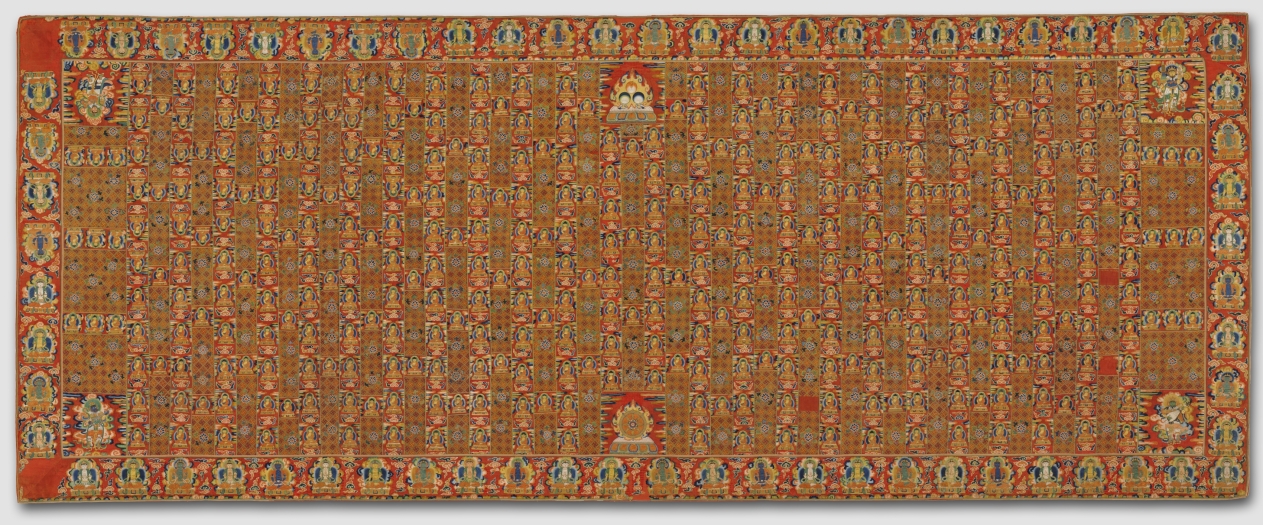
Kesa
Late 18th or early 19th century, Late Edo period (1789–1868)
- Medium
- Silk; satin damask and twill weaves with secondary binding warps and supplementary patterning wefts; stenciled silver foil
- Classification
- Textile
- Dimensions
- 122 × 176.5 cm (48 × 69 1/2 in.); Full pattern repeat in Heri: 13.9 × 5.7 cm (5 1/2 × 2 1/4 in.)
- Culture
- Japan
- Museum
- Art Institute of Chicago, Textiles
- Credit line
- Gift of Ralph E. Hays in memory of Mary Van Artsdalen Hays
- Rights
- Public domain (CC0), as the museum states it.
- Who can see it
- Tweens profiles and older: its subjects are known and suit older children. How works are placed
View at the Art Institute of Chicago
About this work
Most of the kesa in this exhibition, as well as in the museum's collection, were made from multiple pieces of one fabric. Yet the patchwork nature of these examples is often difficult to discern, sometimes evident only from changes in pattern. This example, made for the Jodo sect, was made from two different fabrics and therefore has a very readable composition: the lattice is distinct from the squares forming each column.
Description © Art Institute of Chicago, CC BY 4.0