Window mode follows your eyes with your camera, in this browser only: no picture or position leaves your device.
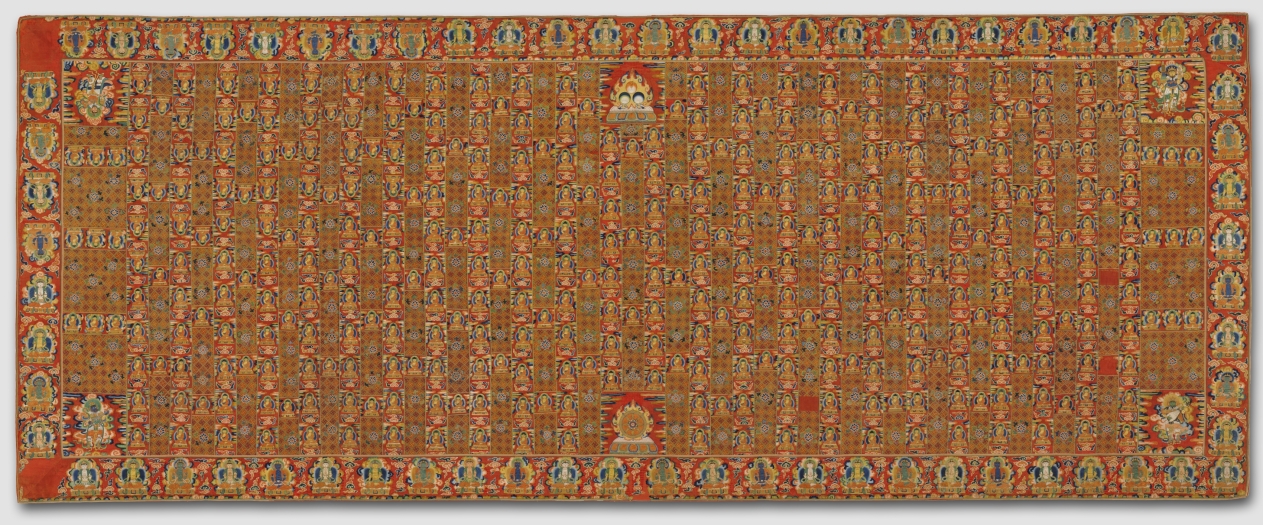
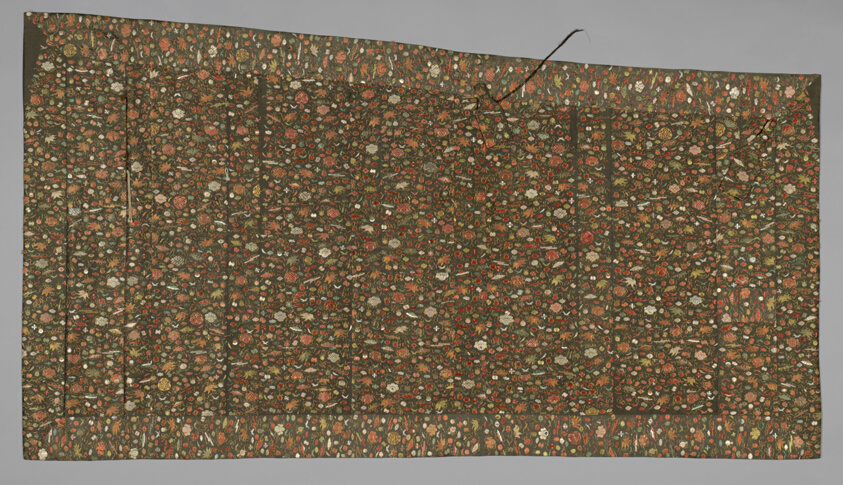
Kesa
1750/1800, Edo period (1615–1868)
- Medium
- Silk; plain weave, embroidered with silk and gilt-paper-strip-wrapped silk; silk cords
- Classification
- Textile
- Dimensions
- 127.8 × 228.8 cm (50 1/4 × 90 in.)
- Culture
- Japan
- Museum
- Art Institute of Chicago, Textiles
- Credit line
- Gift of Ralph E. Hays in memory of Mary Van Artsdalen Hays
- Rights
- Public domain (CC0), as the museum states it.
- Who can see it
- Teens profiles and older: its museum says too little about what it shows to place it for younger viewers. How works are placed
View at the Art Institute of Chicago
About this work
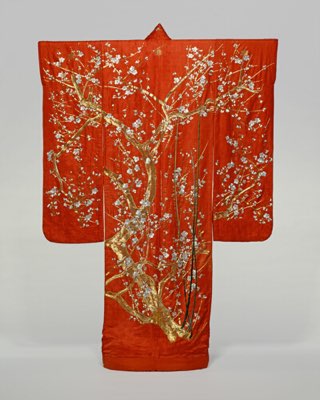
This large kesa was made for use by either the Jodo or the Rinzai sect from an elaborately embroidered kosode, or kimono with small sleeves, that was worn off the shoulders and held at the waist by a belt or sash. Together with a sheer white kimono, it was part of the formal summer dress favored by women of the samurai class. The pattern of the kesa fabric consists of the symbols of riches and good fortune, the so-called treasures (takarazukushi). The gold thread was made of gilt-paper strips, but in this work, unlike kinran, the strips were cut extremely fine and wrapped around a silk core.
Description © Art Institute of Chicago, CC BY 4.0