Window mode follows your eyes with your camera, in this browser only: no picture or position leaves your device.
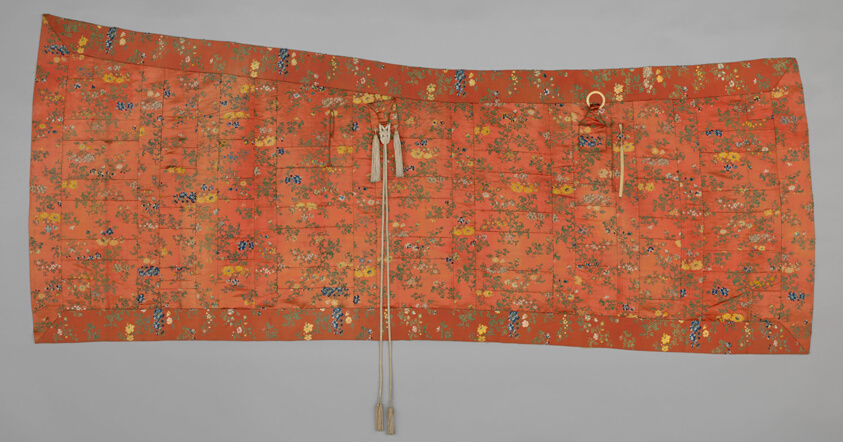
Kesa
Early 19th century, Late Edo period (1789–1868)
- Medium
- Silk; satin weave with supplementary patterning wefts; silk cords and tassels; ivory ring
- Classification
- Religious/Ritual Object
- Dimensions
- 134 × 340.6 cm (55 1/2 × 134 in.)
- Culture
- Japan
- Museum
- Art Institute of Chicago, Textiles
- Credit line
- Gift of Mrs. Charles B. Pope through the Antiquarian Society
- Rights
- Public domain (CC0), as the museum states it.
- Who can see it
- Tweens profiles and older: its subjects are known and suit older children. How works are placed
View at the Art Institute of Chicago
About this work
This kesa was among the first to enter the Art Institute's collection, in 1895. It is noteworthy for its large size, state of completeness (with ring, loop, cords, and tassels), and its pattern showing a profusion of European and Asian flowers. The pattern was made in the kara-ori technique, in which weft-float brocading resembles embroidery. An inscription on the lining states that the kesa was worn by the grand priest of a Buddhist temple.
Description © Art Institute of Chicago, CC BY 4.0