Window mode follows your eyes with your camera, in this browser only: no picture or position leaves your device.
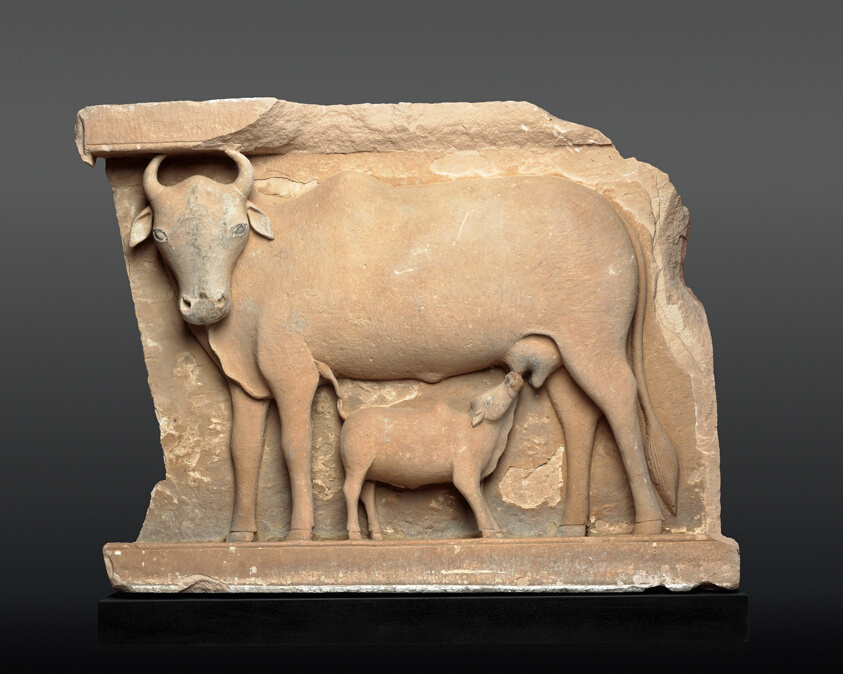
Cow Suckling a Calf
India (Madhya or Uttar Pradesh)
About 9th century
- Medium
- Sandstone
- Classification
- Sculpture
- Dimensions
- 55.3 × 73.7 × 9.6 cm (22 3/4 × 29 × 3 3/4 in.)
- Culture
- India
- Museum
- Art Institute of Chicago, Arts of Asia
- Credit line
- Gift of Marilynn B. Alsdorf
- Rights
- Public domain (CC0), as the museum states it.
- Who can see it
- Adult profiles and older: its museum's description or title mentions nudity. How works are placed
View at the Art Institute of Chicago
About this work
This naturalistic relief panel depicts a calf sucking milk from his mother while she stands patiently looking out at the viewer. Her placid eyes; floppy ears; undulating dewlap; small, upwardly curving horns; and hump help identify her as belonging to the distinctive breed of Brahman cattle originally bred in India. Cows enjoy a respected status in India: they are regarded as the nourishing mother, as portrayed in this frieze, and even their waste is used in purification rituals and for fuel.
In the medieval period in India, the cow came to be particularly associated with Krishna, an incarnation of the Hindu god Vishnu, who grew up in Vrindavan (near Mathura) among cowherds, a theme much celebrated in art. Less common are individual portrayals of a cow and calf, like this relief, which most likely came from the walls of a Hindu temple, possibly from central India, and can be dated to around the ninth century. It is possible that this relief was once part of a larger narrative scene on a temple wall, perhaps depicting Krishna among cows and cowherds.
Description © Art Institute of Chicago, CC BY 4.0