Window mode follows your eyes with your camera, in this browser only: no picture or position leaves your device.
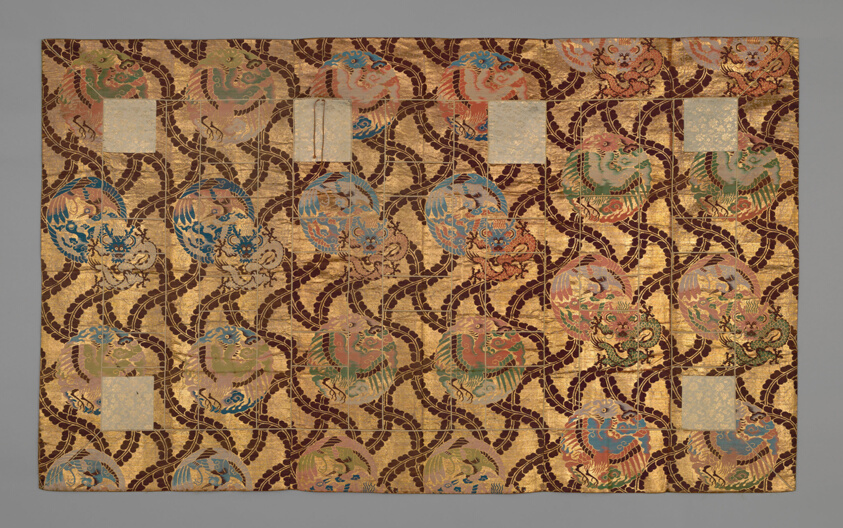
Kesa
Late 19th century, Meiji period (1868–1912)
- Medium
- Silk and gilt-paper strip; twill weave with secondary binding warps and supplementary patterning wefts with couched plied silk; silk cords
- Classification
- Textile
- Dimensions
- 119.2 × 199.5 cm (46 7/8 × 78 1/2 in.)
- Culture
- Japan
- Museum
- Art Institute of Chicago, Textiles
- Credit line
- Gift of Gaylord Donnelley in memory of Frances Gaylord Smith
- Rights
- Public domain (CC0), as the museum states it.
- Who can see it
- Tweens profiles and older: its subjects are known and suit older children. How works are placed
View at the Art Institute of Chicago
About this work
This vestment represents deluxe production that combines a complicated pattern with lavish materials. Round medallions containing a dragon or crane are set against a network of sinuous interlaced wisteria scrolls on a dense and rich gold ground of gilt-paper strip (kinran). The kesa survives in fine condition complete with its matching stole. A very similar robe, but with roundels containing pairs of birds, belongs to the Musée des Tissus in Lyon, France.
Description © Art Institute of Chicago, CC BY 4.0