Window mode follows your eyes with your camera, in this browser only: no picture or position leaves your device.
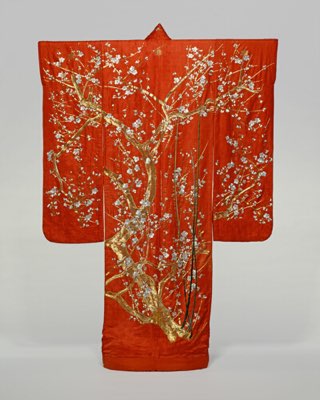
Kesa
Early 19th century, Late Edo period (1789–1868)
- Medium
- Silk and gilt-paper strip; satin weave with secondary binding warps and supplementary patterning wefts; silk cords
- Classification
- Textile
- Dimensions
- 193 × 105.4 cm (76 × 41 1/2 in.)
- Culture
- Japan
- Museum
- Art Institute of Chicago, Textiles
- Credit line
- Gift of Martin A. Ryerson
- Rights
- Public domain (CC0), as the museum states it.
- Who can see it
- Tweens profiles and older: its subjects are known and suit older children. How works are placed
View at the Art Institute of Chicago
About this work
The principal pattern element in this garment is the maple leaf, shown in clusters of three. Along with the cherry blossom, the maple leaf is the most popular seasonal symbol in Japan. Symbols of fall, the leaves here shimmer with autumnal colors.
Description © Art Institute of Chicago, CC BY 4.0