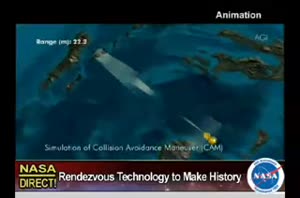
KSC 04 S 00337
NASA Kennedy Space Center
ScienceSpace
Clips are not offered for this film: NASA's media guidelines set the terms of its reuse themselves, not as a public licence.
Parts
About
Safely bringing two spacecraft together as they speed through the vast weightlessness of space isn't easy. It's a challenge the U.S. Space Program has met from the Gemini missions to the International Space Station. Until now, the technology always required human assistance from astronauts. The launch of the Demonstration of Autonomous Rendezvous Technology mission -- known as DART -- could change all that. The 24-hour DART mission is NASA's first test of unassisted rendezvous technology. DART ushers in a new era of U.S. technology that uses only computers and sensors to accomplish the rendezvous between spacecraft. The first rendezvous technology was tested in the Gemini program and served as a key element in the Apollo missions to the Moon. The Moon landings required undocking and docking the Lunar Module from the Command Service Module. Missions of Apollo Soyuz, the Space Shuttle and Mir, and the International Space Station brought with them new tests in overcoming the differences in hardware and language. DART’s hands-off technology paves the way for in-space assembly and servicing of space systems in the future. It will also help return astronauts and supplies to the lunar surface and beyond.
Human-made No record of this work says a model made it. What this means.
More from NASA
 Film
Expedition 65 JAXA PAO Event
 Film
GPM Instrument Animations
 Film
An EPIC View of the 2017 Total Solar Eclipse
 Film
Can You Spot Hubble: Long
 Film
Predicting Malaria Outbreaks with NASA Satellites
 Commercial
Launching America On a Commercial Spacecraft on This Week @NASA – June 5, 2020
 Film
NASA joins last of five sections for Space Launch System Rocket stage
 Film
Science Launching on SpaceX's 30th Cargo Resupply Mission to the Space Station
 Film
Jessica Meir Speaks with Physiologist Magazine
 Film
Video File: Launch of NASA’s Next Mars Rover Perseverance Approaches
 Film
Expedition 63 HTV 9 Release
 Film