KSC 04 S 00336
NASA Kennedy Space Center
ScienceSpace
Clips are not offered for this film: NASA's media guidelines set the terms of its reuse themselves, not as a public licence.
Parts
About
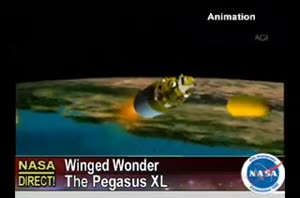
When NASA's DART spacecraft launches into space, it will be carried aboard one of the most inventive and clever vehicles ever devised. DART will soar into the sky on the nose of a Pegasus XL rocket. The Pegasus XL was developed as an inexpensive way of launching small payloads into space. The rocket specializes in carrying satellites and experiments that weigh up to 1,000 pounds into low-Earth orbit. Pegasus' first leap into space is aboard Orbital Science's L-1011 'Stargazer' jet. Using the Stargazer saves money by eliminating the need for an additional rocket motor for launch pad liftoff. Once in the air, the L-1011 requires about one hour to fly to the rocket's launch altitude of 39,000 feet. At that height, the Pegasus is released and allowed to freefall for about five seconds before igniting its engines. The Pegasus then accelerates to a maximum speed of 17,000 miles per hour, vaulting the rocket and its cargo into orbit. Nearly 10 minutes later, the Pegasus will have exhausted its stage two and stage three motors and released its payload to begin the mission.
Human-made No record of this work says a model made it. What this means.
More from NASA
 Film
Expedition 65 JAXA PAO Event
 Film
GPM Instrument Animations
 Film
An EPIC View of the 2017 Total Solar Eclipse
 Film
Can You Spot Hubble: Long
 Film
Predicting Malaria Outbreaks with NASA Satellites
 Commercial
Launching America On a Commercial Spacecraft on This Week @NASA – June 5, 2020
 Film
NASA joins last of five sections for Space Launch System Rocket stage
 Film
Science Launching on SpaceX's 30th Cargo Resupply Mission to the Space Station
 Film
Jessica Meir Speaks with Physiologist Magazine
 Film
Video File: Launch of NASA’s Next Mars Rover Perseverance Approaches
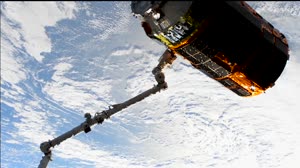 Film
Expedition 63 HTV 9 Release
 Film