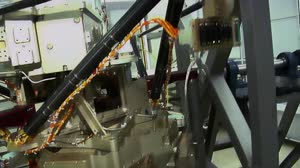
James Webb Space Telescope’s Multifaceted MIRI
NASA Goddard Space Flight Center
ScienceSpace
Clips are not offered for this film: NASA's media guidelines set the terms of its reuse themselves, not as a public licence.
Parts
About
James Webb Space Telescope’s mid-infrared instrument (MIRI) has both a camera and a spectrograph that sees light in the mid-infrared region of the electromagnetic spectrum, with wavelengths that are longer than our eyes see. MIRI covers the wavelength range of 5 to 28.5 microns. Its sensitive detectors will allow it to see the redshifted light of distant galaxies, helping identify the first galaxies in the universe, observe newly forming stars by peering inside dust-shrouded stellar nurseries, and analyze the atmospheres of exoplanets for markers of potential life. MIRI's camera will provide wide-field, broadband imaging that will return breathtaking astrophotography. MIRI was built by the MIRI Consortium (a group that consists of scientists and engineers from European countries), a team from the Jet Propulsion Lab in California, and scientists from several U.S. institutions.
Human-made No record of this work says a model made it. What this means.
More from NASA
 Film
Expedition 65 JAXA PAO Event
 Film
GPM Instrument Animations
 Film
An EPIC View of the 2017 Total Solar Eclipse
 Film
Can You Spot Hubble: Long
 Film
Predicting Malaria Outbreaks with NASA Satellites
 Commercial
Launching America On a Commercial Spacecraft on This Week @NASA – June 5, 2020
 Film
NASA joins last of five sections for Space Launch System Rocket stage
 Film
Science Launching on SpaceX's 30th Cargo Resupply Mission to the Space Station
 Film
Jessica Meir Speaks with Physiologist Magazine
 Film
Video File: Launch of NASA’s Next Mars Rover Perseverance Approaches
 Film
Expedition 63 HTV 9 Release
 Film