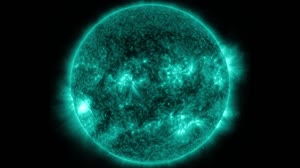
Active Region on the Sun Emits Another Flare
NASA Goddard Space Flight Center
ScienceSpace
Clips are not offered for this film: NASA's media guidelines set the terms of its reuse themselves, not as a public licence.
Parts
About
The sun emitted a significant solar flare on Oct. 22, 2012, peaking at 11:17 p.m. EDT. The flare came from an active region on the left side of the sun that has been numbered AR 1598, which has already been the source of a number of weaker flares. This flare was classified as an X.1-class flare. "X-class" denotes the most intense flares, while the number provides more information about its strength. An X2 is twice as intense as an X1, an X3 is three times as intense, and on. An X-class flare of this intensity can cause degradation or blackouts of radio communications for about an hour. Solar flares are powerful bursts of radiation. Harmful radiation from a flare cannot pass through Earth's atmosphere to physically affect humans on the ground, however — when intense enough — they can disturb the atmosphere in the layer where GPS and communications signals travel. This can disrupt radio signals for anywhere from minutes to hours. The National Oceanic and Atmospheric Association, which is the United States government's official source for space weather forecasts and alerts, categorized the radio blackout associated with this flare as an R3, on a scale from R1 to R5. It has since subsided. Increased numbers of flares are quite common at the moment, since the sun's normal 11-year activity cycle is ramping up toward solar maximum, which is expected in 2013. Humans have tracked this solar cycle continuously since it was discovered in 1843, and it is normal for there to be many…
Human-made No record of this work says a model made it. What this means.
More from NASA
 Film
Expedition 65 JAXA PAO Event
 Film
GPM Instrument Animations
 Film
An EPIC View of the 2017 Total Solar Eclipse
 Film
Can You Spot Hubble: Long
 Film
Predicting Malaria Outbreaks with NASA Satellites
 Commercial
Launching America On a Commercial Spacecraft on This Week @NASA – June 5, 2020
 Film
NASA joins last of five sections for Space Launch System Rocket stage
 Film
Science Launching on SpaceX's 30th Cargo Resupply Mission to the Space Station
 Film
Jessica Meir Speaks with Physiologist Magazine
 Film
Video File: Launch of NASA’s Next Mars Rover Perseverance Approaches
 Film
Expedition 63 HTV 9 Release
 Film