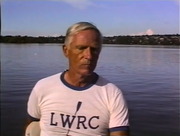
Interview with Stan Pocock - #1
The Seattle Public Library
History
Clips are not offered for this film: no licence or public-domain mark is recorded for it.
Low resolution (483×364): this is the archive's own copy.
Parts
About
Title: Interview with Stan Pocock - #1
Original format: VHS
Item Id.: spl_ds_spocock_01_01
Description: This is part 1 of 2 of an interview with Stan Pocock. This interview was conducted by Phil Titus on September 14, 1986 on Lake Washington.
Stan Pocock (1923-2014) was a prominent rower and coach in Pacific Northwest rowing. He was born in Seattle and had an interest in rowing from an early age thanks to the legacy of his father, George Pocock (1891-1976) who was renowned for his design and construction of rowing shells. George Pocock was responsible for the construction of the rowing shells used by the University of Washington in their 1936 Olympic championship and supplied collegiate rowing shells across the nation. Stan attended the University of Washington and graduated with a degree in engineering. Stan carried in his father’s footsteps and became known for his own innovations, creating the first fiberglass rowing shell in 1961. He also became a successful rowing coach, leading eight crews to the Olympics during the 1950s and 1960s; coaching the University of Washington rowing team and acting as the first coach of the Lake Washington Rowing Club. In 2012, USRowing awarded Pocock the Medal of Honor, honoring his lifetime achievement in the field.
During the interview Pocock talks about his upbringing, building racing shells and his career as a rowing coach. The second part of the interview includes a tour of Pocock’s boathouse.
This interview is part of the Donald Schmechel Oral History Collection. Don Schmechel, who was a member of the Seattle Public Library Foundation board, began this project with Seattle Public Library in 1984, with the Museum of History & Industry (MOHAI) brought on board as a partner in early 1985. Schmechel himself worked to raise the funding for the project, and volunteered his time to manage the project, and to conduct interviews along with a crew of volunteers. Originally titled the Videotaping Historic Figures (VHF) Program, the project interviewed 91 people, with a portion of the interviews entering the collections of the Seattle Public Library and a portion of them going to MOHAI.The interviews conducted with these Seattle civic, business and cultural leaders in 1985 are valuable first-hand accounts that provide insight into developments taking place in the mid-twentieth century.
Digitization of this videotape material has been made possible in part by a grant from the National Historical Publications and Records Commission.
Human-made No record of this work says a model made it. What this means.
More from The VHS Vault
 Documentary
Connections by James Burke (Seasons 1-3)
 Film
SR-71 Blackbird: The Secret Vigil (1989)
 Film
The Warriors (1979) Debut Video Release 1980 Paramount Home Video
 Documentary
The Gulf War
 Film
Jubilee Singers : Sacrifice and Glory
 Film
Michael Jackson - Video Greatest Hits - HIStory (1995 VHS)
 Feature
The Time Machine (1978 Time Travel Sci Fi)
 Film
The Making of a Natural History Film
 Documentary
A is for Atom, B is for Bomb
 Film
Codebreakers
 Film
Red Cliff II
 Documentary