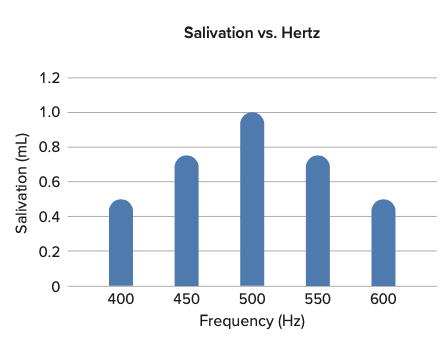
Imagine if you had to learn to make the same response over and over again to each new situation. Fortunately, this is often not necessary. Stimulus generalization refers to the fact that a previously acquired response will occur in the presence of stimuli other than the original one, the likelihood being a function of the degree of similarity. In Figure \(\PageIndex{1}\), we see that a response learned to a 500 Hz frequency tone occurs to other stimuli, the percentage of times depending upon how close the frequency is to 500 Hz. It is as though the individual predicts what happens after one event will happen after similar events.
Figure \(\PageIndex{1}\): Stimulus generalization gradient. [“Stimulus Generalization Graph” by Judy Schmitt is licensed under CC BY-NC-SA 4.0.]
The fact that generalization occurs significantly increases the efficiency of individual learning experiences. However, there are usually limits on the appropriateness of making the same response in different situations. For example, new fathers often beam the first time they hear their infant say “dada.” They are less thrilled when they hear their child call the mailman “dada!” Usually, it is necessary to conduct additional teaching so that the child only says “dada” in the presence of the father. Stimulus discrimination occurs when one stimulus (the S+, e.g., a tone or the father) is predictive of a second stimulus (e.g., food or the word “dada”) but a different stimulus (the S−, e.g., a light or the mailman) is never followed by that second stimulus. Eventually the individual responds to the S+ (tone or father) and not to the S− (light or mailman) as though learning if this happens then that happens, but if this other thing happens that does not happen.