Opening the book…
2.2 Momentum Conservation: 2 Dimensions
2.2.1 Vector Dot Product and Magnitude
Model

Explore
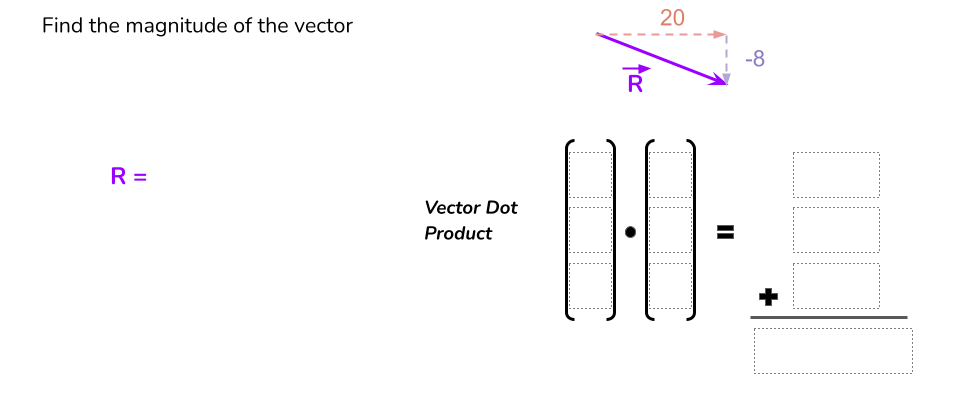
Examine the Pythagorean Theorem:
- What part of the vector is represented by A, B, and C in the Pythagorean theorem?
- What math operations are performed in the process of calculating C?
Examine the Vector Dot Product:
- How do the components of the vector interact for multiplication and division?
- What math operations are performed in the process of calculating R? Describe all steps.
Critical Thinking & Concept Invention
- How are the two processes similar?
- What might be a benefit of the vector dot product?
Apply
2.2.2 Vector Magnitude and Angle
Model
Explore
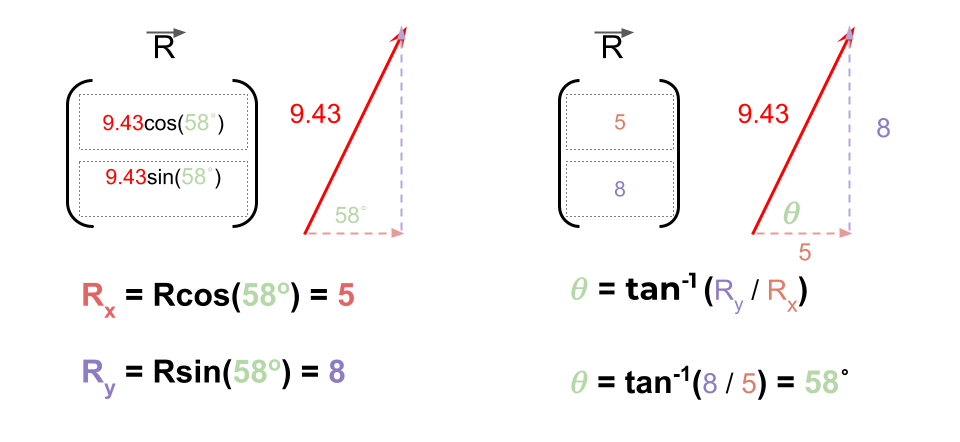
- What is the expression for \(R_x\)?
- What is the expression for \(R_y\)?
- What is the expression for the angle \(\theta\)?
Critical Thinking & Concept Invention
- The angle \(\theta\) represents the angle between which two vectors?
- Is \(R_y\) next to the angle \(\theta\) or opposite that angle?
- Is \(R_x\) next to the angle \(\theta\) or opposite that angle?
- Explain why sine and cosine are used to find the components.
- Explain why tangent is used to find the angle.
Apply

2.2.3 90° Car Collision
Model
A small car of mass 1200 kg traveling east at 60 km/hr collides at an intersection with a truck of mass 3000 kg that is traveling due north at 40 km/hr. The two vehicles are locked together. What is the velocity of the combined wreckage? Example Credit: OpenStax University Physics Vol 1 (https://openstax.org/details/books/university-physics-volume-1)

Physical Story
|
|

Explore
- Read the prompt and examine the Physical Scenario Diagram to write a complete the Physical Story underneath the model:
- There are two objects, a car with mass ______ and a truck with mass ______.
- In the beginning, the car travels in the (+ / −) (x / y) direction and the truck travels in the (+ / −) (x / y) direction.
- The two objects collide and (stick together / bounce apart).
- The two objects (do / do not) have the same final velocity because ____________________.
Critical Thinking & Concept Invention
- Which component (x or y) of the initial momentum for the car should be zero? Fill that into the equation.
- Which component (x or y) of the initial momentum for the truck should be zero? Fill that into the equation.
- Make claims and provide evidence and reasoning to each of the following questions:
- How does the final velocity of the car and the truck compare?
- How should the final momentum of the car and the truck compare?
- Solve the problem:
- Fill in the momentum chart with the assumption that there are no net external interactions with the two vehicles. Tell your group members what part of the equation you can fill in based on this assumption.
- Fill in the empty spaces in the momentum equations. It can be helpful to start with components that are zero.
- Why was it necessary to use column vectors to solve this problem?
2.2.4 Pool Shot
Model
You are playing pool with friends and are trying to sink the eight ball (black, 0.16 kg). You shoot the cue ball (white, 0.17 kg) and it initially has a velocity of 1.5 m/s towards the right. The eight ball is initially at rest and needs to travel at an angle that is 45° below horizontal in order to roll towards the pocket.

Momentum Story
|
|

Explore
- Read the prompt and examine the Physical Scenario Diagram to complete the Physical Story:
- There are two objects, with mass ______ and with mass ______.
- In the beginning, the initial speed of ______ is ______ in the ______ direction and the initial speed of ______ is ______.
- The two objects collide and (stick together / bounce apart).
- After the collision, ______ moves in the direction ______° below horizontal.
- The two objects (do / do not) have the same final velocity because ____________________.
Critical Thinking & Concept Invention
- Construct a Momentum Chart that is consistent with the problem. Underneath the charge, create a Momentum Story to describe each object before, during, and after the collision.
Apply
- Complete the System Momentum Equation that is consistent with the cue ball and eight ball as a closed system. Fill in as much as you can, leaving unknown quantities as variables.
- Circle the unknown quantities in your momentum equations. How many unknowns are there? Can you solve the equation? Explain why or why not.
This page titled 2.2: Momentum in Two Dimensions was last modified on Tue, 20 Oct 2026 21:31:15 GMT and is shared under a CC BY 4.0 license and was authored, remixed, and/or curated by Andrew Totah-McCarty.
The book could not be loaded just now.