Opening the book…
2.1 Momentum Conservation in One Dimension
2.1.1 Motion Quantities: Velocity and Momentum
Model
The charts below represent the motion of two cars. The two cars are initially separate and then Car A collides and sticks to Car B.

Explore
- Which car is initially moving? How can you tell?
- What is the direction of the change in velocity vector \( \Delta \vec{v} \) or change in momentum vector \( \Delta \vec{p} \) for each object? Are the arrows the same length?
- Is the total change in system to the right, left, or zero?
- Is the final arrow the same or different length for each car?
- How many different length arrows are shown?
Critical Thinking & Concept Invention
Use the Evidence in your notes from the Explore section to make claims from the two charts. Use the Claim-Evidence-Reasoning structure.
Claim: The motion of Car A is initially ...
Evidence:
- The velocity vector for Car A...
- The momentum vector for Car A...
Reasoning:
Claim: The final velocity of each cart should be the same.
Evidence:
Reasoning:
Claim: The final momentum of each cart might not be the same, even if the velocity is the same.
Evidence:
Reasoning:
Claim: Velocity ________ conserved in collisions.
Evidence:
Reasoning:
Claim: Momentum ________ conserved in collisions.
Evidence:
Reasoning:
2.1.2 Open and Closed Momentum Systems
Model
The charts below represent the motion of two cars. The two cars are initially separate and then Car A collides and sticks to Car B. Car A has a known, nonzero initial velocity and momentum and Car B is initially at rest. The Open and Closed systems both accurately model the same phenomenon, just in different ways.

Explore
- Examine the closed system model (top) to complete the System Interaction Story:
- There are ______ objects inside the system boundary.
- This system includes ____________________.
- There is/are ______ \( \Delta \vec{p} \) terms inside the boundary.
- There is/are ______ internal interactions (interaction lines fully enclosed in the system) and ______ external interactions (interaction lines that cross the system boundary).
- The system boundary is (solid / dashed).
- The total change in momentum of the system is (zero / nonzero).
- Examine the open system model (bottom) to complete the System Interaction Story:
- There are ______ objects inside the system boundary.
- This system includes ____________________.
- There is/are ______ \( \Delta \vec{p} \) terms inside the boundary.
- There is/are ______ internal interactions (interaction lines fully enclosed in the system) and ______ external interactions (interaction lines that cross the system boundary).
- The system boundary is (solid / dashed).
- The total change in momentum of the system is (zero / nonzero).
Critical Thinking & Concept Invention
- If there are zero external interactions, is the system an open or closed system?
If there are zero external interactions, the system is ____________________. - If there is an external interaction, is the system an open or closed system?
If there is an external interaction, the system is ____________________. - How do we indicate whether the system is open or closed when we draw the system boundary?
- Which part(s) of a p-chart are impacted by the decision to identify the system as open or closed?
Summary
The Momentum Principle is the first of the three key dynamics principles that we will use in our study of Mechanics. This principle is represented by the equation:
\( \Delta \vec{p}_{system} = \sum \vec{J} \)
“The total change in momentum of a system” = “The net impulse acting on the system”
The choice of a system is arbitrary in that any choice can be made and the physics still works. The physics equations will be different (but still accurate) for different choices of system, so it is necessary to identify your chosen system in every problem. For now, we will choose only closed systems so that \( \sum \vec{J} = 0 \), which means the momentum of the system is conserved.
2.1.3 Building a Momentum Chart (p-chart)
Model
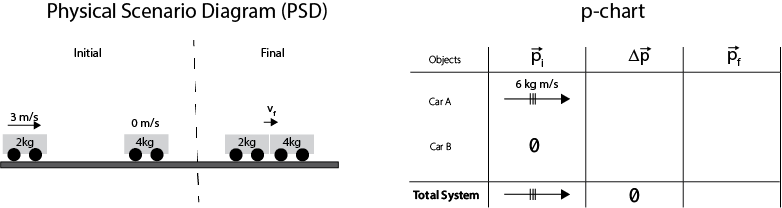
The models below represent the motion of two cars. The two cars are initially separate and then Car A collides and sticks to Car B.
Explore
- Examine the Physical Scenario Diagram (left) to complete the Physical Story:
- There are two Cars, A and B.
- Car ______ has more mass than Car ______.
- In the beginning, Car A has a velocity of ______ to the ______ and Car B has a velocity of ______.
- The two cars collide and (stick together / bounce apart).
- After the collision, Car A has a velocity of ______ to the ______ and Car B has a velocity of ______ to the ______.
- Examine the p-chart (right) to tell a Momentum Story:
- In the beginning, Car A has a momentum of ______ to the ______ and Car B has a momentum of ______.
- The total momentum of the system is ______ to the ______.
Critical Thinking & Concept Invention
- Evaluate the system momentum row to finish your momentum story:
- The two cars collide and ____________________, and the total change in momentum of the system is ____________________.
- This means the system is (open / closed).
- The final momentum of the system should be ______ to the ______.
- Car ______ should have more momentum than Car ______ because...
- Proportionally, Car A should have ______% of the total momentum and Car A should have ______% of the total momentum.
- Summarize: How can you determine the change in momentum (\( \Delta \vec{p} \)) for each car? Describe a process here, then follow that process to complete those rows of the p-chart.
Apply
Create a Physical Scenario Diagram (PSD), Object Interaction Diagram (OID), and Momentum Chart (p-chart) for the following scenarios. Choose a closed system for each scenario. Use your diagrams as evidence to answer the question.
- Victoria initially stands on a boat in still water. Neither Victoria nor the boat are moving. Then, Victoria begins to walk towards the right at 1 m/s. What will happen to the boat?
- A spaceship is filled with gas and moves through space at 10 m/s towards the right.
- Timeline 1: The spaceship turns on its rockets, which send gas out towards the left at 100 m/s. What will happen to the rocket?
- Timeline 2: After sending the gas out, the spaceship turns off its engines. What will happen to the spaceship after the rocket engines have been off for a while?
2.1.4 Equations from a Momentum Chart (p-chart)
Model
The equations below represent the same collision of two cars in the previous model.
\( \vec{p}_{i,A} + \vec{p}_{i,B} = \vec{p}_{i,system} \)
\( \vec{p}_{i,A} + \Delta \vec{p}_{A} = \vec{p}_{f,A} \)
\( \vec{p}_{f,A} + \vec{p}_{f,B} = \vec{p}_{f,system} \)
\( \vec{p}_{i,B} + \Delta \vec{p}_{B} = \vec{p}_{f,B} \)
\( \Delta \vec{p}_{A} + \Delta \vec{p}_{B} = \Delta \vec{p}_{system} \)
\( \vec{p}_{i,system} + \Delta \vec{p}_{system} = \vec{p}_{f,system} \)
Explore
- How many equations represent the interaction of these two carts?
- What are the different labels before the commas in the subscripts? Identify equations that have the same letter before the comma in the subscript for each term in the equation. Circle each of these equations.
- What are the different labels after the commas in the subscripts? Identify equations that have the same letter/word after the comma in the subscript for each term in the equation. Box each of these equations.
- There should be one equation left. Does it more closely resemble the boxed or circled equations? Circle/box it based on your choice.
Critical Thinking & Concept Invention
Each column and each row represents an equation.
- Which sets of equations (circled or boxed) represent the columns and which represent the rows?
- The columns are represented by the equations that were ____________________.
- The rows are represented by the equations that were ____________________.
- Label each equation by the row or column it represents (e.g., Row 1, Row 2, Column 1, Column 2, etc.).
- Could there ever be more than 3 rows (and 3 row equations)? If so, explain how.
- Could there ever be more than 3 columns (and 3 column equations)? If so, explain how.
Summary
All of our physics dynamics equations will be for the system that we select in our models. The physics equations of motion that we will solve using the Momentum Principle are represented by the bottom row of the momentum chart (p-chart):
\( \vec{p}_{i,system} + \Delta \vec{p}_{system} = \vec{p}_{f,system} \)
In each specific scenario, we will create a specific system momentum equation that aligns with the scenario and the chosen system. This generally takes the form of:
\( \vec{p}_{i,A} + \vec{p}_{i,B} + \ldots + \Delta \vec{p}_{system} = \vec{p}_{f,A} + \vec{p}_{f,B} + \ldots \)
with the subscripts A, B, etc. labeling the different interacting objects that are within the system.
Apply
- Create a system momentum equation for the scenario of Carts A and B colliding. Then put a column vector structure under each vector in that equation and fill in values to solve the equation.
- Look back at your models for Victoria and the Boat. Generate momentum equations from that p-chart. Leave unknown quantities as variables (e.g., \( m_{Victoria} \)). Then answer the questions:
- How would the final velocity of the boat compare to the final velocity of Victoria if Victoria and the boat had the same mass?
- How would the final velocity of the boat compare to the final velocity of Victoria if Victoria had more mass than the boat?
- How would the final velocity of the boat compare to the final velocity of Victoria if Victoria had less mass than the boat?
- Look back at your models for the spaceship. Generate momentum equations from that p-chart. Leave unknown quantities as variables (e.g., \( m_{gas} \)). Then answer the question: Does the mass of the gas affect the change in velocity for the rocket? If so, how? Explain your thinking.
This page titled 2.1: Momentum in One Dimension was last modified on Tue, 20 Oct 2026 21:14:39 GMT and is shared under a CC BY 4.0 license and was authored, remixed, and/or curated by Andrew Totah-McCarty.
The book could not be loaded just now.