Opening the book…
The adrenal cortex is devoted to the synthesis of corticosteroid and androgen hormones.
- Describe the adrenal medulla
Key Points
- The adrenal medulla secretes two water-soluble hormones (norepinephrine and epinephrine) that underly the fight-or-flight response.
- To carry out this response, the adrenal medulla receives input from the sympathetic nervous system.
Key Terms
- adrenal cortex: The outer portion of the adrenal glands that produces hormones essential to homeostasis.
- chromaffin: The cells of the adrenal medulla that secrete adrenaline and noradrenaline in response to nervous stimulation.
The adrenal medulla is the core of the adrenal glands, and is surrounded by the adrenal cortex. The adrenal medulla is responsible for the production of catecholamines, derived from the amino acid tyrosine.
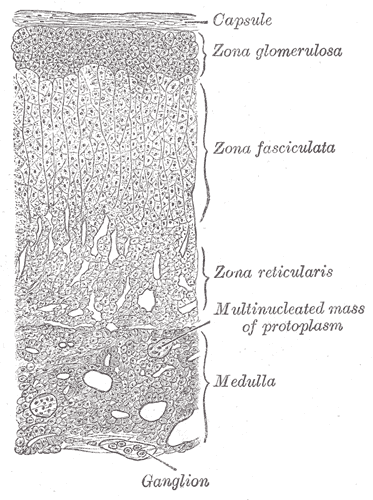
Adrenal gland: The adrenal medulla sits below the three layers of the adrenal cortex and is innervated by nerve fibers.
These water-soluble hormones are the major hormones underlying the fight-or-flight response. The adrenal medulla secretes approximately 20% noradrenaline (norepinephrine) and 80% adrenaline (epinephrine). To carry out this response, the adrenal medulla receives input from the sympathetic nervous system through nerve fibers originating in the thoracic spinal cord from T5–T11.
Chromaffin cells are the neuroendocrine cells found in the medulla; they are modified post-synaptic sympathetic neurons that receive sympathetic input.
When stimulated, chromaffin cells secrete adrenaline and noradrenaline along with enkephalin and enkephalin-containing peptides into the bloodstream. The secreted adrenaline and noradrenaline play an important role in the fight-or-flight response.
The enkephalins and enkephalin-containing peptides are related to, but also distinct from, the endogenous peptides named endorphins (secreted from the pituitary). All of these peptides bind to opioid receptors and produce analgesic (and other) responses.
Some notable effects of adrenaline and noradrenaline include:
- Increased heart rate and blood pressure.
- Blood vessel constriction in the skin and gastrointestinal tract.
- Smooth muscle dilation.
- Dilating bronchioles and capillaries.
- Increased metabolism.
All of these effects are characteristic of the fight-or-flight response. Receptors for catecholamines are widely distributed throughout the body to allow for a systemic response following secretion.
LICENSES AND ATTRIBUTIONS
CC LICENSED CONTENT, SHARED PREVIOUSLY
- Curation and Revision. Authored by: Boundless.com. Provided by: Boundless.com. License: CC BY-SA: Attribution-ShareAlike
CC LICENSED CONTENT, SPECIFIC ATTRIBUTION
- Adrenal gland. Provided by: Wikipedia. Located at: en.Wikipedia.org/wiki/Adrenal_gland. License: CC BY-SA: Attribution-ShareAlike
- Adrenal medulla. Provided by: Wikipedia. Located at: en.Wikipedia.org/wiki/Adrenal%20medulla. License: CC BY-SA: Attribution-ShareAlike
- adrenal cortex. Provided by: Wiktionary. Located at: en.wiktionary.org/wiki/adrenal_cortex. License: CC BY-SA: Attribution-ShareAlike
- Adrenal gland. Provided by: Wikipedia. Located at: en.Wikipedia.org/wiki/Adrenal_gland. License: Public Domain: No Known Copyright
- Adrenal gland. Provided by: Wikipedia. Located at: en.Wikipedia.org/wiki/Adrenal_gland%23Cortex. License: CC BY-SA: Attribution-ShareAlike
- androgen. Provided by: Wiktionary. Located at: en.wiktionary.org/wiki/androgen. License: CC BY-SA: Attribution-ShareAlike
- adrenal cortex. Provided by: Wiktionary. Located at: en.wiktionary.org/wiki/adrenal_cortex. License: CC BY-SA: Attribution-ShareAlike
- Adrenal gland. Provided by: Wikipedia. Located at: en.Wikipedia.org/wiki/Adrenal_gland. License: Public Domain: No Known Copyright
- Adrenal cortex. Provided by: Wikipedia. Located at: en.Wikipedia.org/wiki/Adrenal_cortex. License: Public Domain: No Known Copyright
- Chromaffin cells. Provided by: Wikipedia. Located at: en.Wikipedia.org/wiki/Chromaffin_cells. License: CC BY-SA: Attribution-ShareAlike
- Pheochromocytoma. Provided by: Wikipedia. Located at: en.Wikipedia.org/wiki/Pheochromocytoma. License: CC BY-SA: Attribution-ShareAlike
- Adrenal medulla. Provided by: Wikipedia. Located at: en.Wikipedia.org/wiki/Adrenal_medulla. License: CC BY-SA: Attribution-ShareAlike
- Adrenal gland. Provided by: Wikipedia. Located at: en.Wikipedia.org/wiki/Adrenal_gland%23Cortex. License: CC BY-SA: Attribution-ShareAlike
- Chromaffin cells. Provided by: Wikipedia. Located at: en.Wikipedia.org/wiki/Chromaffin_cells. License: CC BY-SA: Attribution-ShareAlike
- neuroblast. Provided by: Wiktionary. Located at: en.wiktionary.org/wiki/neuroblast. License: CC BY-SA: Attribution-ShareAlike
- neuroendocrine. Provided by: Wiktionary. Located at: en.wiktionary.org/wiki/neuroendocrine. License: CC BY-SA: Attribution-ShareAlike
- adrenal cortex. Provided by: Wiktionary. Located at: en.wiktionary.org/wiki/adrenal_cortex. License: CC BY-SA: Attribution-ShareAlike
- Adrenal gland. Provided by: Wikipedia. Located at: en.Wikipedia.org/wiki/Adrenal_gland. License: Public Domain: No Known Copyright
- Adrenal cortex. Provided by: Wikipedia. Located at: en.Wikipedia.org/wiki/Adrenal_cortex. License: Public Domain: No Known Copyright
- Adrenal cortex. Provided by: Wikipedia. Located at: en.Wikipedia.org/wiki/Adrenal_cortex. License: Public Domain: No Known Copyright
This page titled 15.10C: Adrenal Medulla was last modified on Tue, 14 Oct 2025 23:12:50 GMT and is shared under a CC BY-SA 4.0 license and was authored, remixed, and/or curated by Boundless (now LumenLearning).
The book could not be loaded just now.