Opening the book…
Pancreatic fluid contains digestive enzymes that help to further break down the carbohydrates, proteins, and lipids in the chyme.
- Describe the nature and function of pancreatic juice
Key Points
- Pancreatic fluid or juice contains digestive enzymes that pass to the small intestine where they help to further break down the carbohydrates, proteins, and lipids (fats) in the chyme.
- Pancreatic fluid is alkaline in nature due to its high concentration of bicarbonate ions that neutralize the gastric acid and allow effective enzymic action.
- Pancreatic juice secretion is regulated by the hormones secretin and cholecystokinin. It is produced by the walls of the duodenum upon detection of acid food, proteins, fats, and vitamins.
Key Terms
- pancreatic fluid: A liquid secreted by the pancreas that contains a variety of enzymes, including trypsinogen, chymotrypsinogen, elastase, carboxypeptidase, pancreatic lipase, and amylase.
The pancreas is a glandular organ in the digestive system and endocrine system of vertebrates. It is both an endocrine gland that produces several important hormones—including insulin, glucagon, somatostatin, and pancreatic polypeptide—and a digestive organ that secretes pancreatic juice that has digestive enzymes that assist the absorption of nutrients and digestion in the small intestine. These enzymes help to further break down the carbohydrates, proteins, and lipids in the chyme.
Pancreatic Juice
Pancreatic juice is a liquid secreted by the pancreas that contains a variety of enzymes, including trypsinogen, chymotrypsinogen, elastase, carboxypeptidase, pancreatic lipase, nucleases, and amylase.
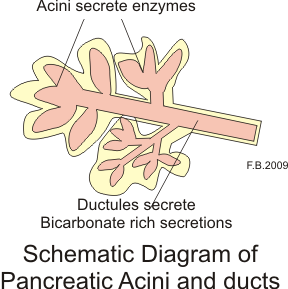
Pancreatic fluid: A schematic diagram that shows pancreatic acini and the ducts where fluid is created and released.
Pancreatic juice is alkaline in nature due to its high concentration of bicarbonate ions that neutralize the gastric acid and allow effective enzymic action.
Pancreatic juice secretion is regulated by the hormones secretin and cholecystokinin. It is produced by the walls of the duodenum upon detection of acid food, proteins, fats, and vitamins. Pancreatic secretion consists of an aqueous bicarbonate component from the duct cells and an enzymatic component from the acinar cells.
Because the pancreas is a sort of storage depot for digestive enzymes, injury to the pancreas is potentially fatal. A puncture of the pancreas generally requires prompt and experienced medical intervention.
A variety of factors cause a high pressure within pancreatic ducts. Pancreatic duct rupture and pancreatic juice leakage cause pancreatic self-digestion.
LICENSES AND ATTRIBUTIONS
CC LICENSED CONTENT, SHARED PREVIOUSLY
- Curation and Revision. Authored by: Boundless.com. Provided by: Boundless.com. License: CC BY-SA: Attribution-ShareAlike
CC LICENSED CONTENT, SPECIFIC ATTRIBUTION
- Human Physiology/The gastrointestinal system.. Provided by: Wikibooks. Located at: en.wikibooks.org/wiki/Human_Physiology/The_gastrointestinal_system%23The_Digestive_System. License: CC BY-SA: Attribution-ShareAlike
- Pancreas. Provided by: Wikipedia. Located at: en.Wikipedia.org/wiki/Pancreas. License: CC BY-SA: Attribution-ShareAlike
- pancreas. Provided by: Wiktionary. Located at: en.wiktionary.org/wiki/pancreas. License: CC BY-SA: Attribution-ShareAlike
- Pancreas. Provided by: Wikimedia. Located at: upload.wikimedia.org/Wikipedia/commons/a/a3/Pancreas.jpg. License: Public Domain: No Known Copyright
- Pancreas. Provided by: Wikipedia. Located at: en.Wikipedia.org/wiki/Pancreas. License: CC BY-SA: Attribution-ShareAlike
- Pancreas. Provided by: Wikipedia. Located at: en.Wikipedia.org/wiki/Pancreas. License: CC BY-SA: Attribution-ShareAlike
- epigastrium. Provided by: Wiktionary. Located at: en.wiktionary.org/wiki/epigastrium. License: CC BY-SA: Attribution-ShareAlike
- Pancreas. Provided by: Wikimedia. Located at: upload.wikimedia.org/Wikipedia/commons/a/a3/Pancreas.jpg. License: Public Domain: No Known Copyright
- Pancreas. Provided by: Wikimedia. Located at: upload.wikimedia.org/Wikipedia/commons/f/fe/Illu_pancreas_duodenum.jpg. License: Public Domain: No Known Copyright
- Pancreas. Provided by: Wikipedia. Located at: en.Wikipedia.org/wiki/Pancreas. License: CC BY-SA: Attribution-ShareAlike
- Pancreas. Provided by: Wikipedia. Located at: en.Wikipedia.org/wiki/Pancreas%23Histology. License: CC BY-SA: Attribution-ShareAlike
- Pancreas. Provided by: Wikipedia. Located at: en.Wikipedia.org/wiki/Pancreas. License: CC BY-SA: Attribution-ShareAlike
- acini. Provided by: Wikipedia. Located at: en.Wikipedia.org/wiki/acini. License: CC BY-SA: Attribution-ShareAlike
- islets of Langerhans. Provided by: Wiktionary. Located at: en.wiktionary.org/wiki/islets_of_Langerhans. License: CC BY-SA: Attribution-ShareAlike
- Pancreas. Provided by: Wikimedia. Located at: upload.wikimedia.org/Wikipedia/commons/a/a3/Pancreas.jpg. License: Public Domain: No Known Copyright
- Pancreas. Provided by: Wikimedia. Located at: upload.wikimedia.org/Wikipedia/commons/f/fe/Illu_pancreas_duodenum.jpg. License: Public Domain: No Known Copyright
- Pancreas. Provided by: Wikipedia. Located at: en.Wikipedia.org/wiki/Pancreas. License: CC BY-SA: Attribution-ShareAlike
- Pancreatic juice. Provided by: Wikipedia. Located at: en.Wikipedia.org/wiki/Pancreatic_juice. License: CC BY-SA: Attribution-ShareAlike
- Pancreas. Provided by: Wikipedia. Located at: en.Wikipedia.org/wiki/Pancreas. License: CC BY-SA: Attribution-ShareAlike
- pancreatic fluid. Provided by: Wikipedia. Located at: en.Wikipedia.org/wiki/pancreatic%20fluid. License: CC BY-SA: Attribution-ShareAlike
- Pancreas. Provided by: Wikimedia. Located at: upload.wikimedia.org/Wikipedia/commons/a/a3/Pancreas.jpg. License: Public Domain: No Known Copyright
- Pancreas. Provided by: Wikimedia. Located at: upload.wikimedia.org/Wikipedia/commons/f/fe/Illu_pancreas_duodenum.jpg. License: Public Domain: No Known Copyright
- Pancreatic. Provided by: Wikimedia. Located at: upload.wikimedia.org/Wikipedia/commons/8/85/Pancreas_secretions2.png. License: CC BY-SA: Attribution-ShareAlike
This page titled 22.9D: Pancreatic Juice was last modified on Tue, 14 Oct 2025 23:13:21 GMT and is shared under a CC BY-SA 4.0 license and was authored, remixed, and/or curated by Boundless (now LumenLearning).
The book could not be loaded just now.