Opening the book…
The human ankle and foot bones include tarsals (ankle), metatarsals (middle bones), and phalanges (toes).
- Describe the different types of bones in the foot
Key Points
- The human foot contains 26 bones.
- The foot can be subdivided into the tarsals, metatarsals, and phalanges.
Key Terms
- phalange: A bone within the digit.
- metatarsal: A bone from the center of the foot that articulates with the tarsals and phalanges.
- tarsal: A bone forming part of the ankle or heel.
The foot contains 26 bones that are divided into three regions: the tarsals (or ankle and heel), the metatarsals (forming the sole of the foot), and the phalanges (forming the digits). While sharing a similar underlying structure with the hand, the foot is visibly and structurally different to account for its greater load-bearing and locomotive duties, and reduced fine movements.
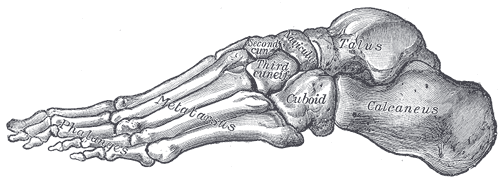
The Foot: The foot contains the proximal tarsals that form the ankle and heel; intermediate metatarsals; and the distal phalanges that form the toes.
Tarsals
The tarsal bones of the foot are organized into three rows: proximal, intermediate, and distal. The proximal row contains the talus, which is the most superior of the tarsals and articulates with the tibia and fibula to form the ankle joint. The talus is responsible for transmitting forces from the tibia to the heel and acts as an attachment point for numerous ligaments that strengthen the ankle joint.
The calcaneus is the thickest tarsal and forms the heel of the foot. It articulates with the talus superiorly and anteriorly with the cuboid of the distal group. Posteriorly the calcaneal tuberosity is the attachment point for the Achilles tendon.
The intermediate group contains only the navicular bone, which articulates with all of the tarsals—with the exception of the calcaneus. The navicular bone plays a key role in maintaining the medial longitudinal arch of the foot.
There are four distal tarsals: the lateral cuboid and the three cuneiforms, located medially. The distal tarsals articulate with the metatarsals and also maintain the transverse arch of the foot.
Metatarsals
The foot contains five metatarsals that are numbered I–V, moving medial to lateral, big toe to little toe. Each metatarsal consists of a head, shaft, and base.
The proximal base articulates with the cuboid bones, and distally with the proximal phalanges, and each metatarsal also articulates laterally with adjacent metatarsals. The interossei of the foot originate from the shafts of the metatarsals.
Phalanges
The digits are named in a similar fashion to the metatarsals, medial to lateral from the big toe. With the exception of the big toe, each digit contains a proximal, intermediate, and distal phalange; the big toe lacks an intermediate phalange. The length of the phalanges decreases distally.
This page titled 7.8D: Tarsals, Metatarsals, and Phalanges (The Foot) was last modified on Tue, 14 Oct 2025 23:13:56 GMT and is shared under a CC BY-SA 4.0 license and was authored, remixed, and/or curated by Boundless (now LumenLearning).
The book could not be loaded just now.