Opening the book…
Before we get into the specifics of preventing and controlling disease, let's take a step back and look at how public health frames a problem and then goes about solving it. This is often called "the public health approach."
There are four steps to the public health approach.
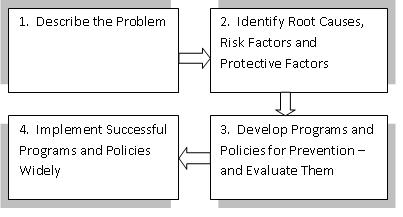
The first step is to describe the problem.
- Epidemiology is used to describe whom a health problem affects, how much of the disease or injury is occurring, whether it is changing over time or in location, and so on. It's not just defining the disease itself -- it's describing its impact in the population using health statistics.
- This step is also called "surveillance," which means monitoring and measuring a disease or injury in the population. (You can see this is a different meaning than"surveillance" by police! Nevertheless, in both cases, surveillance involves watching carefully and gathering evidence.) The previous chapter discussed how epidemiologists find and use data to describe health problems (for example, rates of disease).
The second step is to identify the root causes, risk factors or protective factors associated with the problem.
- The public health principle of prevention ("upstream") comes into play here. You can't prevent a problem if you don't know what causes it, or at least what factors are associated with a greater likelihood of the problem occurring (risk factors). If you can identify risk factors, then you can begin to reduce them, focusing your prevention efforts.
- If you find there are protective factors that create greater resiliency or help protect people from developing the illness or injury, then, likewise, you can work to enhance those protective factors.
- In this chapter, you will learn more about how epidemiologists analyze the risk factors and the causes of disease.
The third step of the public health approach is to develop and evaluate programs and policies that could prevent the problem.
- Sometimes the actual cause of the problem can be eliminated – such as removing asbestos from a building, or eliminating transfats from foods. Othertimes, we reduce the risk factors or increase the protective factors.
- Often these are local programs or smaller-scale programs that have to be tried out and evaluated to see if they work.
- Programs must be evaluated to see what works, for whom, under what conditions. If a program works in one place, it can be tried in another, with adjustments for the local community.
- Public health is population-based, so we look for program effects across a population - not just individual or anecdotal successes. Even a small impact across a large population can mean a lot.
The fourth step is to take what works and implement it more widely.
- We can do this by passing policies or laws that reach more communities.
- Or by setting standards that all programs must meet.
- Or by funding successful programs statewide or nationwide.
- Or by spreading successful ideas through grassroots movements that share strategies and stories -- when that happens, soon similar programs or campaigns are sprouting up in different places.
- Remember the principle that public health is concerned about social justice, and the social determinants of health? If we can ensure that all people have protection from the causes of disease, or access to the programs and policies that reduce their risk, then we will have greater equity in health.
Risk Factor = A condition, behavior, characteristic or situation that contributes to, occurs with, or increases the chance of a particular disease or injury, for example, smoking tobacco.
Protective Factor = A characteristic, condition, situation or behavior, such as physical activity, that is associated with greater health, or less chance of disease or injury.
You will find some version of the public health approach in many publications. This (optional) link provides an example of how this Public Health Approach is used by the World Health Organization in violence prevention work.
Reflection to check your understanding:
Can you think of an example of a successful program or policy that started in one location, and now is used in many places? How do you think this came about?
This page titled 5.2: The Public Health Approach was last modified on Tue, 19 Aug 2025 21:44:26 GMT and is shared under a CC BY-NC-SA 4.0 license and was authored, remixed, and/or curated by Janey Skinner.
The book could not be loaded just now.