Opening the book…
Muscle, one of the fundamental tissue types in the human body, plays a pivotal role in physiological processes. At the cellular level, muscle tissue comprises a singular cell type—the muscle cell. These cells, often recognized by their elongated and slender appearance, are called muscle fibers. Notably, the defining feature of muscle fibers is their remarkable capacity for dynamic changes in length, referred to as muscle contraction, followed by relaxation, wherein they return to their original state.
Functions of Muscle Tissue
Skeletal muscles play a prominent role in the facilitation of bodily movement. However, their functional purview extends beyond motion generation. Skeletal muscles play a pivotal role in counteracting gravitational forces, thereby preserving posture and equilibrium through continuous micro-adjustments. These subtle yet indispensable contractions mitigate excessive mobility within bones and joints, thereby ensuring the structural robustness and stability of the skeletal framework. Furthermore, skeletal muscles act as protective barriers for particularly those within the abdominal and pelvic regions against external traumas. Simultaneously, they provide essential support by bearing the weight of these vital organs, thus augmenting their functional viability.
Skeletal muscles are strategically positioned at the entrances of internal passageways, enabling them to govern the movement of various substances. This control extends to essential functions such as swallowing, urination, and defecation, all of which fall under voluntary functions.
Aside from their role in movement and internal regulation, skeletal muscles are key players in maintaining the body's thermal equilibrium. Muscle contractions, powered by energy from ATP breakdown, generate heat as a byproduct. This thermogenic quality is particularly evident during periods of sustained muscle activity, where increased heat production raises body temperature. Furthermore, in response to cold environmental conditions, the body employs shivering—a coordinated contraction of skeletal muscles—to generate warmth. This unique thermoregulatory function of skeletal muscles underscores their versatility and importance in the body's overall functioning.1
Smooth muscle serves vital functions in the body, such as regulating blood pressure within the arterial walls, essential for propelling blood through the circulatory system. Additionally, smooth muscle in visceral organs and internal passageways plays a pivotal role in facilitating the movement of materials within the body. The highly coordinated cardiac muscle contractions contribute significantly to pumping blood into the vascular system.2
The primary function of cardiac muscle is to contract rhythmically and forcefully, pumping blood throughout the body, ensuring the delivery of oxygen and nutrients to tissues, and removing waste products.2
Types of Muscle Tissue
There are three distinct muscle tissue types. While each possesses unique attributes, they share specific common properties. One such property is excitability, an essential feature stemming from the ability of plasma membranes to alter their electrical states. This alteration facilitates the transmission of action potentials along the membrane's entire expanse. However, the response to excitability differs among muscle tissue types. Skeletal muscle fibers rely entirely on neural signaling from the nervous system to operate effectively. Cardiac and smooth muscle fibers fall into the category of involuntary muscles as they exhibit excitability even without neural stimulus. Although the nervous system can exert some influence on their excitability, they maintain intrinsic responsiveness.3
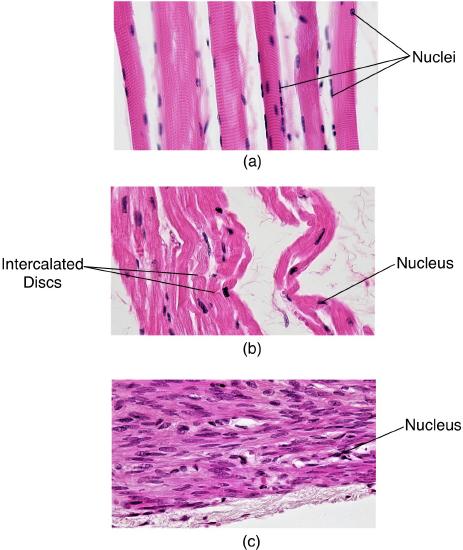
All muscle types depend on ATP to sustain contraction. They possess several distinctive properties, such as elasticity, which allows them to return to their initial length during relaxation; extensibility, which permits stretching and extension; and contractility, where muscle tissue can exert force by shortening and pulling on attachment points.3
There are differences in the microscopic organization of contractile proteins—actin and myosin in the three types of muscle fibers. This divergence in structural arrangement gives rise to distinctive features that set each muscle type apart. Skeletal muscle and cardiac muscle share a notable commonality. In both these muscle types, actin and myosin proteins are arranged in the cytoplasm of individual muscle cells, resulting in a highly ordered pattern called striations. These striations are readily observable under a light microscope at significant magnification (Figure 1) 5. However, there are differences between these two muscle types. Skeletal muscle fibers are multinucleated, with several nuclei per cell. They do not possess direct physical connections between cells but operate under neural control, allowing for voluntary muscle control 6. In contrast, cardiac muscle fibers contain one to two nuclei and are intricately interlinked physically and electrically via special structures called intercalated discs. This interconnection ensures coordinated contractions throughout the heart, functioning as a single unit termed a syncytium. Cardiac muscle fibers are shorter than their skeletal counterparts but extensively branched, facilitating efficient electrical transmission via intercalated discs. Moreover, both skeletal and cardiac muscle fibers have numerous mitochondria and myoglobin molecules, enabling ATP generation primarily through aerobic metabolism 7.
Distinctive among these muscle types is smooth muscle, characterized by the absence of the regular actin-myosin organization seen in skeletal and cardiac muscles. This unique structural aspect imparts a uniform, nonstriated appearance to the cytoplasm of smooth muscle fibers, hence the name "smooth muscle." Each smooth muscle fiber houses a single nucleus.
This page titled 6.3: Muscle Tissue was last modified on Wed, 19 Mar 2025 23:08:32 GMT and is shared under a CC BY-NC-SA 4.0 license and was authored, remixed, and/or curated by Chaya Gopalan (Consortium of Academic and Research Libraries in Illinois (CARLI)) .
The book could not be loaded just now.