Opening the book…
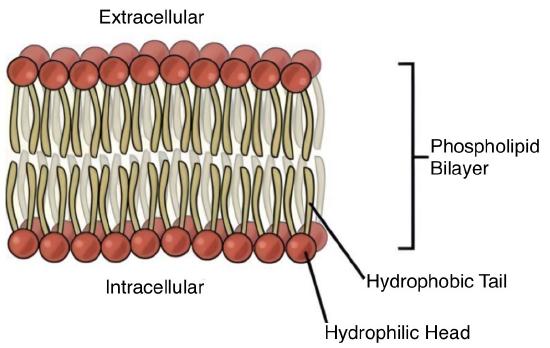
Each phospholipid molecule exhibits a phosphate group at one end, referred to as the "head," while two chains of fatty acids mimic the "tails" attached to a glycerol molecule (Figure 2). The phosphate group carries an anionic charge and, therefore, displays an affinity for water molecules in both extracellular and intracellular compartments, rendering it hydrophilic or water-attracting. Conversely, the lipid tails lack charge and are nonpolar, yielding a hydrophobic or water-repelling nature. Phospholipids are described as amphipathic entities, since they possess both a hydrophilic and a hydrophobic segment. The amphipathic nature allows phospholipids to configure themselves within water, positioning their hydrophilic heads toward the aqueous compartments while their hydrophobic tails orient away from these fluid zones. Consequently, this distinctive phospholipid arrangement forms a bi-layered structure called the bilipid layer and is impermeable to charged particles (Figure 3.)

This page titled 1.2.1.1: Membrane Lipids was last modified on Tue, 18 Aug 2026 18:34:15 GMT and is shared under a CC BY-NC-SA 4.0 license and was authored, remixed, and/or curated by Chaya Gopalan (Consortium of Academic and Research Libraries in Illinois (CARLI)) .
The book could not be loaded just now.