Opening the book…
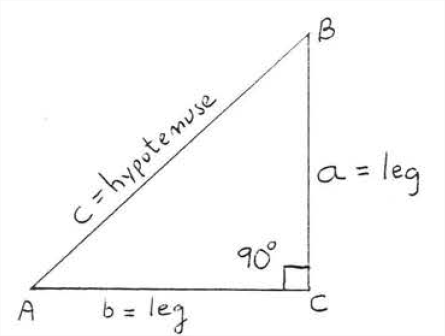
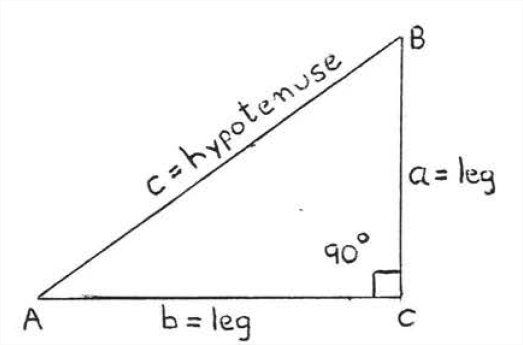
In a right triangle, the sides of the right angle are called the legs of the triangle and the remaining side is called the hypotenuse. In Figure \(\PageIndex{1}\), side \(AC\) and \(BC\) are the legs and side \(AB\) is the hypotenuse.
The following is one of the most famous theorems in mathematics.
In a right triangle, the square of the hypotenuse is equal to the sum of the squares of the legs. That is,
\[\text{leg}^{2}+\text{leg}^{2}=\text{hypotenuse}^{2}\]
Thus, for the sides of the triangle in Figure \(\PageIndex{1}\),
\[a^{2}+b^{2}=c^{2} \nonumber\]
Before we prove Theorem \(\PageIndex{1}\), we will give several examples.
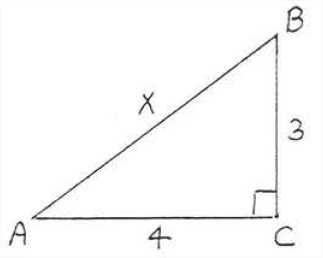
Find \(x\)
Solution
\(\begin{array} {rcl} {\text{leg}^2 + \text{leg}^2} & = & {\text{hyp}^2} \\ {3^2 + 4^2} & = & {x^2} \\ {9 + 16} & = & {x^2} \\ {25} & = & {x^2} \\ {5} & = & {x} \end{array}\)
Check:

Answer: \(x = 5\).
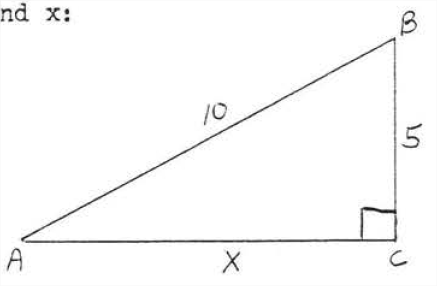
Find \(x\):
Solution
\(\begin{array} {rcl} {\text{leg}^2 + \text{leg}^2} & = & {\text{hyp}^2} \\ {5^2 + x^2} & = & {10^2} \\ {25 + x^2} & = & {100} \\ {x^2} & = & {75} \\ {x} & = & {\sqrt{75} = \sqrt{25} \sqrt{3} = 5\sqrt{3}} \end{array}\)
Check:

Answer: \(x = 5\sqrt{3}\).
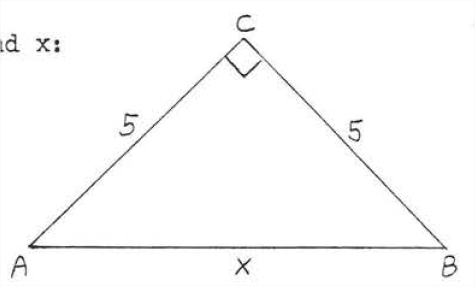
Find \(x\):
Solution
\(\begin{array} {rcl} {\text{leg}^2 + \text{leg}^2} & = & {\text{hyp}^2} \\ {5^2 + 5^2} & = & {x^2} \\ {25 + 25} & = & {x^2} \\ {50} & = & {x^2} \\ {x} & = & {\sqrt{50} = \sqrt{25} \sqrt{2} = 5\sqrt{2}} \end{array}\)
Check:

Answer: \(x = 5\sqrt{2}\).
Find \(x\)
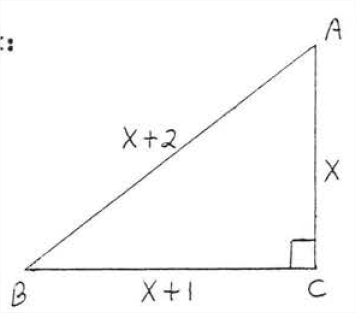
Solution
\(\begin{array} {rcl} {\text{leg}^2 + \text{leg}^2} & = & {\text{hyp}^2} \\ {x^2 + (x + 1)^2} & = & {(x + 2)^2} \\ {x^2 + x^2 + 2x + 1} & = & {x^2 + 4x + 4} \\ {x^2 + x^2 + 2x + 1 - x^2 - 4x - 4} & = & {0} \\ {x^2 - 2x - 3} & = & {0} \\ {(x - 3)(x + 1)} & = & {0} \end{array}\)
\(\begin{array} {rcl} {x - 3} & = & {0} \\ {x} & = & {3} \end{array}\) \(\begin{array} {rcl} {x + 1} & = & {0} \\ {x} & = & {-1} \end{array}\)
We reject \(x = -1\) because \(AC = x\) cannot be negative.
Check, \(x = 3\):

Answer: \(x = 3\).
We will now restate and prove Theorem \(\PageIndex{1}\):
In a right triangle, the square of the hypotenuse is equal to the sum of the squares of the legs. That is,
\(\text{leg}^2 + \text{leg}^2 = \text{hypotenuse}^2.\)
In Figure \(\PageIndex{1}\),
\(a^2 + b^2 = c^2.\)
- Proof
-
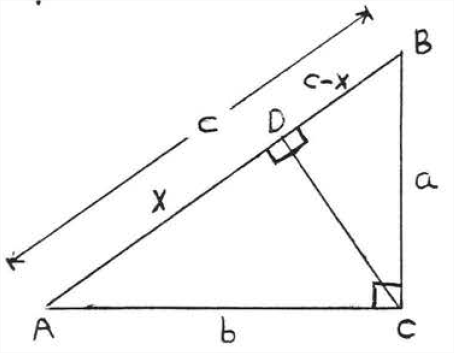
In Figure \(\PageIndex{1}\), draw \(CD\) perpendicular to \(AB\). Let \(x = AD\). Then \(BD = c - x\) (Figure \(\PageIndex{2}\)). As in Example \(\PageIndex{3}\), section 4.2, \(\triangle ABC \sim \triangle ACD\) and \(\triangle ABC \sim \triangle CBD\). From these two similarities we obtain two proportions:

The converse of the Pythagorean Theorem also holds:
In a triangle, if the square of one side is equal to the sun of the squares of the other two sides then the triangle is a right triangle.
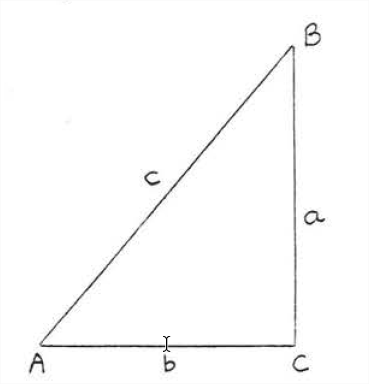
In Figure \(\PageIndex{3}\), if \(c^2 = a^2 + b^2\) then \(\triangle ABC\) is a right triangle with \(\angle C = 90^{\circ}\).
- Proof
-
Draw a new triangle, \(\triangle DEF\), so that \(\angle F = 90^{\circ}\), \(d = a\), and \(e = b\) (Figure \(\PageIndex{4}\)). \(\triangle DEF\) is a right triangle, so by Theorem \(\PageIndex{1}\), \(f^2 = d^2 + e^2\). We have \(f^2 = d^2 + e^2 = a^2 + b^2 = c^2\) and therefore \(f = c\). Therefore \(\triangle ABC \cong \triangle DEF\) because \(SSS = SSS\). Therefore, \(\angle C + \angle F = 90^{\circ}\).

Figure \(\PageIndex{4}\): Given \(\triangle ABC\), draw \(\triangle DEF\) so that \(\angle F = 90^{\circ}\), \(d = a\) and \(e = b\).
Is \(\triangle ABC\) a right triangle?

Solution
\(\text{AC}^2 = 7^2 = 49\)
\(\text{BC}^2 = 9^2 = 81\)
\(\text{AB}^2 = (\sqrt{130})^2 = 130\)
\(49 + 81 = 130\).
so by Theorem \(\PageIndex{2}\), \(\triangle ABC\) is a right triangle.
Answer: yes.
Find \(x\) and \(AB\):

Solution
\(\begin{array} {rcl} {x^2 + 12^2} & = & {13^2} \\ {x^2 + 144} & = & {169} \\ {x^2} & = & {169 - 144} \\ {x^2} & = & {25} \\ {x} & = & {5} \end{array}\)
\(CDEF\) is a rectangle so \(EF = CD = 20\) and \(CF = DE = 12\). Therefore \(FB = 5\) and \(AB = AE + EF + FB = 5 + 20 + 5 = 30\).
Answer: \(x = 5\), \(AB = 30\).
Find \(x\), \(AC\) and \(BD\):

Solution
\(ABCD\) is a rhombus. The diagonals of a rhombus are perpendicular and bisect each other.
\(\begin{array} {rcl} {6^2 + 8^2} & = & {x^2} \\ {36 + 64} & = & {x^2} \\ {100} & = & {x^2} \\ {10} & = & {x} \end{array}\)
\(AC = 8 + 8 = 16, BD = 6 + 6 = 12.\)
Answer: \(x = 10, AC = 16, BD = 12\).
A ladder 39 feet long leans against a building, How far up the side of the building does the ladder reach if the foot of the ladder is 15 feet from the building?

Solution
\(\begin{array} {rcl} {\text{leg}^2 + \text{leg}^2} & = & {\text{hyp}^2} \\ {x^2 + 15^2} & = & {39^2} \\ {x^2 + 225} & = & {1521} \\ {x^2} & = & {1521 - 225} \\ {x^2} & = & {1296} \\ {x} & = & {\sqrt{1296} = 36} \end{array}\)
Answer: 36 feet.
Pythagoras (c. 582 - 507 B.C.) was not the first to discover the theorem which bears his name. It was known long before his time by the Chinese, the Babylonians, and perhaps also the Egyptians and the Hindus, According to tradition, Pythagoras was the first to give a nroof of the theorem, His proof probably made use of areas, like the one suggested. In Figure \(\PageIndex{5}\) below, (each square contains four congruent right triangles with sides of lengths \(a\), \(b\), and \(c\), In addition the square on the left contains a square with side a and a square with side \(b\) while the one on the right contains a square with side c.)

um theorem for triangles, the properties of parallel lines, and the theory of similar triangles and proportions.
This page titled 0.2: Pythagorean Theorem was last modified on Tue, 03 Nov 2026 01:58:08 GMT and is shared under a CC BY-NC-SA 4.0 license and was authored, remixed, and/or curated by Henry Africk (New York City College of Technology at CUNY Academic Works) via source content that was edited to the style and standards of the LibreTexts platform.
The book could not be loaded just now.