Opening the book…
Classification of Angles
Angles are classified according to their measures as follows:
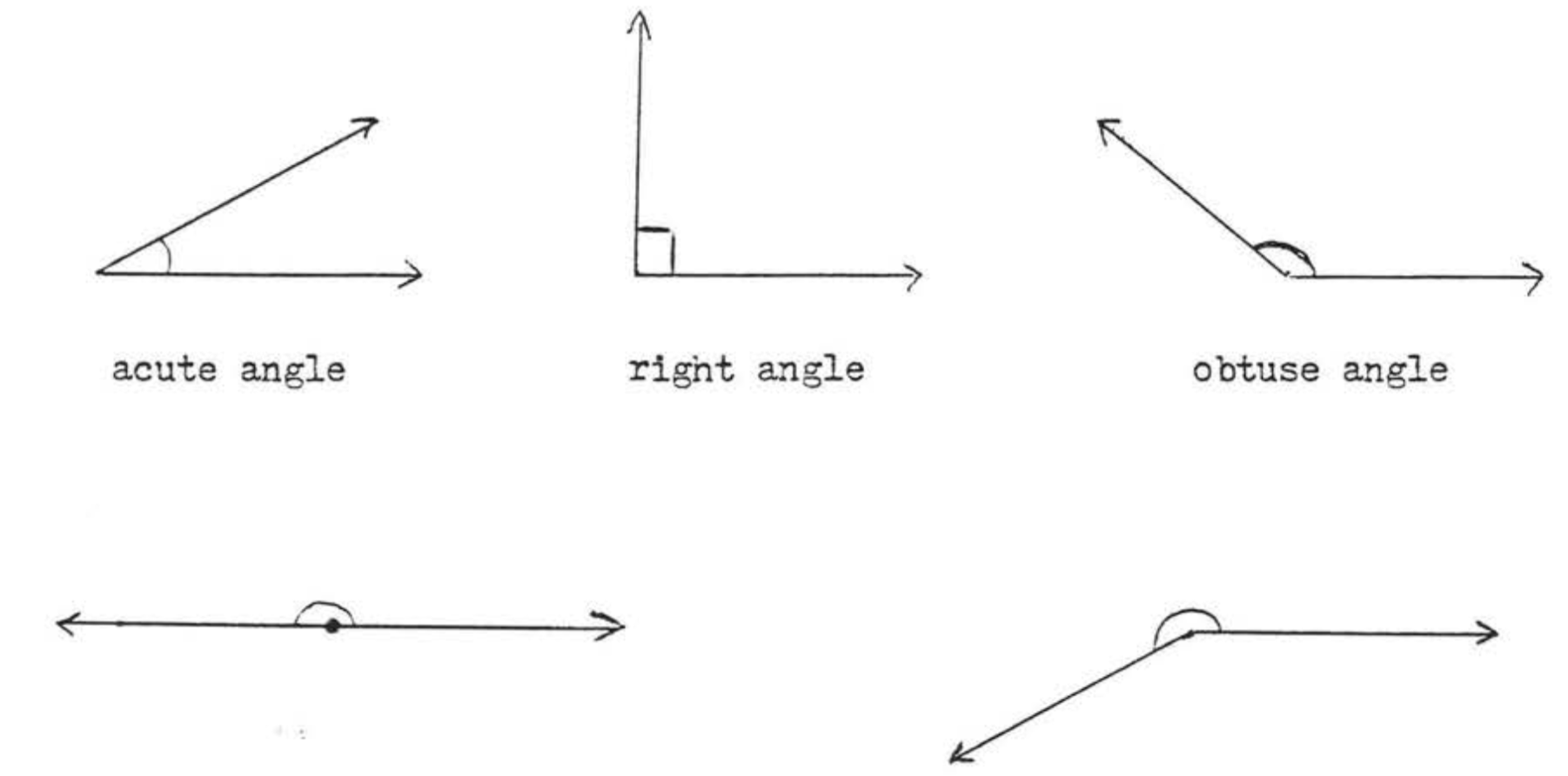
- An acute angle is an angle whose measure is between \(0^{\circ}\) and \(90^{\circ}\).
- A right angle is an angle whose measure is \(90^{\circ}\). We often use a little square to indicate a right angle.
- An obtuse angle is an angle whose measure is between \(90^{\circ}\) and \(180^{\circ}\).
- A straight angle is an angle whose measure is \(180^{\circ}\). A straight angle is just a straight line with one of its points designated as the vertex.
- A reflex angle is an angle whose measure is greater than \(180^{\circ}\).
Complementary and Supplementary Angles
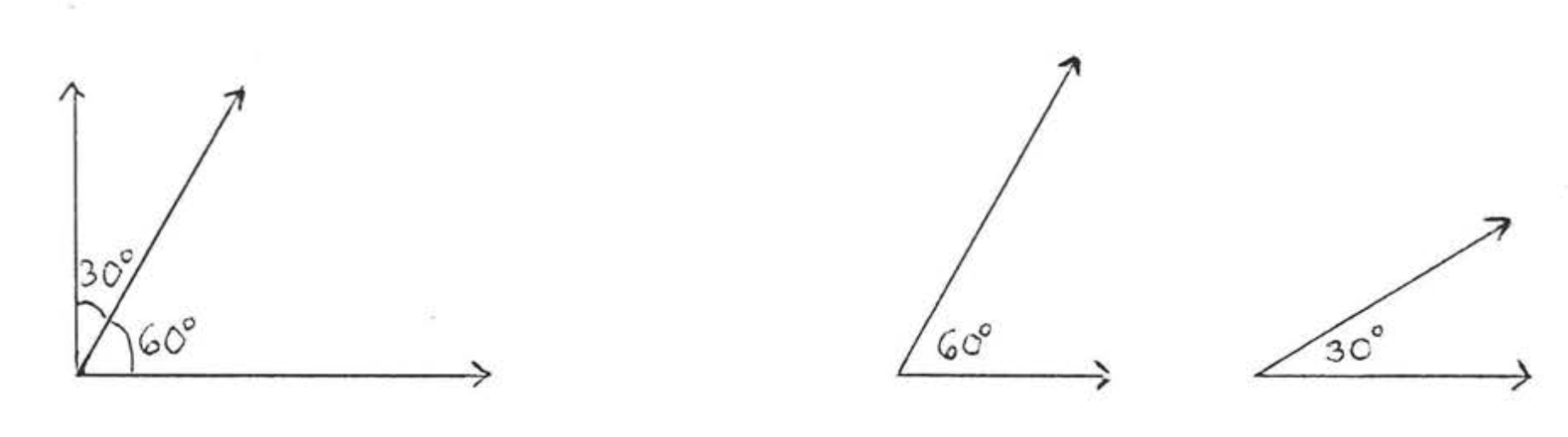
Two angles are called complementary if the sum of their measures is \(90^{\circ}\). Each angle is called the complement of the other. For example, angles of \(60^{\circ}\) and \(30^{\circ}\) are complementary.
Find the complement of a \(40^{\circ}\) angle.
Solution
\(90^{\circ} - 40^{\circ} = 50^{\circ}\).
Answer: \(50^{\circ}\).
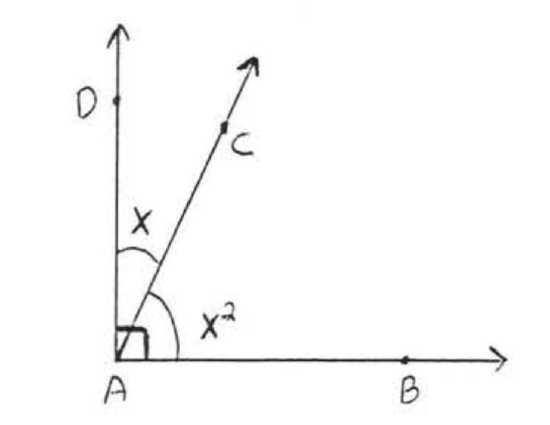
Find \(x\) and the complementary angles:
Solution
Since \(\angle BAD = 90^{\circ}\),
\[\begin{array} {rcl} {x^2 + x} & {90^{\circ}} \\ {x^2 + x - 90} & {0} \\ {(x - 9)(x + 10)} & {0} \end{array}\]
\[\begin{array} {rcl} {x - 9} & = & {0} \\ {x} & = & {9} \end{array}\ \ \ \ \ \ \ \ \ \ \ \ \ \ \ \ \begin{array} {rcl} {x + 10} & = & {0} \\ {x} & = & {-10} \end{array}\]
\(\angle CAD = x = 90^{\circ}\). \(\angle CAD = x = -10^{\circ}.\)
\(\angle BAC = x^2 = 9^2 = 81^{\circ}\).
\(\angle BAC = \angle CAD = 81^{\circ} + 9^{\circ} = 90^{\circ}\).
We reject the answer \(x = -10\) because the measure of an angle is always positive.(In trigonometry, when directed angles are introduced, angles can have negative measure. In this book, however, all angles will be thought of as having positive measure,)
Check, \(x = 9\):
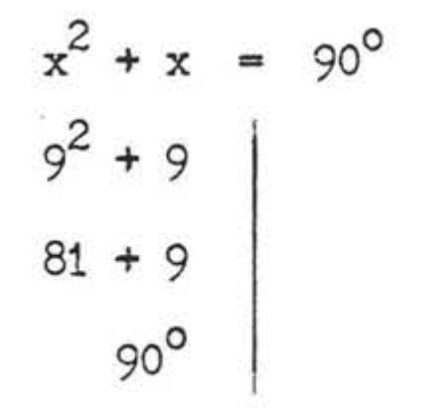
Answer: \(x = 9\), \(\angle CAD = 9^{\circ}\), \(\angle BAC = 81^{\circ}\).
Two angles are called supplementary if the sum of their measures is \(180^{\circ}\). Each angle is called the supplement of the other. For example, angle of \(150^{\circ}\) and \(30^{\circ}\) are supplementary.
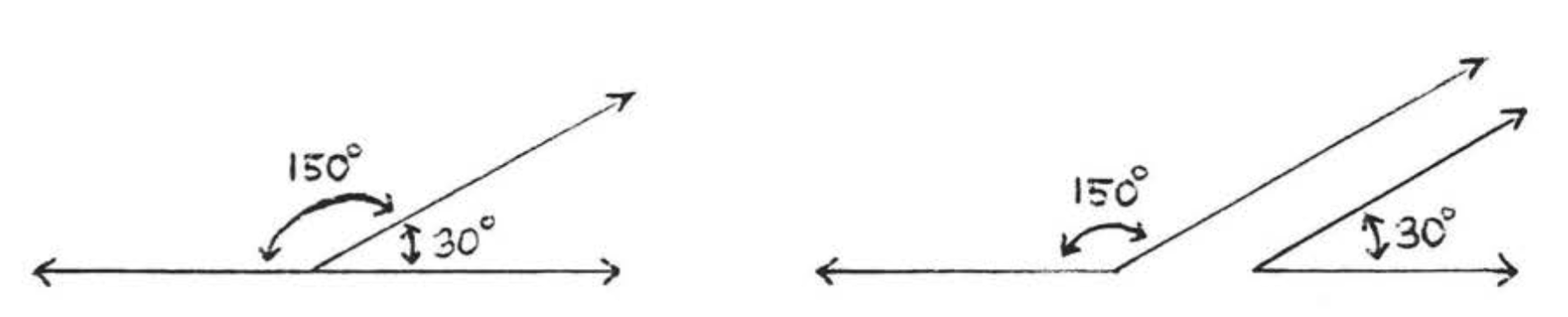
Find the supplement of an angle of \(40^{\circ}\).
Solution
\(180^{\circ} - 40^{\circ} = 140^{\circ}\).
Answer: \(140^{\circ}\).
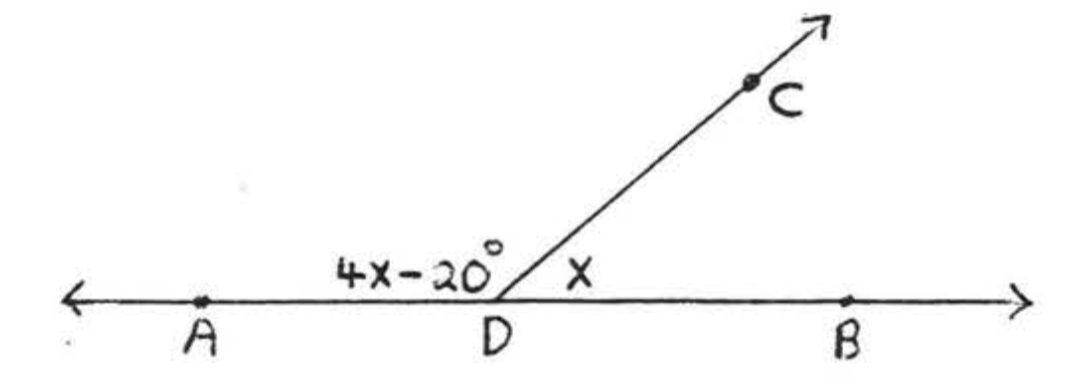
Find \(x\) and the supplementary angles:
Solution
Since \(\angle ADB = 180^{\circ}\),
\[\begin{array} {rcl} {4x - 20 + x} & = & {180^{\circ}} \\ {5x} & = & {180 + 20} \\ {5x} & = & {200} \\ {x} & = & {40} \end{array}\]
\(\angle ADC = 4x - 20 = 4(40) - 20 = 160 - 20 = 140^{\circ}\)
\(\angle BDC = x = 40^{\circ}\),
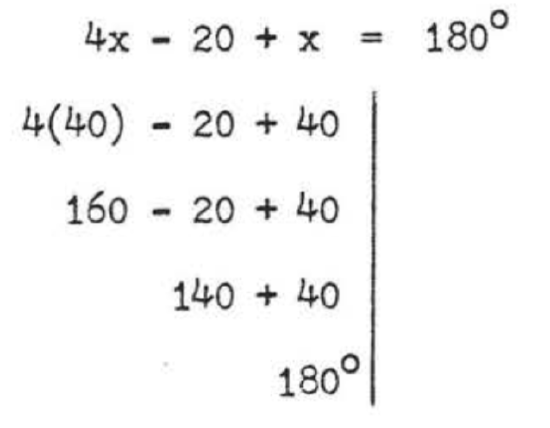
\(\angle ADC + \angle BDC = 140^{\circ} + 40^{\circ} = 180^{\circ}\).
Check:
Answer
\(x = 40, \angle ADC = 140^{\circ}, \angle BDC = 40^{\circ}\).
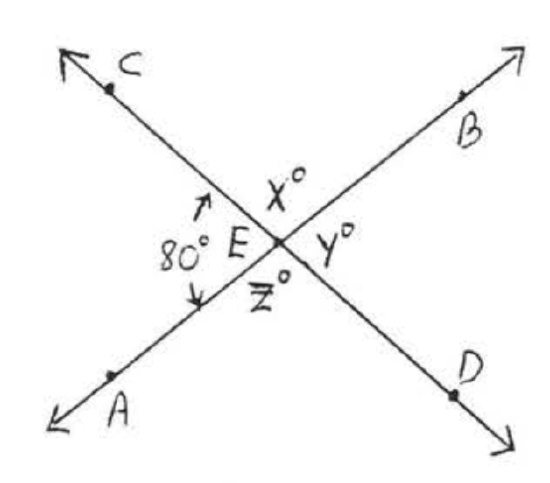
Find \(x, y, z\):
Solution
\(x^{\circ} = 180^{\circ} - 80^{\circ} = 100^{\circ}\) because \(x^{\circ}\) and \(80^{\circ}\) are the measures of supplementary angles.
\[\begin{array} {l} {y^{\circ} = 180^{\circ} - x^{\circ} = 180^{\circ} - 100^{\circ} = 80^{\circ}.} \\ {z^{\circ} = 180^{\circ} - 80^{\circ} = 100^{\circ}.} \end{array}\]
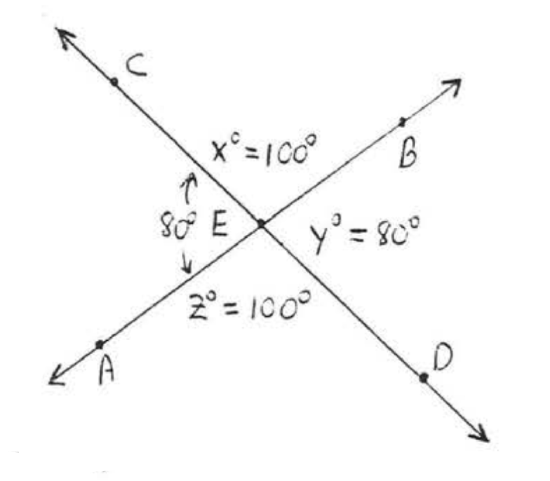
Answer: \(x = 100\), \(y = 80\), \(z = 100\).
Triangles
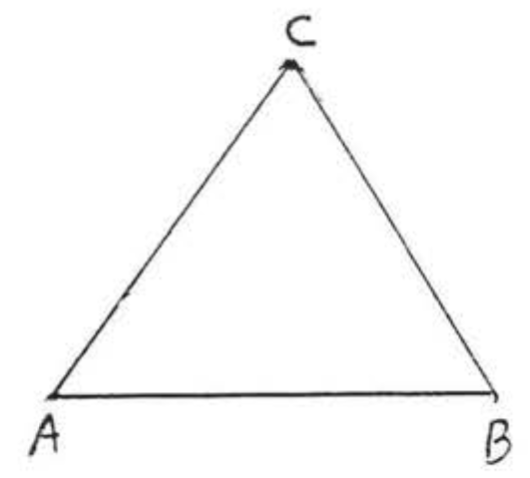
triangle is formed when three straight line segments bound a portion of the plane. The line segments are called the sides of the triangle. A point where two sides meet is called a vertex of the triangle, and the angle formed is called an angle of the triangle. The symbol for triangle is \(\triangle\).
The triangle in Figure \(\PageIndex{1}\) is denoted by \(\triangle ABC\) (or \(\triangle BCA\) or \(\triangle CAB\), etc.).
- Its sides are \(AB\), \(AC\), and \(BC\).
- Its vertices are \(A, B\), and \(C\).
- Its angles are \(\angle A\), \(\angle B\), and \(\angle C\).
A fundamental property of triangles is the following:
The sum of the angles of a triangle is \(180^{\circ}\).
In \(\triangle ABC\) of Figure \(\PageIndex{1}\), \(\angle A + \angle B + \angle C = 180^{\circ}\).
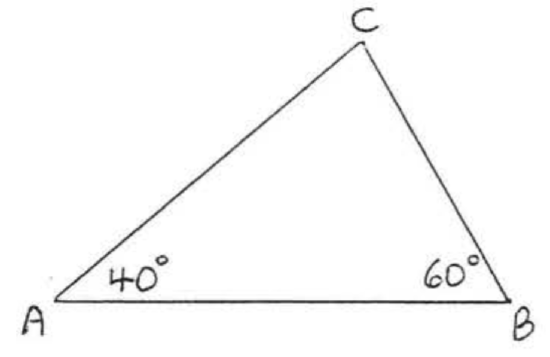
Find \(\angle C\):
Solution
\[\begin{array} {rcl} {\angle A + \angle B + \angle C} & = & {180^{\circ}} \\ {40^{\circ} + 60^{\circ} + \angle C} & = & {180^{\circ}} \\ {100^{\circ} + \angle C} & = & {180^{\circ}} \\ {\angle C} & = & {180^{\circ} - 100^{\circ}} \\ {\angle C} & = & {80^{\circ}} \end{array} \nonumber\]
Answer: \(\angle C = 80^{\circ}\)
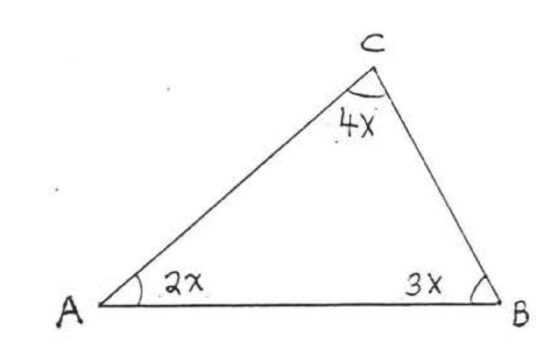
Find \(x\):
Solution
\[\begin{array} {rcl} {\angle A + \angle B + \angle C} & = & {180^{\circ}} \\ {2x + 3x + 4x} & = & {180} \\ {9x} & = & {180} \\ {x} & = & {20} \end{array} \nonumber\]
Check:
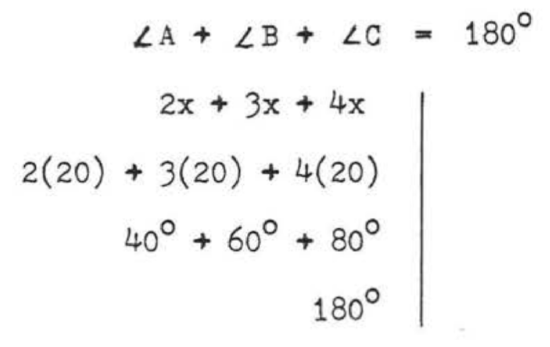
Answer: \(x = 20\).
Classification of Triangles
Triangles may be classified according to the relative lengths of their sides:
- An equilateral triangle has three equal sides,
- An isosceles triangle has two equal sides.
- A scalene triangle has no equal sides.

Triangles may also be classified according to the measure of their angles:
- An acute triangle is a triangle with three acute angles.
- An obtuse triangle is a triangle with one obtuse angle.
- An equiangular triangle is a triangle with three equal angles,
Each angle of an equiangular triangle must be \(60^{\circ}\), We will show in section 2, 5 that equiangular triangle are the same as equilateral triangles,

A right triangle is a triangle with one right angle, The sides of the right angle are called the legs of the triangle and the remaining side is called the hypotenuse,

0.1: Angles and Triangles is shared under a CC BY-NC-SA 4.0 license and was authored, remixed, and/or curated by LibreTexts.
The book could not be loaded just now.