Opening the book…

Figure \(\PageIndex{1}\): The Constitution of the United States (detail), 1787 (National Archives)
“We the People.”
Essay by Dr. Bryan Zygmont
Thus begins the Preamble to the United States Constitution. And though this phrase be only three words, it is a complicated and ever-shifting expression. Indeed, who are “We the People” (today) and who have “We the People” been (over the past millennium)?
The close study of art can do much to answer this question, but one must proceed with extreme caution. Traditionally, the study of the art made in North America has largely involved the examination of painting and sculpture commissioned by the only group affluent enough to pay for such works: wealthy white men. The study of eighteenth-century art from the American Colonies is an excellent case in point. To look only at the artistic record, one might assume North America was predominantly populated by wealthy, well-dressed men of European heritage. If we broaden the lens of our examination—that is, if we look at art that extends beyond the painting and sculpture that was restricted to the elite—we see the ways the artistic record is filled with works from a panoply of peoples: those who were native to North America, and from peoples from both sides of the Atlantic and Pacific oceans. These works have much to say about the shifting nature of national identity.
Mississippian culture
The Mississippian gorget (c. 1300 C.E.) is an excellent point of departure. A gorget is an ornament meant to be worn around the neck. This small object, carved out of shell likely brought from the Gulf of Mexico, was discovered at the end of the nineteenth century by an amateur archaeologist in a burial site in what is now north-central Tennessee. It is an object that speaks to the civilization, world views, and identity of the culture that made it, and those cultures with which it was in close contact.

Figure \(\PageIndex{2}\): Gorget, c. 1250-1350, probably Middle Mississippian Tradition, whelk shell, 10 x 2 cm (National Museum of the American Indian, Smithsonian Institution, 18/853)
The body of the intricately incised figure has been contorted to fit within the constraints of the round shape. The figure’s right knee is raised in front of him, while his left knee is similarly bent behind him, as if to suggest he is running. He holds a mace—a kind of weapon—in his left hand, while in his right he holds a decapitated human head. The fork-shaped form around his eye suggests the markings of a peregrine falcon, an element commonly seen in similar gorgets. He displays beads, both on his necklace and around his legs, and he also wears an elaborate headdress and decorated loincloth around his waist. The iconography of this object suggests the figure is Morning Star—who astronomically corresponds with Venus—a hero figure, who, with his twin brother, retrieved his father’s remains from the underworld. That similar figures have been found all over the large Mississippi Valley—and in a variety of media—tells us important things about pre-Columbian cultures in North America.
To begin an examination of this object, we need to displace some (likely) preconceived notions about pre-Columbian cultures in North America. When we speak of groups of Native Americans, we sometimes use the archaic term “tribes,” a word that seems to suggest a sense of isolation and separation. Moreover, when we think of the date of this object—it was made about 700 years ago—we might believe that the Mississippi Valley was an untamed wilderness, devoid of hamlets or towns. In fact, neither of these notions are necessarily true. As the Spanish conquistador Hernando de Sota observed between 1539-42, North America was filled with cities of various sizes. For example, the original Mississippian town, Cahokia, had a population of around 30,000 early in the second millennium, a size that was roughly equal to that of London at the same time. Clearly, any city of this size was multi-ethnic in nature and contained groups of different “tribes.” It also must have had contact with communities far beyond its own borders. Indeed, the Mississippian gorget is not an object about a single “tribe” that roamed the North American wilderness. Instead, it is a work that eloquently speaks about the ways in which different cultures lived in complex civilizations with firmly established belief systems before the first Europeans arrived.
Fashioning diplomacy: an Anishinaabe outfit

Figure \(\PageIndex{3}\): Anishinaabe outfit, c. 1790, collected by Lieutenant Andrew Foster, Fort Michilimackinac (British), Michigan, Birchbark, cotton, linen, wool, feathers, silk, silver brooches, porcupine quills, horsehair, hide, sinew; the moccasins were likely made by the Huron–Wendat people (National Museum of the American Indian, Smithsonian Institution)
It would be inaccurate, of course, to assume that these disparate groups of Native Americans shunned contact with Europeans once they began to settle North America, and there is a perception that these two groups, from different sides of the Atlantic Ocean, were in constant conflict. In fact, these two groups often peacefully coexisted, deriving at least some mutual benefit. One might even suggest that in certain cases friendships formed. And like friendships today, these relationships centuries ago might prompt gift exchanges. The Anishinaabe outfit from the National Museum of the American Indian is one such gift. But this is no simple token of friendship. Instead, it is a powerful and forceful testament to trans-world mercantilism and trade, and the complex diplomatic relationships between world powers.
At first glance one might assume that this Native American outfit was intended for a Native American wearer. Instead, it was a gift to Andrew Foster, a lieutenant in the British army who served in the Great Lakes area—in what is now Michigan—around the year 1790. The end of the eighteenth century was a complicated time in the history of the United States. The Treaty of Paris, signed on 3 September 1783, officially ended the American Revolutionary War. Moreover, New Hampshire ratified the Constitution in June 1788, and the government of the United States formally began less than a year later on 4 March 1789. In an attempt to protect their North American interests, Great Britain searched out diplomatic relationships with various Native American groups in the Great Lakes area to buffer the approach of the ever-growing United States that was already eyeing westward expansion.
Clearly, about the time this extravagant outfit was made—and presented to a British army officer—the United States was very much attempting to figure out its place in the world, to say nothing of its place in North America. Six years after the close of the War of American Independence, the British army was still fully entrenched in the Great Lakes area and actively engaged in trade and diplomatic relationships with the Anishinaabe peoples who lived there. Although we are looking only at an Anishinaabe outfit given to a British officer, we can easily imagine British tokens of friendship being given to the leadership of the Anishinaabe peoples, too.

Figure \(\PageIndex{4}\): Anishinaabe outfit (detail), c. 1790, collected by Lieutenant Andrew Foster, Fort Michilimackinac (British), Michigan, Birchbark, cotton, linen, wool, feathers, silk, silver brooches, porcupine quills, horsehair, hide, sinew; the moccasins were likely made by the Huron–Wendat people (National Museum of the American Indian, Smithsonian Institution)
A close examination of these garments points to the ways in which the eighteenth century was a time of long-distance commerce and trade. Great Britain became one of the world’s foremost mercantile powers, so much so that after the conclusion of the Seven-Years’ War (also referred to as the French and Indian War), the Irish-born British Statesman George Macartney wrote that Great Britain had become “the vast empire on which the sun never sets.” A fine illustration of this point is the shirt. The cotton for this shirt was grown in India—a British territory at the end of the eighteenth century—and then exported to Great Britain where the cloth was milled and manufactured into the cloth from which the shirt was made. The cut of the garment and the floral decoration were intended to appeal to a Native American audience. In short, this cotton shirt has had a multi-continent life. The cotton was grown in India, made into a shirt in England, exported to North America, and then returned to Britain when Foster returned home.
Other elements—such as the glass beads that decorate the necklace—are European made but designed to look as if they were manufactured in North America. These Venetian glass beads have been made to resemble wampum, a material Native Americans traditionally made from shells. Still other elements suggest trade between different groups of Native Americans. For example, the intricately decorated deerskin moccasins are not of Anishinaabe origin, but were instead made by women of the Huron-Wendat Nation and subsequently traded with Anishinaabe peoples. Like the Mississippian Gorget, Andrew Foster’s outfit eloquently speaks to intertribal commerce, exchange, and cooperation.
Wilderness, settlement, and American identity

Figure \(\PageIndex{5}\): Thomas Cole, The Hunter’s Return, 1845, oil on canvas (Amon Carter Museum of American Art)
If these first two works of art—the Mississippian Gorget and the Anishinaabe outfit—involve Native Americans both before and after the arrival of European settlers, Thomas Cole’s The Hunter’s Return (1845) is very much about that act of settlement by those Europeans. Although born in England, Cole moved to the United States when a teenager and is most well-known today for his landscapes that depict the Hudson River Valley of New York. In this autumnal landscape, the inclusion of the human figures and their domicile points to the westward expansion of the United States during the middle of the nineteenth century.
It is unlikely that Cole depicts a specific location in The Hunters Return. A log cabin—complete with smoke billowing from the chimney—can be observed on the right side of the composition, and a small garden is located just to its left. We see seven figures: the hunters of the title include the two men on the left side of the composition carrying the recently killed stag, and the young boy carrying the rifle over his shoulder who walks along the path towards the log cabin. Those who stayed behind include the two adult women (one of whom holds up an infant), and another young boy who embraces a dog, one that presumably was out with the hunting party. This multi-generational family suggests that they have lived here for a while, and the presence of a permanent structure such as a log cabin indicates that they will remain for some time to come, too.
Manifest Destiny
One can easily imagine what this scene may have looked like fifty years before Cole painted it. There would have been no log cabin, there would have been no human figures—and if they were there, they would not have been of European descent—and there would have been no felled trees or tree stumps to show the evidence of the saw (as we see in the lower right corner of the painting and between the garden and the log cabin). But by the middle third of the nineteenth century, there was an underlying notion in the United States that God placed Europeans in North America in order to settle the land and make it useful. No writer more forcefully expressed this than did John L. O’Sullivan, who in the July-August 1845 issue of the Democratic Review wrote that it was “our manifest destiny to overspread the continent allotted by Providence for the free development of our yearly multiplying millions.”
It is interesting to note that the first use of this term—Manifest Destiny, which would in time acquire Proper Noun status—was in 1845, the very year Cole completed The Hunters Return. Thus, Cole’s painting is not merely a composition about several hunters returning to their homestead after a successful hunt. Instead, it is a visual declaration of the political ideology of the process of (and results of) Manifest Destiny.
The middle of the nineteenth century in the United States was not only about westward expansion, it was also troubled by the brewing social, economic, and political turmoil growing between the North and the South in the ever-expanding country. The use of the first-person “our” in the O’Sullivan’s phrase “our manifest destiny” is as ambiguous as the first-person “we” in the “We the People” opening of the United States Constitution. It was clear by the middle of the nineteenth century that the “we” of “We the People” was restricted to the (white) people of European descent, not the Native Americans who predated European settlers by millennia or the African-Americans who had been enslaved here for generations.
Representing freedom during the Civil War

Figure \(\PageIndex{6}\): John Quincy Adams Ward, The Freedman, 1863, bronze (Amon Carter Museum of American Art, Fort Worth, Texas)
The artist John Quincy Adams Ward cast The Freedman in 1863 during the middle of the American Civil War (1861-65). This creation date is important, for this object has strong ties to Abraham Lincoln’s Emancipation Proclamation.
The Emancipation Proclamation
On 22 September 1862, Lincoln issued a warning that he would free every slave in the states that did not end their rebellion against the Union. This was in strident opposition to the Fugitive Slave Act of 1850 that stipulated that all slaves who escaped to free states must be returned to their captors, and the Dred Scott vs. Sandford decision of 1857 which stated that slaves were not citizens but instead only constitutionally protected property of their masters.
When the Civil War was still in full swing on 1 January 1863—and no slave state had withdrawn from the Confederacy and rejoined the Union—Lincoln issued the formal Emancipation Proclamation. In it, Lincoln wrote, “And by the virtue of the power, and for the purpose aforesaid, I do order and declare that all persons held as slaves within said designated States, and parts of states, are, and henceforward shall be free; and that the Executive government of the United States, including the military and naval authorities thereof, will recognize and maintain the freedom of said persons.”
What Ward has so elegantly cast is the tangible and human result of Lincoln’s Emancipation Proclamation. An idealized and nude-to-the-waist African American male sits atop a tree stump, looking to his right with a sense of intense concentration on his face. His left forearm rests upon his left knee, and we can clearly see a manacle still in place around his left wrist. In contrast, he holds in his right hand the links to a manacle that once bound his two hands together. The juxtaposition of these two manacles—one still attached to the wrist, the other recently removed—suggests the ways in which his freedom has also not yet been fully accomplished.
While the Emancipation Proclamation may have freed this man, it hardly gave him freedom. It was not until the ratification of the 13th Amendment on 6 December 1865 that the practice of slavery was formerly abolished in the United States. But although the 13th Amendment only ended slavery, it did not necessarily provide citizenship, something that was only accomplished in July 1868 when the ratification of the 14th Amendment provided citizenship to all born in the United States. But even still, this was not the end of the road. For there are citizens, and there are citizens who can vote. And it was not until February 1870 when the ratified 15th Amendment—“The right of citizens of the United States to vote shall not be denied or abridge by the United States or by any State on the account of race, color, ore previous condition of servitude”—provided male African-Americans with full enfranchisement (at least in theory). And it was not until the 19th Amendment was ratified in 1920 that women of any ethnicity were allowed the right to vote.
“Give me your tired, your poor, Your huddled masses yearning to breathe free”

Figure \(\PageIndex{7}\): Frédéric-Auguste Bartholdi (sculptor), Gustave Eiffel (interior structure), Richard Morris Hunt (base), Statue of Liberty, begun 1875, dedicated 1886, copper exterior, 151 feet 1 inch / 46 m high (statue), New York Harbor
One of the most recognizable works of art in the history of the United States is the Statue of Liberty. Although it was formally dedicated on 28 October 1886, a poem—written three years earlier by Emma Lazarus—was engraved onto a bronze plaque and placed inside the lower level of the statue’s pedestal in 1903. It reads, in part:
From her beacon-hand
Glows world-wide welcome; her mild eyes command
The air-bridged harbor that twin cities frame.
“Keep, ancient lands, your storied pomp!” cries she
With silent lips. “Give me your tired, your poor,
Your huddled masses yearning to breathe free,
The wretched refuse of your teeming shore.
Send these, the homeless, tempest-tost to me,
I lift my lamp beside the golden door!”Emma Lazarus, from The New Colossus, 1883
By 1903, Ellis Island was the busiest immigration inspection station through which aspiring citizens-to-be could enter the United States. Of course, immigration was not a new thing—the United States has always been a country populated by immigrants and the descendants of those immigrants—but immigration into the United States during the decades surrounding the turn of the twentieth century was particularly robust. It was during this time when the tired, the poor, the huddled masses yearning to breathe free most flocked to the United States. The Statue of Liberty stood tall to welcome them to their American Dream.
The Johnson-Reed Act
Then, as now, the topic of immigration was a complicated political topic. For example, the Immigration Act of 1924—sometimes called the Johnson-Reed Act—was passed to restrict the flow of potential immigrants from targeted parts of Europe. In an attempt to ensure that “America must remain American,” this act proposed an annual limit to the number of immigrants from each country to 2% of the number of people already living in the United States from that country. For those countries with a high immigration population already living in the United States—nations such as England and Germany—this act would have had little real practical effect (two percent of an enormous number is still a big number). For other countries—such as predominantly Catholic Italy, and those in Eastern Europe with a large Jewish population—this law severely restricted who could pursue the American Dream. At its core, the Johnson-Reed Act was an attempt to manipulate and control what future Americans would look like and what Americans believed (their religious faith).
Strange Worlds, immigrant experience in the early 20th century

Figure \(\PageIndex{8}\): Todros Geller, Strange Worlds, 1928, oil on canvas, 71.8 x 66.4 cm (Art Institute of Chicago)
Todros Geller painted Strange Worlds in 1928, just four years after the passage of the Johnson-Reed Act. Geller was an immigrant himself, having fled the pogroms (organized massacres of the Jews in Eastern Europe) in Ukraine, in 1906. He settled in Montreal, and then moved to the United States in 1918 and studied at the Art Institute of Chicago. This city had been a hotbed of immigration from Eastern Europe for decades. One only need recall Jurgis Rudkus, the Lithuanian immigrant in Upton Sinclair’s novel, The Jungle (1906) to be reminded of the incredible melting pot Chicago had become.
In Strange Worlds, Geller gives us a visual representation of what the immigrant experience might have been for those living in Chicago during the early decades of the twentieth century, and the plurality of that title—Strange Worlds, not Strange World—speaks to the difficulty many had in coming to America. A solitary elderly man stares out at us from the left foreground, a tense, distant look on his face. With his dark hat and nondescript clothing, it is clear that this figure is not intended to be a portrait of a specific person. Instead, it is a representation of a type; in this instance, the type is that of the Eastern European immigrant. The compressed foreground is filled by the figure, a diagonal staircase leading upwards to one of Chicago’s elevated trains (a track of which can be seen in the distance, in the upper right corner), and a collage of newspapers. These two elements—the L and newspapers—would hardly have seemed strange to anyone living in Chicago at the time. But the figure’s wearied look and his own isolation makes clear that he is a foreigner in a foreign land.
If the foreground—the man’s own space—is static, and, one might say, comparatively traditional, then the background is much more dynamic and modern. The human figures and the landscape have been painted with a kind of kinetic energy that vibrates through the background. And this tension—between the man’s own space and that which surrounds him—was part of the immigrant experience for millions of new Americans. America was strange to them, and, as important, they were strange to (the) Americans (already here). Even if this man were granted citizenship and the right to vote, one gets the idea that he is not yet a part of “We the People.”

Figure \(\PageIndex{9}\): Nari Ward, We the People (black version), 2015, shoelaces, 8 × 27 feet (Crystal Bridges Museum of American Art, Bentonville, Arkansas)
E Pluribus Unum
In the Declaration of Independence, Thomas Jefferson wrote, “We hold these truths to be self-evident, that all men are created equal, that they are endowed by their Creator with certain unalienable Rights, that among these are Life, Liberty and the pursuit of Happiness.” Who qualified for these unalienable rights has shifted and changed over time, just as who has been included in “We the People” has changed, too. These changes and additions are part of our national identity, one that is also in a state of dynamic flux. But even though that identity may have changed, the idea of E Pluribus Unum—out of many, one—has remained constant in the United (an adjective that implies singularity) States (a plural noun).
Selected Contributors
Seeing America is developed and distributed by Smarthistory together with a consortium of museums, including:
Amon Carter Museum of American Art
Crystal Bridges Museum of American Art
Fine Arts Museums of San Francisco
Los Angeles County Museum of Art
National Museum of the American Indian, Smithsonian Institution
Pennsylvania Academy of Fine Arts
Smithsonian American Art Museum
Terra Foundation for American Art
Wadsworth Atheneum Museum of Art
c. 1250-1350
America before Columbus: a Mississippian view of the cosmos
Found marking the grave of an important individual, this gorget was worn as a neck ornament during life
America before Columbus
A gorget and a Mississippian view of the cosmos
by DR. DAVID W. PENNEY, NATIONAL MUSEUM OF THE AMERICAN INDIAN, SMITHSONIAN INSTITUTION and DR. BETH HARRIS
Video \(\PageIndex{1}\): Gorget, c. 1250-1350, probably Middle Mississippian Tradition, whelk shell, 10 x 2 cm (National Museum of the American Indian, Smithsonian Institution, 18/853). Speakers: Dr. David Penney, Associate Director for Museum Scholarship, Exhibitions, and Public Engagement, National Museum of the American Indian and Dr. Steven Zucker
Test your knowledge with a quiz
Key points
- In the centuries before European contact, Native Americans built networks of cities that shared technologies, belief systems, and cultural forms.
- This Mississippian gorget, made from a shell found in the Gulf of Mexico, but discovered in a burial mound in Tennessee, demonstrates the extensive exchange between native peoples in different geographic regions before European contact.
- Mississippian Society, which flourished between 800 and 1500 C.E. in Eastern North America, was united by the widespread production of corn, shared ideologies, and towns that often featured platform mounds.
- The representation of Morning Star reflects a shared cosmology where the Earth is situated between an underworld and a sky world, and this is reinforced by the shell’s circular shape and incised circles that may suggest a cycle of life, death, and regeneration.
Go deeper
Learn more about this object from the National Museum of the American Indian
What do we know about the Mississippian period?
What do we know about the mounds that characterized Mississippian cities?
What is the story of Morningstar?
How did agricultural technology contribute to the rise of Mississippian culture?
More to think about
This gorget was found in a burial mound, marking the owner as possibly an important founder of Castalian Springs. Why do you think this particular object might have been included in his burial?
Smarthistory images for teaching and learning:


Figure \(\PageIndex{10}\): More Smarthistory images…
Selected Contributors
Seeing America is developed and distributed by Smarthistory together with a consortium of museums, including:
Amon Carter Museum of American Art
Crystal Bridges Museum of American Art
Fine Arts Museums of San Francisco
Los Angeles County Museum of Art
National Museum of the American Indian, Smithsonian Institution
Pennsylvania Academy of Fine Arts
Smithsonian American Art Museum
Terra Foundation for American Art
Wadsworth Atheneum Museum of Art
c. 1790
Fashioning diplomacy: the Anishinaabe, Britain, and 18th-century America
This outfit was likely made for a British lieutenant and gifted to him in a ritual exchange to show mutual respect.
Fashioning diplomacy
the Anishinaabe, Britain, and 18th-century America
by DR. DAVID W. PENNEY, NATIONAL MUSEUM OF THE AMERICAN INDIAN, SMITHSONIAN INSTITUTION and DR. STEVEN ZUCKER
Video \(\PageIndex{2}\): Anishinaabe outfit, c. 1790, collected by Lieutenant Andrew Foster, Fort Michilimackinac (British), Michigan, Birchbark, cotton, linen, wool, feathers, silk, silver brooches, porcupine quills, horsehair, hide, sinew; the moccasins were likely made by the Huron–Wendat people (National Museum of the American Indian, Smithsonian Institution). Speakers: Dr. David Penney, Associate Director for Museum Scholarship, Exhibitions, and Public Engagement, National Museum of the American Indian and Dr. Steven Zucker
Test your knowledge with a quiz
Key points
- This Anishinaabe outfit highlights the alliance between native cultures of the Great Lakes region and the British, who wanted to preserve their lucrative trade routes in the area during the years following the American Revolutionary War.
- Anishinaabe women artisans transformed materials available through the trade networks of the British Empire to create finely-crafted clothing reflecting native traditions and aesthetic preferences.
- Border disputes contesting the United States’ claim to northern territories near the Great Lakes and Canada contributed to political tensions that led to the War of 1812.
- Ritual trade with native peoples involved the practice of gift-giving, exchanging objects of cultural value that demonstrated mutual respect between trade partners.
Despite the unequal power between themselves and the colonists, indigenous North American societies were able, over time, to adapt to the new presence in their land, finding some convergences between their artistic practices and those of the Europeans. The term used to define this form of cultural encounter is syncretism—the melding of two or more different belief systems, artistic styles, or cultural practices to form a third, distinctly different one.
Although many indigenous societies had been dislocated from their ancestral homelands as a result of white settlement, epidemic, forced relocation, intertribal raiding, warfare, and shifting ethnic alliances, they were nevertheless often able to devise a culture of the middle ground. The crucial factor permitting this was that Natives and Europeans met in partnerships from which each benefited, based on trade. Natives retained aspects of their cultural autonomy as they hunted and trapped America’s abundant wildlife to supply an international market. The pelts and hides were sent to Europe; in exchange, cloth, iron and silver, and glass beads made their way across the ocean to North America. The indigenous artistic repertoire expanded to incorporate these trade goods. Although their cultures were changing so rapidly as to be threatened with virtual extinction, Native people acquired and assimilated new materials and motifs, while trying to exploit new opportunities for economic and artistic enrichment. The visual culture of the middle ground was hybrid and inventive, resilient in the face of foreign occupation.
From Angela L. Miller, Janet Catherine Berlo, Bryan J. Wolf, and Jennifer L. Roberts, American Encounters: Art, History, and Cultural Identity (Washington University Libraries, 2018), p. 32. CC BY-NC-SA 4.0
Go Deeper
Learn more about this outfit at the National Museum of the American Indian
Primary sources from the Digital Public Library of America
What can we learn from Native American clothing?
What effect did Europeans have on native cultures in the Great Lakes regions?
What was the Native American perspective on the War of 1812?
More to think about
We often use clothes and fashion to express our identity to others. How does this Anishinaabe outfit complicate the notion of a singular American or national identity in the early years of the United States?
Smarthistory images for teaching and learning:
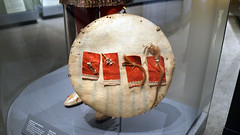
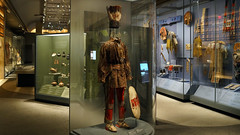
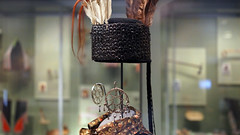

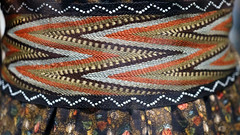

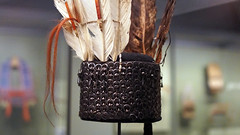
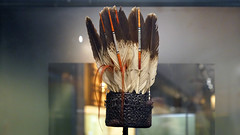
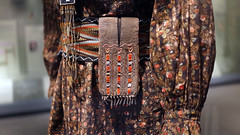
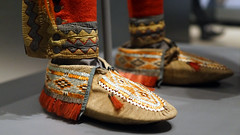
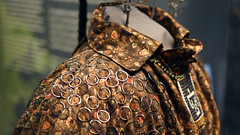
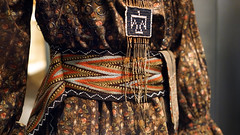
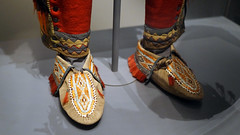

Figure \(\PageIndex{11}\): More Smarthistory images…

Selected Contributors
Seeing America is developed and distributed by Smarthistory together with a consortium of museums, including:
Amon Carter Museum of American Art
Crystal Bridges Museum of American Art
Fine Arts Museums of San Francisco
Los Angeles County Museum of Art
National Museum of the American Indian, Smithsonian Institution
Pennsylvania Academy of Fine Arts
Smithsonian American Art Museum
Terra Foundation for American Art
Wadsworth Atheneum Museum of Art
1845
Wilderness, settlement, and American identity, Thomas Cole's The Hunter's Return
Cole feared for the American landscape as his country expanded westward.
Wilderness, settlement, American identity
Cole feared for the American landscape as his country expanded westward
by MAGGIE ADLER, AMON CARTER MUSEUM OF AMERICAN ART and DR. BETH HARRIS
Video \(\PageIndex{3}\): Thomas Cole, The Hunter’s Return, 1845, oil on canvas, 153.7 x 101.9 cm (Amon Carter Museum of American Art). Speakers: Dr. Maggie Adler, Curator, Amon Carter Museum of American Art and Dr. Beth Harris
Test your knowledge with a quiz
Key points
- Manifest Destiny propelled westward expansion in the U.S. in the 19th century. Increased settlement and industry transformed the landscape of the American frontier.
- Cole sought to represent the sublime grandeur of the American landscape. The painting represents his conflicted feelings over the inevitable loss of wilderness that accompanied economic development.
- Cole was one of the first environmentalists. He shared the notion, popular in the early 19th century, that God’s divine presence was embodied in nature, and saw the American wilderness as central to the nation’s identity.
- Cole is credited as the founder of the Hudson River School, which is often described as the first style of painting to be considered American.
“The seemingly untouched quality of the nation’s wilderness distinguished the United States from Europe. The landscape came increasingly to embody what Americans most valued in themselves: an “unstoried” past, and “Adamic” freedom, an openness to the future, a fresh lease on life. In time, Americans came to think of themselves as “nature’s nation.” And yet one of the paradoxes of American history…lay in the unresolved tension between the subduing of the wilderness and the honoring of it. The tension is still alive with us today, in the competing voices of environmentalists and advocates of development.”
— Angela L. Miller, Janet Catherine Berlo, Bryan J. Wolf, and Jennifer L. Roberts, American Encounters: Art, History, and Cultural Identity (Washington University Libraries, 2018), p. 24 (CC BY-NC-SA 4.0)
An unresolved tension
For much of the nineteenth century, America’s landscape was intimately connected with the nation’s identity (unlike Europe, nature in North America was seen as untouched by the hand of man). But the United States has also always prided itself on its entrepreneurial spirit, its economic progress, and its industry. This tension between the nation’s natural beauty and the inevitable expansion of industry was clearly felt in the mid-nineteenth century as logging, mining, railroads, and factories were quickly diminishing what once seemed an endless wilderness. Thomas Cole (1801-48) beautifully expressed the tension between these two American ideals in many of his landscape paintings.
Thomas Jefferson had envisioned that American democracy would be sustained by a nation of yeoman farmers who worked small farms with their families—such as the household pictured by Cole. By the end of 19th century, however, manufacturing had became a primary driver of the American economy.
The opening of the Erie Canal in 1825 linked midwestern farms with cities on the east coast. Tanneries (where animal hides were processed to make leather using tannin, which was derived from hemlock trees) proliferated and lumber merchants deforested the landscape. As many as 70 million eastern hemlock trees were cut down to provide tannin. Beginning in the 1830s, the railroad had begun to cut across the American landscape, allowing for easier transportation of goods and passengers.
As the east coast grew increasingly populous and developed, more people moved westward in search of economic opportunity. The Homestead Acts were a series of laws enacted in 1862 to provide 160-acre lots of land at low cost, to encourage settlers to move west, answering Manifest Destiny’s [popup] call for westward expansion (the term was coined in 1845, the year this painting was made). Importantly, the popular conception of the west as unspoiled territory ignored the many nations of American Indians who had already settled the North American continent.
Cole’s painting
Though Cole’s The Hunter’s Return features human figures, it was seen as a landscape painting, since nature is dominant. In the art academies of Europe landscapes were not accorded the same respect as history paintings (whose subjects came from history, the bible or mythology, and therefore had clear moral elements and treated noble subjects), but Cole was intent on elevating his landscapes by imbuing them with a more serious message.
At first glance, a viewer might assume that this painting is set in the Catskill Mountains in the Hudson River Valley in New York State where Cole lived and painted, but in fact this painting is a composite of many scenes, and promotes a specific point of view—one that is ambivalent about the ways that Americans were rapidly transforming the natural beauty that was so fundamental to the nation’s understanding of itself. The foreground of the painting juxtaposes the tree stumps left by man’s axe against the more pristine wilderness seen in the middle and background of the painting.
Cole’s image then is not real, but nostalgic. The artist gave voice to the longing for a pristine, pre-industrial America. Cole wrote,
“I cannot but express my sorrow that the beauty of such landscapes are quickly passing away. The ravages of the axe are daily increasing. The most noble scenes are made desolate, and oftentimes with a wantonness and barbarism scarcely credible in a civilized nation. This is a regret rather than a complaint. Such is the road society has to travel.”
—Thomas Cole, “Essay on American Scenery,” The American Monthly Magazine, vol. 7, January 1836, p. 12.
Go deeper
Learn more about this painting from the Amon Carter Museum
Read Thomas Cole’s “An Essay on American Scenery”
Learn about Cole and the other painters in the Hudson River School
Learn about the impact of tanneries on the landscape of the Catskill mountains
How did the Erie canal impact the development of the midwest?
More to think about
Compare Cole’s The Hunter’s Return with John Gast’s American Progress. Discuss how these works suggest different perspectives on westward expansion of the United States in the 19th century.
Smarthistory images for teaching and learning:
Smarthistory images for teaching and learning:


Figure \(\PageIndex{12}\): More Smarthistory images…
Selected Contributors
Seeing America is developed and distributed by Smarthistory together with a consortium of museums, including:
Amon Carter Museum of American Art
Crystal Bridges Museum of American Art
Fine Arts Museums of San Francisco
Los Angeles County Museum of Art
National Museum of the American Indian, Smithsonian Institution
Pennsylvania Academy of Fine Arts
Smithsonian American Art Museum
Terra Foundation for American Art
Wadsworth Atheneum Museum of Art
1848
Before the Civil War, the Mexican-American War as prelude
Painted for a divided US, people from North and South could identify with this image—others remain marginalized.
War News from Mexico
The Mexican American War as prelude to the Civil War
by DR. MINDY BESAW, CRYSTAL BRIDGES MUSEUM OF AMERICAN ART Array DR. BETH HARRIS and DR. TOM FOLLAND
Video \(\PageIndex{5}\): Richard Caton Woodville, War News from Mexico, 1848, oil on canvas, 68.6 × 63.5 cm (Crystal Bridges Museum of American Art), Speakers; Dr, Mindy Besaw, Curator, Crystal Bridges Museum of American Art, and Dr. Steven Zucker
Test your knowledge with a quiz
Key points
- Anglo-American belief in Manifest Destiny served to justify the U.S. government’s efforts to claim new territories.
- The 1848 Treaty of Guadalupe Hidalgo, which ended the Mexican-American War, resulted in the Mexican Cession of what is now the southwestern United States, including parts of what are now Arizona, Nevada, Utah, New Mexico, California, Wyoming and Colorado.
- The conflict in the 1840s over whether new territories should enter the U.S. as free or slave states foreshadowed the national division over slavery that led to the Civil War.
- New technologies such as the newspaper and telegraph speeded communication, connected the growing nation, and helped shape the public’s response about current events.
- Woodville’s politically ambiguous image had broad popular appeal.
 ystal Bridges Museum of American Art, Bentonville, Arkansas)
A crowd gathered for the news
The young man in the center of a crowd in Richard Caton Woodville’s War News From Mexico (1848) holds open a newspaper with his elbows up, but the paper is low enough that we can see the astonished look on his face.

Figure \(\PageIndex{14}\): Map of Mexico, color-filled areas show Mexican territory in 1847. The yellow and green areas at the top left became part of the southwestern United States in 1848.

Figure \(\PageIndex{15}\): Volunteer Flyer (detail), Richard Caton Woodville, War News from Mexico, 1848, oil on canvas, 68.6 × 63.5 cm (Crystal Bridges Museum of American Art, Bentonville, Arkansas)
And the news itself? As the title indicates, this is a dispatch from the front of the Mexican-American War. United States troops entered Mexico City in 1848, bringing to an end a war that had begun in 1846 over a territorial dispute involving Texas. In the resulting Treaty of Guadalupe Hidalgo, Mexico ceded half its territory to the United States, effectively concluding the U.S. program of westward expansion.
To convey the characteristics of a Western outpost, the men gathered in the painting are shown standing on the porch of a building typical of the kind erected in the American frontier during the rush for territories in the early decades of the nineteenth century. In fact, the building serves multiple functions: it is both an “American Hotel” and post office, as indicated on the signs. While the building emulates in wood the style of stone classical structures found in Philadelphia or New York City, the artist has taken great care with the details to remind the viewer this is on the frontier: the wood is worn, and underneath the “post office” sign is tacked a recruitment notice asking for “Volunteers for Mexico!”
A range of responses
Opinion on the war was divided and Woodville thus depicts a range of responses. An older man in Revolutionary-era clothing just to the right of the standing figure holding the newspaper, strains to hear as another repeats into his ear what is being read. One young man in the background is tossing his hat into the air; he clearly welcomes the news but the seated elder shows far less enthusiasm. His outdated clothing identifies him as part of the generation that fought the Revolutionary War but did not endorse the expansion embraced by the new Jacksonian-era democracy. And what of the inhabitants themselves of the former Spanish colonies in the southwest (Mexico had gained independence from Spain in 1821)? This could only be bad news; the surrendering of territory spelled the loss of cultural identity. A protestant, Anglo-American culture, pushing westward, acquiring new states for the Union, would seek to eradicate any vestiges of Hispanic-Catholic identity. Mexicans would wake up the day after the treaty was signed and find themselves second-class citizens in a new country.

Figure \(\PageIndex{16}\): Porch (detail), Richard Caton Woodville, War News from Mexico, 1848, oil on canvas, 68.6 × 63.5 cm (Crystal Bridges Museum of American Art, Bentonville, Arkansas)
Genre scenes
American genre-scene painters during this period typically strove to represent an array of social types in their rapidly modernizing nation, and Woodville’s painting is no exception (“genre” paintings depict scenes of everyday life). There were often humorous illustrations of class status or newly immigrant Americans in genre scene paintings but they also betrayed, in equal measure, social anxiety about a shifting demography in a new political environment. There are African-American figures in the painting but they are pushed to the border, outside the framing beams of the hotel’s portico—a seated man in a bright orange shirt and a child wearing a tattered white dress. They look on from the bottom right, at the foot of the steps, but their facial expressions seem to register only weariness or perhaps resignation. The question as to whether the new territories would be slave states or free ones was hotly debated—some saw the war as extending the institution of slavery—and Woodville nods to this larger political reality. There is also an elderly woman barely visible in the shadows; she leans out a window and looks in the direction of the group on the porch. These figures are not included within the immediate circle of white men—perhaps suggesting their less central position within society.

Figure \(\PageIndex{17}\): Man and child, lower right (detail), Richard Caton Woodville, War News from Mexico, 1848, oil on canvas, 68.6 × 63.5 cm (Crystal Bridges Museum of American Art, Bentonville, Arkansas)
Images of frontier life were popular in the years leading up to the Civil War and Woodville had great success depicting this kind of everyday subject matter. He specialized in domestic interiors—an important subset of this newly emergent category of genre-scene painting. This subject type was popular in Europe (particularly during the 17th century in the Dutch Republic), however it was a relatively new phenomenon in American art—reaching its height of popularity in the period that stretched from the 1830s through the Civil War of 1861-65. Genre scene paintings were aimed at a broadly expanded and increasingly literate middle-class whose tastes ran to familiar scenarios of everyday life, rather than the mythic or historical themes favored by the art academies (the Royal Academies of Europe and the National Academy in the United States). Genre-scene paintings were promoted by organizations like the American Art Union (AAU). The AAU was formed in 1839 to promote American artists and specifically to forge a uniquely American art. Once exhibited under the aegis of the AAU—Woodville’s War News From Mexico was exhibited in 1849 right after the war ended—paintings were then turned into engravings and sold to AAU members by subscription.

Figure \(\PageIndex{18}\): Woman in window (detail), Richard Caton Woodville, War News from Mexico, 1848, oil on canvas, 68.6 × 63.5 cm (Crystal Bridges Museum of American Art, Bentonville, Arkansas)
In contrast to the marginalized figures of the woman and the African Americans, the newspaper takes pride of place in this painting. The “penny presses,” as they were called, a relatively recent invention, were mass-produced commercial newspapers that emerged in the 1830s during a period of rapid industrialization and modernization. Unlike their more expensive, subscription-based counterparts, the penny presses (so named because they cost mere pennies) reached a broad swath of the American public. Not only was the Mexican-American War one of the very first to be photographed, it was also extensively broadcast through print—through the very type of paper depicted in the painting, with its top banner emblazoned with the words “EXTRA.” The newspaper, in fact, functioned as a powerful symbol of the power of the press to bring Americans together and the painting suggests the role of the paper in shaping public opinion.

Figure \(\PageIndex{19}\): Newspaper (detail), Richard Caton Woodville, War News from Mexico, 1848, oil on canvas, 68.6 × 63.5 cm (Crystal Bridges Museum of American Art, Bentonville, Arkansas)
Genre-scene paintings often conveyed a sense of immediacy and here War News From Mexico orients itself towards the viewer in such a way that one feels as if one has just stumbled upon the scene. Notice, for example, how the perspective is tilted to the right of the viewer; this has the effect of positioning us off to the left side as if we have just come around some imaginary corner and the American Hotel, its porch crowded with the town’s inhabitants, careens into view.

Figure \(\PageIndex{20}\): Moses (detail) Emanuel Leutze, Westward the Course of Empire Takes its Way, 1862
Manifest Destiny
Despite this seeming spontaneity, War News from Mexico is as carefully composed and even as moralizing as the staid history paintings and Neoclassical subjects favored by the academies. Though it was commonplace to view genre-scene paintings as “snapshots” of daily American life without larger purpose, this unfolding scene (meant to indicate some place on the frontier far removed from the military action, but close enough that it mattered), takes place against the backdrop of Manifest Destiny—the theory that drove and justified westward expansion.
The ideology of Manifest Destiny construes Anglo-Americans as God’s chosen people who—like the ancient Israelites of the Old Testament—are guided by God to their destiny. This was a subject often depicted in painting. For example, in Emmanuel Leutze’s mural for the west stairway of the U.S. Capitol, Westward the Course of Empire Takes its Way, we see American pioneers and their covered wagons looking towards the sunset and the Pacific Ocean while one of the scenes in the lower right border (illustrated left) depicts Moses leading the Israelites through the desert.

Figure \(\PageIndex{21}\): Emanuel Leutze, Westward the Course of Empire Takes its Way, 1862, stereochrome, 6.1 × 9.1 m (United States Capitol, Washington, D.C.)
Beginning with the American Revolution, this American “exceptionalism” (as it also came to be known), rationalized not only the acquisition of land all the way to the Pacific Ocean, but also the subjugation and removal of people from their land—the Indian Removal Act of 1830 that President Andrew Jackson signed into law strengthened the rapid acquisition of land that went hand in hand with expulsion and extermination.
Woodville makes no overt statement of his politics in War News from Mexico but his painting nevertheless encapsulates a larger history than the scale of this relatively small painting (it measures approximately 27 x 25 inches) would seem to allow. If War News from Mexico does, however ambiguously, extol the ideology of Manifest Destiny and the inevitability of America’s domination of a large part of the continent, it is an ironic fact of history that Woodville’s scenes of life in the American West were painted while he lived in Europe. Born in Baltimore, Woodville left for Europe as a young man to train in Düsseldorf, Germany, and remained abroad until his death in London at the age of 30.
Go Deeper
Learn more about this painting from the Crystal Bridges Museum of American Art
How did the Mexican-American War reshape America’s international standing?
What was the role of President Polk in westward expansion?
How did Texas become a part of the United States?
How did the media affect the public response to the Mexican-American War?
How did artists represent scenes of everyday life in nineteenth-century America?
More to think about
If the scene depicted in War News from Mexico represented life today, how would you populate the image? Who would be on the porch? The steps? Inside the house? On the periphery?
Smarthistory images for teaching and learning:
Smarthistory images for teaching and learning:


Figure \(\PageIndex{22}\): More Smarthistory images…
Selected Contributors
Seeing America is developed and distributed by Smarthistory together with a consortium of museums, including:
Amon Carter Museum of American Art
Crystal Bridges Museum of American Art
Fine Arts Museums of San Francisco
Los Angeles County Museum of Art
National Museum of the American Indian, Smithsonian Institution
Pennsylvania Academy of Fine Arts
Smithsonian American Art Museum
Terra Foundation for American Art
Wadsworth Atheneum Museum of Art
1863
Representing freedom during the Civil War
This remarkable work honors those who fought for their own freedom, but acknowledges that the struggle goes on.
John Quincy Adams Ward, The Freedman
Honoring those who fought for their own freedom during the Civil War
by ERIN LONG, AMON CARTER MUSEUM OF AMERICAN ART and DR. BETH HARRIS
Video \(\PageIndex{6}\): John Quincy Adams Ward, The Freedman, 1863, bronze (Amon Carter Museum of American Art, Fort Worth, Texas). Speakers: Erin Long, Lead Gallery Teacher, Amon Carter Museum of American Art, and Beth Harris
Test your knowledge with a quiz
Key points
- Lincoln’s Emancipation Proclamation in January 1863 made clear the Union’s intention to abolish slavery. However, it only freed slaves in states still in open rebellion against the Union. Slavery was not formally abolished in the United States until 1865 when the 13th Amendment was ratified.
- The Freedman directly responds to the Emancipation Proclamation and may reflect Ward’s frustration at the slow progress of slavery’s abolition. The figure appears to have broken off one manacle, but the other still binds him, reinforcing the notion that he is not yet completely free.
- Ward’s sculpture depicts an African-American man in charge of his own freedom. This depiction departs from typical Abolitionist-era images that typically showed slaves pleading for sympathy. Ward elevates his subject by building on the ideal of heroic male nudity in Greek art, but he also includes realistic details that suggest the man’s age, experience, and character.
- In this version of the sculpture, Ward inscribes the dangling manacle with a reference to the Massachusetts 54th, the first African-American regiment in the Union Army. This reference underscores African-Americans’ willingness to fight, and die, for their freedom.
Ward’s Freedman imagines the agent of emancipation to be the man himself. The Freedman eliminates the figure of Lincoln, focusing instead on the powerfully modeled slave. Entirely nude except for drapery across his loins, he still wears one manacle on his left wrist. His torso twists to the right, where his arm anchors the torque of his body in a pose that conveys coiled strength. His seated posture implies a further ambiguity—is he resting his weight upon the tree trunk that props his body up, or is he preparing to stand? The tension of his pose suggests an open-ended future no longer dictated by external forces but by the internal poise and dynamic power of the man himself.
…The Freedman speaks a sculptural language that originates in antiquity. The classical canon of proportion, the athleticism of idealized male form, and the graceful torsion of head and body, are all apparent in Ward’s freedman. Unusually for this period, Ward uses a heroic model from antiquity—the Hellenistic Belvedere Torso, which linked physical perfection with moral grandeur—to represent a racial type that had been ordinarily associated with grotesque exaggeration and ungainly proportions. Conveying physical power and individualized features, Ward’s Freedman holds the promise of fuller human endowments and responsibilities.
The Freedman reflects the uncertainties of the future. This black American frees himself through his own efforts. Yet he cannot act alone. A decade of federally enforced efforts to establish a new order of equality collapsed in 1877, foreclosing for the time being the unrealized promise of racial justice.
From Angela L. Miller, Janet Catherine Berlo, Bryan J. Wolf, and Jennifer L. Roberts, American Encounters: Art, History, and Cultural Identity (Washington University Libraries, 2018), p. 284. CC BY-NC-SA 4.0
Go deeper
Learn more about this sculpture in the Amon Carter Museum of American Art
What was the Massachusetts 54th Volunteer Infantry Regiment?
What was the significance of the Emancipation Proclamation?
Learn more about the Emancipation Proclamation
More to think about
Think about other types of images that ask for our sympathy for political or social causes today. How do these images portray their subjects? Are they depicted in positions or power or passivity? What effects do these depictions have on us as viewers?
Smarthistory images for teaching and learning:
Smarthistory images for teaching and learning:


Figure \(\PageIndex{23}\): More Smarthistory images…
Selected Contributors
Seeing America is developed and distributed by Smarthistory together with a consortium of museums, including:
Amon Carter Museum of American Art
Crystal Bridges Museum of American Art
Fine Arts Museums of San Francisco
Los Angeles County Museum of Art
National Museum of the American Indian, Smithsonian Institution
Pennsylvania Academy of Fine Arts
Smithsonian American Art Museum
Terra Foundation for American Art
Wadsworth Atheneum Museum of Art
before 1870
The power of the bear and the story an American massacre
Six bears were required to create this necklace, meant to imbue the Pawnee chief with protection and power.
The story of an American massacre
a Pawnee chief and the power of the bear
by DR. JOHN P. LUKAVIC, DENVER ART MUSEUM and DR. STEVEN ZUCKER
Video \(\PageIndex{7}\): Bear Claw Necklace (Pawnee), before 1870, grizzly bear claws and hide, otter pelt, beads, cedar, tobacco and other materials (Denver Art Museum). Speakers: Dr. John Lukavic, curator of Native Arts, Denver Art Museum and Dr. Steven Zucker
Additional historical narratives
Matt Reed, Tribal Historic Preservation Officer, Cultural Resource Division of the Pawnee Nation of Oklahoma notes that:
When the Lakota attacked, Sky Chief put the necklace and the family’s sacred bundle on his young daugther, put her on his horse, and told her to run. She made it to safety. Sky Chief died right after he killed his own little boy to prevent the child’s capture, torture, and death by the Sioux. When Sky Chief’s daughter eventually got back to Genoa, Nebraska (then the Pawnee Reservation), the little girl, now an orphan, was taken in by Bluehawk (Matt Reed’s grandfather), who raised her as his own. She grew up, married, and in 1987, her granddaughter, Elizabeth, gave the sacred bundle to the Earthlodge Museum in Republic, Kansas. More information on the bundle can be found here.
Roger Echo-Hawk, Pawnee tribal historian, notes that:
Stacy Matlock, a Chaui Pawnee chief, was said to have worn this necklace in 1925 during a visit to the Lakota when they formally apologized for the 1873 attack at Massacre Canyon. The Denver Art Museum acquired the necklace in 1973.
Test your knowledge with a quiz
Key points
- The Battle of Massacre Canyon was the last large-scale battle between Native Americans (the Lakota and the Pawnee). Following this devastating conflict, the Pawnee were relocated to Oklahoma.
- This necklace was worn by Sky Chief during the last large-scale buffalo hunt on the plains.
- The Pawnee assisted the United States in protecting lands that were under development for the transcontinental railroad. This agreement was known as an “accommodation treaty,” though it was not a formal treaty.
- The Bear Claw Necklace is a sacred and powerful Pawnee object that is believed to provide protection to its wearer. It is still revered by the Pawnee people today.
Go deeper
Read about another Pawnee Bear Claw Necklace
Why were bear claw necklaces important to different Plains Indian and Upper Missouri tribes?
An image of Sky Chief wearing the Bear Claw necklace
What other objects survived the Battle of Massacre Canyon?
What is the history of the Pawnee?
What do we know about bison on the Great Plains?
More to think about
The Bear Claw Necklace remains a potent spiritual object for the Pawnee, and it gives visitors to the museum a glimpse into U.S. history. What are some issues raised by the presence of Native American objects in museums or other cultural institutions? Based on the prayer read by William Riding In (below), how do you think the Pawnee feel about the necklace’s current display in the Denver Art Museum?
Fathers, smoke and take note of this smoke.
I have clothed you and placed you upon Mother Earth.
Now then, Fathers, smoke with me. Take pity upon me.
Hear my prayers and give long life to him who will hereafter keep you and place you in a prominent place in his home.
Once, you were owned by Sky Chief, a prominent chief. It was through your power that he was great. I have placed new clothing upon you. Another man will now take care of you and be with you always.
Show your powers to him and make him a good, wise chief and great man as you did to the others. May the men of the Bear Society have long life.
Smarthistory images for teaching and learning:
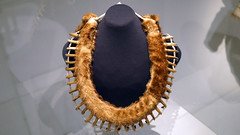


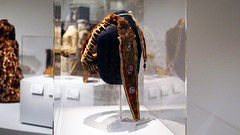

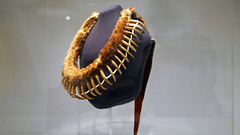
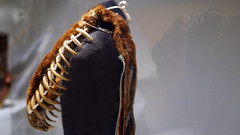
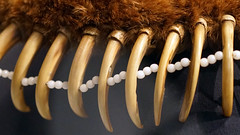


Figure \(\PageIndex{24}\): More Smarthistory images…
Selected Contributors
Seeing America is developed and distributed by Smarthistory together with a consortium of museums, including:
Amon Carter Museum of American Art
Crystal Bridges Museum of American Art
Fine Arts Museums of San Francisco
Los Angeles County Museum of Art
National Museum of the American Indian, Smithsonian Institution
Pennsylvania Academy of Fine Arts
Smithsonian American Art Museum
Terra Foundation for American Art
Wadsworth Atheneum Museum of Art
1895
The closing of the frontier and Remington's The Fall of the Cowboy
Remington mourns the decline of the cowboy by depicting the very thing that destroyed his iconic lifestyle.
The closing of the frontier
The Fall of the Cowboy
by SARA KLEIN, AMON CARTER MUSEUM OF AMERICAN ART and DR. BETH HARRIS
Video \(\PageIndex{7}\): Frederic Remington, The Fall of the Cowboy, 1895, oil on canvas, 24 x 35-1/8 inches (Amon Carter Museum of American Art). Speakers: Sara Klein, Teacher and School Programs Manager, Amon Carter Museum of American Art and Steven Zucker
Test your knowledge with a quiz
Key points
- In the late 19th century, the United States saw the closing of the frontier and the completion of westward expansion.
- Cowboys played an essential role in the ranching industry by driving cattle across the open range in the mid-19th century, but the invention of barbed wire fencing, the increased privatization of land, and the growth of the railroad brought an end to the cowboys’ way of life.
- Remington’s painting uses a monochromatic palette, quiet winter setting, and minimal movement to evoke nostalgia about the end of the era of the cowboy.
- In 1893, Frederick Jackson Turner argued that settlement of the west had ended the frontier era in the United States.
- As the 19th century came to a close, the image of the cowboy began to transform into a mythic persona that reflects a romanticized history of the U.S. frontier.
Go Deeper
Learn about this painting at the Amon Carter Museum of American Art
How did Frederic Remington become such a well known artist?
Where can I read Owen Wister’s 1895 essay “Evolution of the Cow-Puncher” ?
What events led to settlement in the west and the end of the frontier era?
What was it like to be a cowboy?
What factors contributed to the mythologizing of the American West?
What was Frederick Jackson Turner’s “frontier thesis” and why is it important to U.S. history?
More to think about
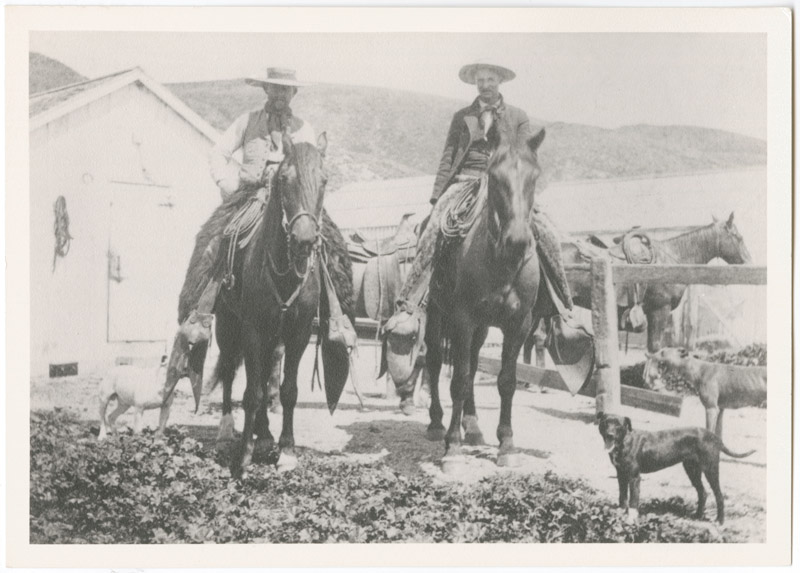
Figure \(\PageIndex{25}\): Santa Anito Rancho, California, c. 1895, 4-7/8 x 6-7/8 inches (California State Library)
Remington’s depictions of cowboy combine details of close observation with idealizations of the American West. Compare this 1895 photograph to Remington’s painting. What is similar? What is different? How does the photograph present cowboys differently than the painting?
Smarthistory images for teaching and learning:


Figure \(\PageIndex{26}\): More Smarthistory images…
Selected Contributors
Seeing America is developed and distributed by Smarthistory together with a consortium of museums, including:
Amon Carter Museum of American Art
Crystal Bridges Museum of American Art
Fine Arts Museums of San Francisco
Los Angeles County Museum of Art
National Museum of the American Indian, Smithsonian Institution
Pennsylvania Academy of Fine Arts
Smithsonian American Art Museum
Terra Foundation for American Art
Wadsworth Atheneum Museum of Art
c. 1925
Cities and pueblos: the search for an authentic America
The Southwest became a hub for artists seeking “quintessentially American” subjects beyond New York and Chicago.
Cities and pueblos
The search for an authentic America
by DR. JENNIFER HENNEMAN, DENVER ART MUSEUM and DR. BETH HARRIS
Video \(\PageIndex{8}\): E. Martin Hennings, Rabbit Hunt, c. 1925, oil on canvas (Denver Art Museum). Speakers: Dr. Jennifer Henneman, Assistant Curator of Western American Art, Denver Art Museum, and Dr. Beth Harris
Test your knowledge with a quiz
Key points
- The Taos Pueblo Indians have maintained residence for centuries in what is now New Mexico. Their history was deeply affected by the Spanish colonial presence.
- The people in the painting wear 20th-century clothing as well as items that refer to their cultural identity as Pueblo people. This imagery disrupts the stereotype of the American Indian as belonging only to the past.
- In the early 20th century, the American Southwest became a popular destination for tourists. Railroads made travel easier and developed marketing materials promoting the region as a site for recreation.
- The landscape and the mix of Taos Pueblo Indians and Hispanic cultures drew academically-trained artists from cities like New York and Chicago. They were looking for fresh and distinctly American subjects that differed from the industrialized places the artists had come from.
Many readers today carry an image of New Mexico seen through the lens of Georgia O’Keeffe’s now famous paintings…But O’Keeffe is only the best-known of an extensive colony of artists drawn to New Mexico by its particular blend of austere beauty, premodern village life, and Pueblo and Hispanic spirituality. Beginning in the 1890s, artists from the East flocked to Taos and Santa Fe in northern New Mexico. Culturally remote from the Euro-dominated eastern half of the nation, New Mexico was, as Charles Lummis put it, “the United States which is not the United States.” Spanning the spectrum from academic to modernist, these artists struggled to anchor the lessons of their European training in native themes. The peasant cultures of Brittany had furnished subject matter for American artists working in France. Returning to the United States, they responded eagerly to the possibilities presented by the Pueblo Indians and Hispanic villagers of the Rio Grande Valley, whose lives seemed to embody a timeless round of earthbound ritual and communal piety.
From the Renaissance to the “new age” movements of the late twentieth century, Europeans have romanticized Native cultures as embodying virtues their own societies were lacking.
From Angela L. Miller, Janet Catherine Berlo, Bryan J. Wolf, and Jennifer L. Roberts, American Encounters: Art, History, and Cultural Identity (Washington University Libraries, 2018), p. 494. CC BY-NC-SA 4.0
Go Deeper
Learn more about this painting at the Denver Art Museum
What are some terms and issues to consider when learning about Native American arts and culture?
What was the Taos Revolt of 1847? How did it demonstrate tensions between the Pueblo and the US government in the 19th century?
Learn about the Fred Harvey Company’s role in promoting tourism in the West
More to think about
Compare Henning’s representation of Native Americans in Rabbit Hunt to photographs by Edward Curtis. How might images of Native Americans have contributed to perceptions about American Indians today?
Smarthistory images for teaching and learning:


Figure \(\PageIndex{27}\): More Smarthistory images…
Selected Contributors
Seeing America is developed and distributed by Smarthistory together with a consortium of museums, including:
Amon Carter Museum of American Art
Crystal Bridges Museum of American Art
Fine Arts Museums of San Francisco
Los Angeles County Museum of Art
National Museum of the American Indian, Smithsonian Institution
Pennsylvania Academy of Fine Arts
Smithsonian American Art Museum
Terra Foundation for American Art
Wadsworth Atheneum Museum of Art
1928
Strange Worlds, immigrant experience in the early 20th century
Geller captures the tensions of the Jewish immigrant experience in the early 20th-century United States.
Strange Worlds
Painting the the Jewish immigrant experience in the early 20th century
by SARAH ALVAREZ, THE ART INSTITUTE OF CHICAGO and DR. STEVEN ZUCKER
Video \(\PageIndex{9}\): Todros Geller, Strange Worlds, 1928, oil on canvas, 71.8 x 66.4 cm (Art Institute of Chicago) Speakers: Sarah Alvarez, Director of School Programs, Department of Learning and Engagement, The Art Institute of Chicago and Steven Zucker
Test your knowledge with a quiz
Key points
- The early twentieth century was a period of mass immigration from Southern and Eastern Europe to the United States.
- Strange Worlds draws on modern European painting by fragmenting forms to suggest the immigrant struggle to adapt to life in the United States.
- Anti-immigration sentiment and nativism arose in the U.S. during the early twentieth century, strengthening groups such as the Klu Klux Klan and prompting laws such as the Johnson-Reed Act of 1924.
- Todros Geller represents aspects of his own experiences as an Eastern European Jew who immigrated to the U.S., but also represents the more general struggle to retain cultural identity in America.
Go Deeper
Learn more about this painting at the Art Institute of Chicago
How did migration and immigration impact life and politics in American cities?
How did the Great Migration change life in northern cities such as Chicago?
Who was Todros Geller and how did his background influence this painting?
More to think about
Like the early twentieth century, immigration to the U.S. has resulted in divisive public rhetoric and political unrest today. How do the issues raised in contemporary discussions around immigration compare to the historical conditions seen in Geller’s painting?
Smarthistory images for teaching and learning:

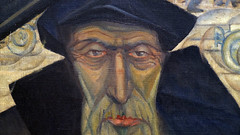
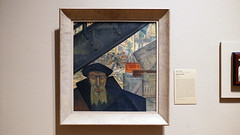


Figure \(\PageIndex{28}\): More Smarthistory images…
Selected Contributors
Seeing America is developed and distributed by Smarthistory together with a consortium of museums, including:
Amon Carter Museum of American Art
Crystal Bridges Museum of American Art
Fine Arts Museums of San Francisco
Los Angeles County Museum of Art
National Museum of the American Indian, Smithsonian Institution
Pennsylvania Academy of Fine Arts
Smithsonian American Art Museum
Terra Foundation for American Art
Wadsworth Atheneum Museum of Art
c. 1930s
Pottery and tourism: Pueblo culture and the lure of the Southwest
Nampeyo found inspiration from the old to create a pottery style that was entirely new and highly sought after.
Pueblo pottery and tourism
Nampeyo found inspiration in the old, to create a striking new style
by DR. DAVID W. PENNEY, NATIONAL MUSEUM OF THE AMERICAN INDIAN, SMITHSONIAN INSTITUTION and DR. STEVEN ZUCKER
Video \(\PageIndex{10}\): Nampeyo (Hopi-Tewa), polychrome jar, c. 1930s, clay and pigment, 13 x 21 cm (National Museum of the American Indian, Smithsonian Institution). Speakers: Dr. David Penney, Associate Director for Museum Scholarship, Exhibitions, and Public Engagement, National Museum of the American Indian and Dr. Steven Zucker
Test your knowledge with a quiz
Key points
- In the early 20th century, indigenous artists—including Nampeyo—helped to create a market for their artwork that became a way of managing relationships between native peoples and Anglo Americans.
- Nampeyo’s pottery, which built on Hopi-Tewa traditions, appealed to Anglo-American collectors as they sought an authentic Native American culture, partly in response to the rise of mass production in the early twentieth century.
- The Pueblo peoples create pottery that draws on traditions passed down through individual families. Pots can be distinguished by the use of local clays and the designs that decorate them.
- The Southwest became a popular travel destination in the early 20th century, spurred on by tour companies in partnership with the railroads that had recently expanded into this area.
Go deeper
Learn more about this pot from the National Museum of the American Indian
Who are the Pueblo people? What is the relationship between Tewa and Hopi Indians?
What was the Pueblo Revolt of 1680?
How did the development of the railroads affect Native American cultures in the American West?
How did the rise in tourism impact the work produced by Native American artists?
More to think about
What does it mean when something is considered “authentic?” Discuss how Nampeyo’s story challenges and/or contradicts notions of authenticity when applied to questions of history, identity, or cultural heritage.
Smarthistory images for teaching and learning:


Figure \(\PageIndex{29}\): More Smarthistory images…
Selected Contributors
Seeing America is developed and distributed by Smarthistory together with a consortium of museums, including:
Amon Carter Museum of American Art
Crystal Bridges Museum of American Art
Fine Arts Museums of San Francisco
Los Angeles County Museum of Art
National Museum of the American Indian, Smithsonian Institution
Pennsylvania Academy of Fine Arts
Smithsonian American Art Museum
1939
Revisiting the myth of George Washington and the cherry tree with Grant Wood
Wood infuses a famous folktale about George Washington with theatricality, humor, and a Gilbert Stuart sample.
George Washington and the cherry tree
A famous myth about George Washington infused with theatrical humor
by DR. SHIRLEY REECE-HUGHES, AMON CARTER MUSEUM OF AMERICAN ART and DR. STEVEN ZUCKER
Video \(\PageIndex{11}\): Grant Wood, Parson Weems' Fable, 1939, oil on canvas, 38 1/8 x 50 1/8 inches (Amon Carter Museum of American Art). Speakers: Dr. Shirley Reece-Hughes, Curator, Amon Carter Museum of American Art and Dr. Steven Zucker
Test your knowledge with a quiz
From the artist
“I sincerely hope this painting will help reawaken interest in the cherry tree and other bits of American folklore that are too good to lose. In our present and unsettled times, when democracy is threatened on all sides, the preservation of our folklore is more important than is generally realized….While our own patriotic mythology has been increasingly discredited and abandoned, the dictator nations have been building up their respective mythologies and have succeeded in making patriotism glamorous.”
Grant Wood, “A Statement from Grant Wood Concerning his Painting Parson Weems’ Fable.” Unpaginated transcript dated January 2, 1940 (Amon Carter Museum of American Art curatorial files)
Key points
- Americans watched the rise of fascism in Europe, and to a lesser extent in the United States, in the late 1930s. The founding stories about American democracy became newly relevant in the face of these threats.
- The fable of the cherry tree was first popularized by Parson Weems in 1806 in his biography of George Washington. This story highlighted the virtues of truth-telling and further enhanced Washington’s status as national icon.
- Grant Wood’s theatrical portrayal of this fable is rooted in his work on the stage earlier in his career.
In the years between the wars, Regionalism in the visual arts came to be most directly identified with a widely celebrated triumvirate of painters: Grant Wood, John Steuart Curry, and Thomas Hart Benton. Benton’s self-portrait was on the cover of Time magazine in 1934. Dramatically varied in style, these artists shared a belief that art is most vital when it expresses the particularities of a locality. The Regionalism of Wood, Curry, and Benton also shared with other art forms in these decades between the wars a sense of art’s obligation to shape popular histories, beliefs, and legends. Regionalism was about public memory and collective identity; artists were mythmakers, not only reflecting but also creating a sense of place.
Yet from the 1930s up to the present, the regional themes of Wood, Curry, and Benton have raised suspicions about their conservative social values and rejection of modernism. These suspicions first took shape in the charged international climate of emerging fascism. To some, Regionalism represented a dangerously isolationist, regressive, and anti-modern impulse in art that paralleled the Nazi art of the Third Reich. Regionalism and its foremost apologist, the art critic Thomas Craven, had set its course against European modernism, with its formal distortions and anti-naturalistic interests. Its anti-modern stance linked it to the Nazi propagandizing against the “degenerate art” of the German Expressionists and other modernists.
Was there any validity to these claims that the Regionalists were first cousins to the blindly xenophobic artists who served Hitler’s Reich? The questions are still debated, but the evidence suggests otherwise. All three artists called for an indigenous expression as far removed as possible from the abstractions of blind patriotism. Rejecting provincialism (a narrow attachment to one’s place of birth), all three artists shared a belief that art stemmed from experience, and was most powerful when tied to what the artist himself knew directly. Despite their dismissal of modernism, Wood, Benton, and Curry were all urban-trained artists who had traveled widely, studied the artistic traditions of Europe, and had an understanding of how painting had evolved since Impressionism. (page 490)
In 1939 Hitler invaded Poland, the opening act of World War II. In that year Wood painted Parson Weems’ Fable. A child’s storybook fable of exemplary honesty (George Washington as a child admits his naughty deed to his father), it was popularized by Washington’s most famous biographer, Parson Weems, who stands outside the scene pulling aside a theatrical curtain. The head of the young Washington is that of Gilbert Stuart’s famous painting of the first president as a bewigged old man-an iconic image universally known by its use on the dollar bill. So wide was its circulation that Stuart’s portrait has itself displaced in national memory the historical figure of George Washington as a young boy (or so Wood suggests). In the background of the scene, two slaves are shown picking fruit from a cherry tree, an allusion to the gap between myth and social reality in our national imagination.
Parson Weems’ Fable calls attention to the ways in which our understanding of the past is mediated—literally framed-by representations, by stories within stories, like a series of Chinese boxes. With its toy-like landscape, deliberately naïve presentation, and tale-within-a-tale structure, Parson Weems’ Fable reveals how we construct our national myths, and witnesses the framing power of stories and legends in shaping our collective identity. Unlike the painters of the German Reich, Wood recognized the “folk” as an invented concept, the product not of some essential race identity grounded in the soil, but of stories told and retold, tales whose “authenticity” was itself a product of a nation-state that required unifying myths. Parson Weems’ Fable pointedly exposes the mechanisms of cultural myth rather than presenting them as transparent truths. Among those who collected Wood’s work were a number of Hollywood actors and directors, who, like him, engaged myths with humor and irony. (pages 491-492)
From Angela L. Miller, Janet Catherine Berlo, Bryan J. Wolf, and Jennifer L. Roberts, American Encounters: Art, History, and Cultural Identity (Washington University Libraries, 2018). CC BY-NC-SA 4.0
Go deeper
Learn more about this painting at the Amon Carter Museum of Art
Where can I read Parson Weems’s fable?
Where can I access Parson Weems’s entire biography of Washington?
More to think about
Wood was associated with American Regionalism, an art movement that focused on the heartland as a symbol of national values and cultural identity. Discuss whether you think Parson Weems’s Fable upholds this idea of wholesome American values or if it offers more critical commentary about the United States in the late 1930s. Which details support your conclusion?
Smarthistory images for teaching and learning:


Figure \(\PageIndex{30}\): More Smarthistory images…
Selected Contributors
Seeing America is developed and distributed by Smarthistory together with a consortium of museums, including:
Amon Carter Museum of American Art
Crystal Bridges Museum of American Art
Fine Arts Museums of San Francisco
Los Angeles County Museum of Art
National Museum of the American Indian, Smithsonian Institution
Pennsylvania Academy of Fine Arts
Smithsonian American Art Museum
1948
Harlem 1948, Ralph Ellison, Gordon Parks and the photo essay
Gordon Parks and the writer Ralph Ellison collaborated to show that Harlem is everywhere.
Ralph Ellison, Gordon Parks, and Harlem
Harlem is Nowhere, a photo-essay collaboration
by MICHAL RAZ-RUSSO, ART INSTITUTE OF CHICAGO and DR. STEVEN ZUCKER
Video \(\PageIndex{12}\): Gordon Parks, Off on My Own (Harlem, New York), 1948, gelatin silver print (The Art Institute of Chicago, Amanda Taub Veazie Acquisition Fund, 2016.125) © The Gordon Parks Foundation. From "Harlem is Nowhere," a collaborative project between Gordon Parks and Ralph Ellison. Special thanks to Michal Raz-Russo, Sarah E. Alvarez, The Gordon Parks Foundation, the Ralph and Fanny Ellison Charitable Trust, and the Art Institute of Chicago.
Test your knowledge with a quiz
Key points
- The mass media’s portrayal of urban spaces like Harlem in the years after World War II often reinforced negative stereotypes of African Americans. Photographer Gordon Parks and writer Ralph Ellison wanted to offer corrective views of African American life in the popular press. This led them to collaborate on the 1948 essay “Harlem is Nowhere.”
- The text of the essay focused on the Lafargue Clinic, the first non-segregated psychiatric clinic in New York. Ellison argued that segregation and racism were having negative psychological effects on African Americans, and that problems present in Harlem represented larger systemic issues across America. These are issues he would tackle in his famous book, Invisible Man.
- The photographs by Parks were not meant to illustrate the essay. They present their own visual argument about the tensions around race in both Harlem and the United States more broadly by portraying the psychological and societal difficulties that were a daily part of the African American experience.
Go deeper
Learn more about this photo from the Art Institute of Chicago
Visit the website of the Gordon Parks Foundation
Read an excerpt from “Harlem is Nowhere”
Learn more about the collaboration between Parks and Ellison from the Art Institute of Chicago
Learn about the development of suburbs in the post-war era
See some of Parks’s photographs for LIFE Magazine and others
Read an interview with Gordon Parks
Learn about the life of Ralph Ellison
See videos and other primary sources about Invisible Man
More to think about
Re-read the caption that Ellison wrote for this photograph:
“Who am I? Where am I? How do I come to be? Behind endless walls of his ghetto, man searches for social identity. Refugees from southern feudalism, many Negroes wander dazed in the mazes of northern ghettos, the displaced persons of American democracy.”
Which details of Parks’s image seem specifically addressed by Ellison’s caption? How do you think Ellison’s choice of words affects the way we interpret the photograph?
Selected Contributors
Seeing America is developed and distributed by Smarthistory together with a consortium of museums, including:
Amon Carter Museum of American Art
Crystal Bridges Museum of American Art
Fine Arts Museums of San Francisco
Los Angeles County Museum of Art
National Museum of the American Indian, Smithsonian Institution
Pennsylvania Academy of Fine Arts
Smithsonian American Art Museum
1954-55
Icon and irony: Jasper Johns, Flag
by SAL KHAN and DR. STEVEN ZUCKER
Video \(\PageIndex{13}\): Jasper Johns, Flag, 1954-55 (dated on reverse 1954), encaustic, oil, and collage on fabric mounted on plywood, three panels, 42-1/4 x 60-5/8" / 107.3 x 153.8 cm (MoMA)
Key points
- The image is painted in encaustic, which allows the viewer to see the layers of newspaper beneath the painted surface. This process reflects the dense history and complex meaning embedded in the symbol of the American flag.
- As a precursor to Pop Art of the 1960s, Johns was one of the first artists to make art based on common everyday objects.
- By representing a flag, Johns eliminated the artist’s subjective role to choose color and forms to express an idea, and thus forces us to reconsider these things traditionally valued in art.
Go deeper
Jasper Johns on The Metropolitan Museum of Art’s Heilbrunn Timeline of Art History
Deborah Solomon, “Jasper Johns Still Doesn’t Want to Explain His Art,” The New York Times (2018)
Smarthistory images for teaching and learning:
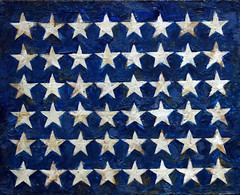
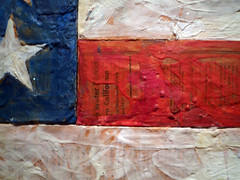
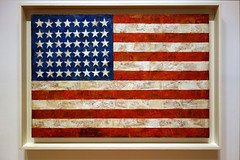
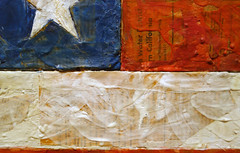


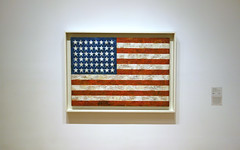
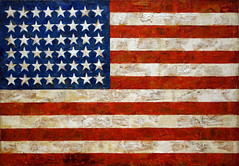
Figure \(\PageIndex{31}\): More Smarthistory images…
Selected Contributors
Seeing America is developed and distributed by Smarthistory together with a consortium of museums, including:
Amon Carter Museum of American Art
Crystal Bridges Museum of American Art
Fine Arts Museums of San Francisco
Los Angeles County Museum of Art
National Museum of the American Indian, Smithsonian Institution
Pennsylvania Academy of Fine Arts
Smithsonian American Art Museum
1958
From wire to weightlessness: Ruth Asawa, Untitled
Asawa was interned in World War II, but we must be careful about interpreting her artworks as related to that trauma.
From wire to weightlessness
Interned in World War II, Ruth Asawa went on to become a modernist sculptor
by ALLISON GLENN, CRYSTAL BRIDGES MUSEUM OF AMERICAN ART, and DR. BETH HARRIS
Video \(\PageIndex{14}\): Ruth Asawa, Untitled, c. 1958, iron wire, 219.7 × 81.3 × 81.3 cm (Crystal Bridges Museum of American Art, © Estate of Ruth Asawa)
Test your knowledge with a quiz
Key points
- Following the Japanese attack on Pearl Harbor in December 1941, Franklin D. Roosevelt ordered the forced relocation of more than 100,000 Japanese Americans, many of whom were American citizens—among them, Ruth Asawa. These Americans were imprisoned in internment camps, often secured with barbed wire and guard towers.
- Works of art created by artists who come from marginalized groups (including women and people of color), are often explained in terms of their biographies and histories of trauma. While historians have connected Asawa’s use of wire to her time in internment camps, these sculptures are also based on her artistic experiences at Black Mountain College and teaching in Mexico.
- Asawa’s wire sculptures transform a mundane and unattractive material into weightless, organic shapes that create movement. The sculptures, especially when seen in groups, reflect a mid-20th-century shift in the expectations and materials of fine art to create a more immersive and participatory experience.
Go deeper
Learn more about this work from Crystal Bridges Museum of American Art
Learn more about Black Mountain College
See official documents and government photographs about life in the internment camps from the National Archives and DPLA
Learn about the legal structures that allowed for Japanese internment
Read some of the publications created by Japanese-American detainees
More to think about
Why do you think art historians have been more inclined to discuss biography and personal life when it comes to the work of women artists than male artists?
Selected Contributors
Seeing America is developed and distributed by Smarthistory together with a consortium of museums, including:
Amon Carter Museum of American Art
Crystal Bridges Museum of American Art
Fine Arts Museums of San Francisco
Los Angeles County Museum of Art
National Museum of the American Indian, Smithsonian Institution
Pennsylvania Academy of Fine Arts
Smithsonian American Art Museum
1966
Identity and civil rights in 1960s America
Does the figure emerge from the stripes of the flag, or do they imprison him?
by ROBYN FARRELL, THE ART INSTITUTE OF CHICAGO and DR. BETH HARRIS
Video \(\PageIndex{15}\): Benny Andrews, Flag Day, 1966, oil on canvas, 53.3 x 40.6 cm ©The Benny Andrews Estate (The Art Institute of Chicago). Speakers: Robyn Farrell, Assistant Curator of Contemporary Art, The Art Institute of Chicago, and Beth Harris
Test your knowledge with a quiz
Key points
- In the 1960s, the Civil Rights movement promised greater equality for African-Americans, who struggled for visibility and equal rights.
- It isn’t clear how Andrews intends us to interpret the relationship between the man and the American flag in this painting. The flag may symbolize the promise of freedom and democracy, or it may suggest that the United States remains a hostile environment for African-Americans.
- The artist’s experience as the son of sharecroppers in Georgia and in the racially-divided New York art world led him to advocate for greater equality in society, as well as within the cultural sector.
Go deeper
Learn more about this painting at the Art Institute of Chicago
Learn more about Benny Andrews
See primary source and multimedia documents about the Civil Rights Act
See primary source documents about the Voting Rights Act of 1965
What was the impact of the Harlem on My Mind exhibition on the art world?
See primary source documents on the Black Emergency Cultural Coalition
More to think about
The 1960s was an era of protest by many different groups, many of which used art in their campaigns. For an artist involved in activist causes, why do you think Benny Andrews left the meaning of Flag Day so unclear?
Smarthistory images for teaching and learning:


Figure \(\PageIndex{32}\): More Smarthistory images…
Selected Contributors
Seeing America is developed and distributed by Smarthistory together with a consortium of museums, including:
Amon Carter Museum of American Art
Crystal Bridges Museum of American Art
Fine Arts Museums of San Francisco
Los Angeles County Museum of Art
National Museum of the American Indian, Smithsonian Institution
Pennsylvania Academy of Fine Arts
Smithsonian American Art Museum
2014
Speaking to past and present, Clarissa Rizal’s Resilience Robe
This prestigious garment follows a traditional design passed down through generations of indigenous Alaskans.
Chilkat past and present
Clarissa Rizal's Resilience Robe speaks to indigenous Alaska
by LILY HOPE AT PORTLAND ART MUSEUM and DR. BETH HARRIS
Video \(\PageIndex{16}\): Clarissa Rizal, Resilience Robe, 2014, merino wool, 64 x 53 inches (Portland Art Museum)
Test your knowledge with a quiz
Key points
- Clarissa Rizal (the mother of Lily Hope, the speaker in the video) was a Chilkat weaver who was part of the Tlingit tribe of Southeast Alaska. Chilkat is a traditional form of weaving that originated among the Tlingit and other tribes in this area. Robes like this one are worn by high-ranking members of the community during important dances and ceremonies.
- The creation of a Chilkat robe requires many months or even years of labor. The wool is hand spun and then expertly woven on a loom where the threads are attached only at the top. The techniques used in Chilkat weaving are passed down through generations of female weavers.
- Chilkat weaving is traditionally done only by women, but it incorporates formline imagery (curvilinear shapes) that can also be seen in the Northwest Coast wood carving that is typically done by men. This particular robe incorporates both traditional and modern motifs (such as the important tribal symbols of eagle and raven, as well as European ships and museum doors) to express the resilience and continued strength of the Tlingit people.
Go deeper
Learn more about Chilkat weaver Lily Hope
What is the history of Chilkat weaving?
What is the history of the Tlingit people?
What is life like today in the ancestral Tlingit village of Klukwan, Alaska?
Find resources about Southeast Alaskan Native culture from the Sealaska Heritage Institute
More to think about
Chilkat weaving demonstrates how the Tlingit people preserve their cultural identity by teaching successive generations the traditional art of Chilkat weaving. What are some other examples of passing on traditions to maintain cultural heritage? How might this practice among different cultures in the United States reveal the nation’s historical shifts and changing notions of individual or national identity over time?
Selected Contributors
Seeing America is developed and distributed by Smarthistory together with a consortium of museums, including:
Amon Carter Museum of American Art
Crystal Bridges Museum of American Art
Fine Arts Museums of San Francisco
Los Angeles County Museum of Art
National Museum of the American Indian, Smithsonian Institution
Pennsylvania Academy of Fine Arts
Smithsonian American Art Museum
2014
Wendy Red Star, 1880 Crow Peace Delegation
Red Star annotated photographs to restore dignity and context to government-issue photographs of Crow chiefs.
Restoring meaning to Crow chiefs
Wendy Red Star reinscribes history
by WENDY RED STAR AT PORTLAND ART MUSEUM and DR. STEVEN ZUCKER
Video \(\PageIndex{17}\): Wendy Red Star, 1880 Crow Peace Delegation: Peelatchiwaaxpáash/Medicine Crow (Raven), Peelatchixaaliash/Old Crow (Raven), Déaxitchish/Pretty Eagle, Bia Eélisaash/Large Stomach Woman (Pregnant Woman) aka Two Belly, Alaxchiiaahush/Many War Achievements or Plenty Coups aka Chíilaphuchissaaleesh/Buffalo Bull Facing The Wind, 2014, 10 inkjet prints and red ink on paper, 16 15/16 x 11 15/16 inches (each) © Wendy Red Star (Portland Art Museum)
Test your knowledge with a quiz
Key points
- The Crow Peace Delegation of 1880 included Medicine Crow and five other chiefs who traveled to Washington DC to discuss land rights and negotiations over building the Northern Pacific Railroad through Crow territory.
- Although these are portraits of individual chiefs, the photographs reflect the deliberate erasure of Native American culture that served to dehumanize the Crow and other indigenous peoples in the U.S. The use of these images in popular reproductions today continues the practice of outsiders commercializing Indian identity.
- Red Star uses her artistic process to assert each man’s individual identity and accomplishments, as well as to learn more about her own culture as a Crow Indian and to share it with others.
Go deeper
Learn about this object at the Portland Museum of Art
Visit Wendy Red Star’s website
More to think about
Wendy Red Star’s commentary on these images restore specific and personal details of Medicine Crow and his colleagues that were erased in both the original photographs and their reinterpretations in popular culture. She creates a fuller and more complicated history by adding information that an outsider may not know. Think about photographs of your family that reflect your cultural heritage or personal stories. What details are excluded from the image, or might be unknown to an outsider? How might you annotate a document from your own history so that it tells a more complete story?
Selected Contributors
Seeing America is developed and distributed by Smarthistory together with a consortium of museums, including:
Amon Carter Museum of American Art
Crystal Bridges Museum of American Art
Fine Arts Museums of San Francisco
Los Angeles County Museum of Art
National Museum of the American Indian, Smithsonian Institution
Pennsylvania Academy of Fine Arts
Smithsonian American Art Museum
2015
Nari Ward, We the People (black version)
Hundreds of shoelaces form just three words. Here, the artist takes an abstract idea and makes it immediate.
by DR. MINDY BESAW, CRYSTAL BRIDGES MUSEUM OF AMERICAN ART and DR. STEVEN ZUCKER
Video \(\PageIndex{18}\): Nari Ward, We the People (black version), 2015, shoelaces, 8 × 27 feet (Crystal Bridges Museum of American Art), a Seeing America video
Test your knowledge with a quiz
Key points
- “We the People” is the introductory line to the Preamble of the Constitution that boldly declared the right of people of the United States to govern themselves. Still, when it was written in 1787, the “people” was narrowly defined and did not necessarily include women, African-Americans, Native Americans, or those who did not own land.
- Nari Ward uses a common material, shoelaces, to evoke the many different people who are today brought together in the phrase “We the People.”
- By using the draping shoelaces to define the old-fashioned calligraphic script, Ward obscures the words slightly. In this way, he encourages the viewer to pause and perhaps reconsider this familiar text.
Go deeper
Learn more about this work from Crystal Bridges Museum of American Art
Watch Nari Ward discuss We The People in a 2017 video interview
Look at an online exhibition of Ward’s work at Philadelphia’s Fabric Workshop and Museum
More to think about
Nari Ward’s We The People demonstrates how contemporary art often asks viewers to think more critically about everyday things that we may take for granted. Can you think of another important icon of American culture that has become commonplace and taken for granted, and that should be examined more carefully?
Smarthistory images for teaching and learning:
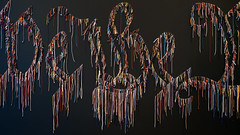


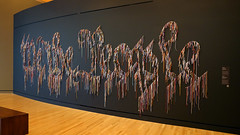
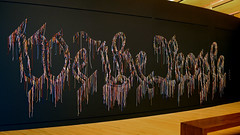



Figure \(\PageIndex{33}\): More Smarthistory images…
Selected Contributors
Seeing America is developed and distributed by Smarthistory together with a consortium of museums, including:
Amon Carter Museum of American Art
Crystal Bridges Museum of American Art
Fine Arts Museums of San Francisco
Los Angeles County Museum of Art
National Museum of the American Indian, Smithsonian Institution
Pennsylvania Academy of Fine Arts
Smithsonian American Art Museum
This page titled 13.1: American and National identity was last modified on Mon, 04 Oct 2021 15:49:38 GMT and is shared under a CC BY-NC-SA 4.0 license and was authored, remixed, and/or curated by Smarthistory.
The book could not be loaded just now.