Opening the book…
Watch this introduction to Nineteenth-Century Art, focusing on Romanticism:
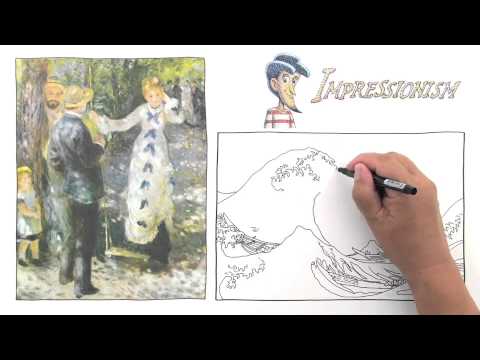
The link to this video is provided at the bottom of this page.
On Romanticism
Romanticism was the first major stylistic development in nineteenth-century art.
As is fairly common with stylistic rubrics, the word “Romanticism” was not developed to describe the visual arts but was first used in relation to new literary and musical schools in the beginning of the nineteenth century. Art came under this heading only later. Think of the Romantic literature and musical compositions of the early nineteenth century. The poetry of Lord Byron, Percy Shelley, and William Wordsworth and the scores of Beethoven, Richard Strauss, and Chopin (by the way, the pianist Chopin and the painter Delacroix were friends) are concerned with the spectrum and intensity of human emotion.
Even if you do not regularly listen to classical music, you’ve heard plenty of music by these composers. In his epic film, 2001: A Space Odyssey, the late director Stanley Kubrick used Strauss’s Thus Spake Zarathustra (written in 1896, Strauss based on Friedrich Nietzsche’s book of the same name). Kubrick’s A Clockwork Orange similarly uses the sweeping ecstasy and drama of Beethoven’s Ninth Symphony, in this case to intensify the cinematic violence of the film.
Listen
An audio element has been excluded from this version of the text. You can listen to it online here: pb.libretexts.org/history2/?p=374
Strauss’s Thus Spake Zarathustra
An audio element has been excluded from this version of the text. You can listen to it online here: pb.libretexts.org/history2/?p=374
Beethoven’s Ninth Symphony (as used in the Anthem of Europe)
Romantic music expressed the powerful drama of human emotion: anger and passion, but also quiet passages of pleasure and joy. So too, the French painter Eugene Delacroix and the Spanish artist Francisco Goya broke with the cool, cerebral idealism of David and Ingres’ Neo-Classicism. They sought instead to respond to the cataclysmic upheavals that characterized their era with line, color, and brushwork that was more physically direct, more emotionally expressive.
Contributors
- Introduction to 19th Century Art. Provided by: Khan Academy. Located at: https://web.archive.org/web/20141006214923/http://smarthistory.khanacademy.org/1800-1848-Industrial-Revolution-I.html. License: CC BY-NC-SA: Attribution-NonCommercial-ShareAlike
- Richard Strauss - Also Sprach Zarathustra. Authored by: Kevin MacLeod. Provided by: incompetech.com. Located at: https://en.Wikipedia.org/wiki/File:Richard_Strauss_-_Also_Sprach_Zarathustra.ogg. License: CC BY: Attribution
- TICE ART 1010 Nineteenth Century Art. Authored by: Nancy Ross. Located at: https://youtu.be/XdYgyO0RmFI. License: All Rights Reserved. License Terms: Standard YouTube License
- Anthem of Europe (US Navy instrumental short version). Authored by: Ludwig van Beethoven; performed by US Navy Band. Located at: https://en.Wikipedia.org/wiki/File:Anthem_of_Europe_(US_Navy_instrumental_short_version).ogg. License: Public Domain: No Known Copyright
10.7: Introduction to Romanticism is shared under a CC BY-NC-SA 4.0 license and was authored, remixed, and/or curated by LibreTexts.
The book could not be loaded just now.