Opening the book…
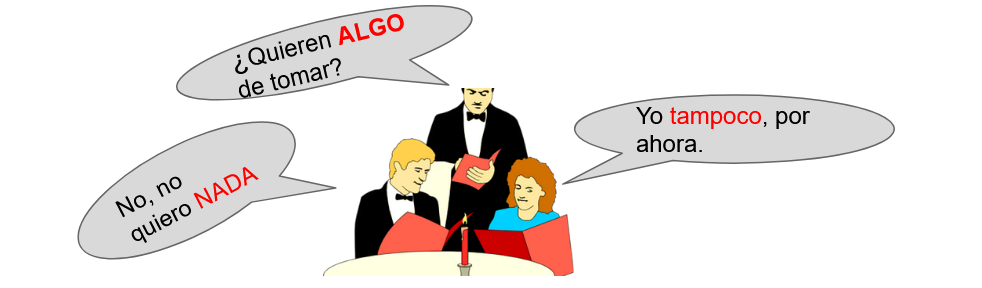
- Indefinite words refer to people and things that are not specific. For example, someone or something.
- Negative words deny the existence of people and things or contradict statements. For example, no one or nothing.
- Spanish indefinite words have the corresponding negative words (which are opposite in meaning)
Indefinite (Affirmative) and Negative Words
| Indefinite (Affirmative) Words | |
|---|---|
| algo | something; anything |
| alguien | someone; somebody; anyone |
| alguno/a (s), algún | some; any |
| siempre | always |
| también | also; too |
| o…o | either… or |
| Negative Words | |
|---|---|
| nada | nothing; not anything |
| nadie | no one; nobody; not anyone |
| ninguno/a, ningún | no; none; not any |
| nunca; jamás | never; not ever |
| tampoco | neither; not either |
| ni….ni | neither… nor |
There are TWO ways to form negative sentences in Spanish:
1. Place the negative word (e.g., nada, nadie, nunca) before the verb.
En mi casa, NADIE se levanta temprano.
At my house, no one gets up early.
Yo NUNCA me ducho por las mañanas.
I never take a shower in the mornings.
2. Place NO before the verb and the negative word after.
En mi casa, NO se levanta temprano NADIE.
At my house, no one gets up early.
Yo NO me ducho por la mañanas NUNCA.
I never take a shower in the mornings.
- ¡Atención! Note that ALGUNO (A) can be used in the plural form, but NINGUNO (A) can not be use in the plural form.
- ¡Atención! Before a masculine singular noun, ALGUNO and NINGUNO are shortened to ALGÚN and NINGÚN.
-¿Tienes algún amigo colombiano?
-No, no tengo ningún amigo colombiano.
Actividad # 1
Change the following statements to negatives. Follow the example.
Ejemplo:
Siempre me visto muy bien.
Nunca me visto muy bien.
No me visto muy bien nunca.
1. Alguien se ducha con agua fría.
__________ se ducha con agua fría.
_____ se ducha con agua fría ___________.
2. Ellas también se maquillan todos los días.
Ellas ____________ se maquillan todos los días.
Ellas ______ se maquillan todos los días _____________.
3. Algunas personas se quitan los zapatos en la casa.
______________ persona se quita los zapatos en la casa.
4. La profesora hace algo al final de la clase.
La profesora _____ hace ________ al final de la clase.
5. Tú y yo nos levantamos temprano.
____ tú _____yo nos levantamos temprano.
6. Yo siempre me lavo las manos antes de comer.
Yo ___________ me lavo las manos antes de comer.
Yo _______ me lavo las manos antes de comer __________.
¡Inténtalo!
Actividad # 2
No estoy de acuerdo (I don’t agree). Change the following statements or questions to express the most logical opposite idea.
Ejemplo:
Yo SIEMPRE me levanto a las seis de la mañana.
Yo NUNCA me levanto a las seis de la mañana.
- Ella nunca se ducha por la mañana.
___________________________________________________ - Nosotros tenemos algunos amigos mexicanos.
___________________________________________________ - Mi hermana va a España y yo quiero ir a España también.
___________________________________________________ - ¿Hay algún restaurante bueno por aquí?
___________________________________________________ - ¿Quieres comer en este restaurante o en aquel?
___________________________________________________ - Nadie va a ayudarme a cocinar.
___________________________________________________
¡Inténtalo!
Actividad # 3
Entrevista: Mis gustos. With a partner, take turns asking and answering questions about how often you like to do the following activities. Use the expressions:
siempre (always) algunas veces (sometimes)
casi nunca (almost never) nunca (never)
Ejemplo:
Levantarse a las cinco de la mañana.
E1: ¿Te gusta levantarte a las 5 de la mañana?
E2: ¡Nunca! Me gusta dormir hasta tarde (until late) -or- Casi nunca me levanto a las 5 de la mañana.
| ¿Te gusta… | Siempre | Algunas veces | Casi nunca | Nunca |
|---|---|---|---|---|
| …ducharte con agua fría? | ||||
| …leer antes de dormirte? | ||||
| …cepillarte los dientes después de comer? | ||||
| …lavarte el pelo con jabón? | ||||
| …peinarte en el carro? | ||||
| …usar el despertador en las mañanas? | ||||
| …despertarte temprano los domingos? |
This page titled 8.6: Gramática- Indefinite and negative words (expresiones indefinidas y negativas) was last modified on Thu, 22 Oct 2026 17:25:34 GMT and is shared under a CC BY-NC 4.0 license and was authored, remixed, and/or curated by Maria Y. Martell via source content that was edited to the style and standards of the LibreTexts platform.
The book could not be loaded just now.