Opening the book…
To be ferroelectric, a material must possess a spontaneous dipole moment that can be switched in an applied electric field, i.e. spontaneous switchable polarisation. This is found when two particles of charge q are separated by some distance r, i.e.:
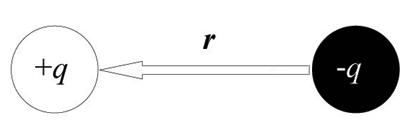
The dipole moment, μ is:
\[ \mu = q r \]
In a ferroelectric material, there is a net permanent dipole moment, which comes from the vector sum of dipole moments in each unit cell, Σμ. This means that it cannot exist in a structure that has a centre of symmetry, as any dipole moment generated in one direction would be forced by symmetry to be zero. Therefore, ferroelectrics must be non-centrosymmetric. This is not the only requirement however. There must also be a spontaneous local dipole moment (which typically leads to a macroscopic polarisation, but not necessarily if there are domains that cancel completely). This means that the central atom must be in a non-equilibrium position. For example, consider an atom in a tetrahedral interstice.
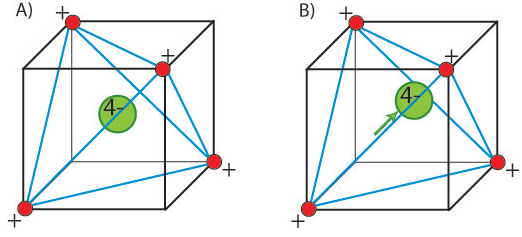
In (A) the structure is said to be non-polar. There is no displacement of the central atom, and no net dipole moment. In (B) however, the central atom is displaced and the structure is polar. There is now an inherent dipole moment in the structure. This results in a polarisation.
This page titled 28.2: The Dipole Moment was last modified on Thu, 24 Aug 2023 21:18:01 GMT and is shared under a CC BY-NC-SA 2.0 license and was authored, remixed, and/or curated by Dissemination of IT for the Promotion of Materials Science (DoITPoMS) via source content that was edited to the style and standards of the LibreTexts platform.
The book could not be loaded just now.