Opening the book…
Before considering sources of feedstocks, it is useful to consider how those feedstocks can be used in the least polluting, most sustainable way possible. Feedstocks are modified by chemical processes to produce new chemical materials with commercial uses. The ideal feedstock is renewable and poses no hazards. And it can be converted to the desired product using few steps with 100% yield and 100% atom economy. This should be done with minimum quantities of reagent using only safe media in which the reaction occurs.
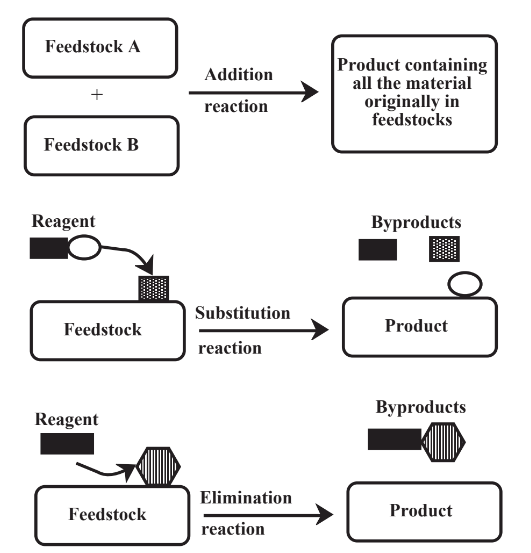
There are three major categories of reactions that are involved in chemical processing of feedstocks as shown in a general sense in Figure 14.1. In an addition reaction, all feedstock material becomes part of the product and there are no byproducts. These are the best kinds of reactions from the viewpoint of green chemistry because, when they work ideally, there are no wastes. A substitution reaction uses a reagent to replace a functional group on the feedstock molecule. As its name implies, an elimination reaction removes a functional group from a feedstock molecule. Both of these latter kinds of reactions produce byproduct materials from the feedstock and from spent reagent. Their impacts can be reduced by reclaiming byproducts, if a use can be found for them, and by regenerating reagent, when that is possible. In some cases,elimination reactions can be carried out without use of a reagent, reducing the impact of this kind of reaction.
This page titled 14.2: Utilization of Feedstocks was last modified on Sun, 08 Mar 2026 07:04:58 GMT and is shared under a CC BY-NC-SA 4.0 license and was authored, remixed, and/or curated by Stanley E. Manahan.
The book could not be loaded just now.