Opening the book…
Now that we understand why intermolecular forces exist, we can use them to explain many of the physical properties of substances. Although molecules differ in size, shape, and polarity, the underlying question is always the same:
How strongly are neighboring particles attracted to one another?
In general, stronger intermolecular forces require more energy to overcome. As a result, substances with stronger intermolecular forces tend to have higher boiling points, higher melting points, greater surface tension, and higher viscosity. They also tend to evaporate more slowly and have lower vapor pressures.
Instead of memorizing each property separately, it is often helpful to ask:
What intermolecular force explains this property?
The answer to that question provides the key to understanding the behavior of liquids and molecular solids.
Boiling Point
The boiling point is the temperature at which a liquid changes into a gas. During boiling, molecules must completely overcome the intermolecular forces holding them together in the liquid phase. Consequently, substances with stronger intermolecular forces require more energy to separate the molecules and therefore have higher boiling points.
For example, methane (CH₄) experiences only London dispersion forces and boils at a much lower temperature than methanol (CH₃OH), which is capable of hydrogen bonding.
Melting Point
The melting point is the temperature at which a solid changes into a liquid. Before molecules can move freely in the liquid phase, some of the intermolecular forces that hold neighboring particles in their fixed positions must be overcome.
In general, stronger intermolecular forces produce higher melting points, although crystal structure and molecular shape can also influence how efficiently molecules pack together in the solid state.
Vapor Pressure and Evaporation
Even below the boiling point, some molecules at the surface of a liquid possess enough kinetic energy to escape into the gas phase. This process is called evaporation.
Liquids with weak intermolecular forces lose molecules more easily and therefore evaporate more rapidly. Because more molecules enter the gas phase, these liquids also develop a higher vapor pressure.
In contrast, liquids with strong intermolecular forces retain their molecules more effectively. They evaporate more slowly and have lower vapor pressures.
Thus, vapor pressure and intermolecular force strength are inversely related:
- Stronger intermolecular forces → lower vapor pressure
- Weaker intermolecular forces → higher vapor pressure
Surface Tension
Molecules at the surface of a liquid experience fewer attractive interactions than molecules within the interior of the liquid. As a result, the surface behaves like a stretched elastic film, a property known as surface tension.
Liquids with stronger intermolecular forces exhibit higher surface tension because the molecules attract one another more strongly. Water is a familiar example. Its extensive hydrogen-bonding network produces an unusually high surface tension, allowing small insects to walk across its surface and causing water droplets to bead together.
Viscosity
Viscosity describes a liquid's resistance to flowing. Molecules that strongly attract one another cannot easily slide past their neighbors, producing a more viscous liquid.
Liquids with weaker intermolecular forces flow readily and have low viscosity, whereas liquids with stronger intermolecular forces have higher viscosity.
For example, glycerol, which contains three hydroxyl (-OH) groups capable of extensive hydrogen bonding, is much more viscous than ethanol.
Connecting Physical Properties to Intermolecular Forces
Rather than memorizing individual trends, remember the following general relationship:
| Property | Stronger Intermolecular Forces |
|---|---|
| Boiling point | ↑ Higher |
| Melting point | ↑ Higher |
| Vapor pressure | ↓ Lower |
| Evaporation rate | ↓ Slower |
| Surface tension | ↑ Higher |
| Viscosity | ↑ Higher |
Challenge Question:
Which intermolecular force best explains each of the following observations?
- Water beads up on a freshly waxed car.
- Rubbing alcohol evaporates quickly from your skin.
- Honey pours much more slowly than water.
- Methanol has a much higher boiling point than methane.
- Carbon dioxide is a gas at room temperature, whereas iodine is a solid.
Worked Examples:
One of the most useful applications of intermolecular forces is predicting physical properties such as boiling point. In general, molecules with stronger intermolecular forces require more energy to separate from one another and therefore have higher boiling points.
To compare boiling points, first identify the intermolecular forces present in each molecule. Then compare the relative strengths of those forces. If two molecules possess the same dominant intermolecular force, compare their molecular size (molar mass) and shape (surface area), since larger, more polarizable molecules generally exhibit stronger London dispersion forces.
General Guidelines for Comparing Boiling Points
- All molecules experience London dispersion forces.
- Polar molecules also experience dipole-dipole interactions.
- Molecules containing O–H, N–H, or F–H bonds can participate in hydrogen bonding, which generally produces the strongest intermolecular attractions between neutral molecules.
- If two molecules have the same dominant intermolecular force, the molecule with the larger electron cloud (greater polarizability), higher molar mass, or greater surface area generally has the higher boiling point.
Rank the following molecules from the highest boiling point to the lowest boiling point.

Solution
We can start with the assumption that these molecules each have London dispersion forces. To determine the polarity, we could start by drawing Lewis structures. However, these three molecules are made up of only carbon and hydrogen atoms. We know that carbon-hydrogen bonds are nonpolar. So regardless of the molecular geometry, there will be no net dipole. Because all three molecules are nonpolar, London dispersion forces are the only significant intermolecular force present. The larger molecules contain more electrons and are more polarizable, resulting in progressively stronger London dispersion forces. CH3CH2CH3 has the highest molecular weight and will have the highest boiling point. CH4 has lowest molecular weight and will have the lowest boiling point.
CH3CH2CH3 > CH3CH3 > CH4
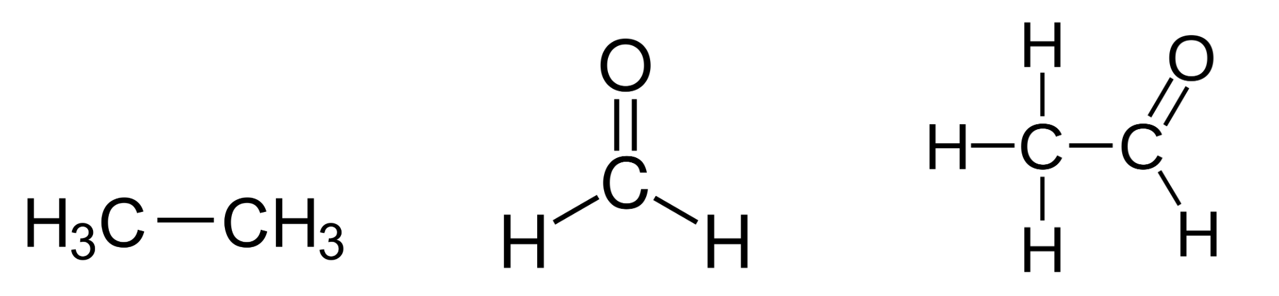
Rank the following molecules from the highest boiling point to the lowest boiling point.
- Answer
-
Both CH₂O and CH₃CHO contain a polar carbonyl (C=O) bond, making them polar molecules. As a result, they experience both London dispersion forces and dipole-dipole interactions. Neither molecule contains an O–H, N–H, or F–H bond, so neither can hydrogen bond with itself. Since both molecules possess the same dominant intermolecular force (dipole-dipole), the larger molecule, CH₃CHO, has the higher boiling point because it exhibits stronger London dispersion forces. CH3CH3 only has London dispersion forces and no permanent dipoles. Thus, it will have the lowest boiling point.
CH3CHO > CH2O > CH3CH3
Rank the following molecules from the highest boiling point to the lowest boiling point.

- Answer
-
CH4 only experiences London dispersion forces as it only contains nonpolar C-H bonds. CH₂O experiences London dispersion forces and dipole-dipole interactions, while CH₃OH experiences London dispersion forces, dipole-dipole interactions, and hydrogen bonding. Because hydrogen bonding is the strongest intermolecular force present between these neutral molecules, methanol (CH₃OH) has the highest boiling point.
CH3OH > CH2O > CH4
This page titled 5.5: Physical Properties of Intermolecular Forces was last modified on Tue, 11 Aug 2026 18:40:47 GMT and is shared under a CC BY-NC-SA 4.0 license and was authored, remixed, and/or curated by Hadeel Abozenadah, Adam Bishop, Scott Bitner, Kaysha Lehman and Patricia Flatt.
The book could not be loaded just now.