Opening the book…
- Explain how elements are organized into the periodic table.
The periodic table is one of the cornerstones of chemistry because it organizes all the known elements on the basis of their chemical properties. A modern version is shown in Figure \(\PageIndex{1}\). Most periodic tables provide additional data (such as atomic weight) in a box that contains each element’s symbol. The elements are listed in order of atomic number.

Features of the Periodic Table
Elements that have similar chemical properties are grouped in columns called groups (or families). As well as being numbered, some of these groups have names—for example, alkali metals (the first column of elements-1A), alkaline earth metals (the second column of elements-2A), halogens (the next-to-last column of elements-7A), and noble gases (the last column of elements-8A).
Each row of elements on the periodic table is called a period. Periods have different lengths; the first period has only 2 elements (hydrogen and helium), while the second and third periods have 8 elements each. The fourth and fifth periods have 18 elements each, and later periods are so long that a segment from each is removed and placed beneath the main body of the table.
Metals, Nonmetals, and Metalloids
Certain elemental properties become apparent in a survey of the periodic table as a whole. Every element can be classified as either a metal, a nonmetal, or a semimetal, as shown in Figure \(\PageIndex{2}\). A metal is a substance that is shiny, typically (but not always) silvery in color, and an excellent conductor of electricity and heat. Metals are also malleable (they can be beaten into thin sheets) and ductile (they can be drawn into thin wires). A nonmetal is typically dull and a poor conductor of electricity and heat. Solid nonmetals are also very brittle. As shown in Figure \(\PageIndex{2}\), metals occupy the left three-fourths of the periodic table, while nonmetals (except for hydrogen) are clustered in the upper right-hand corner of the periodic table. The elements with properties intermediate between those of metals and nonmetals are called semimetals (or metalloids). Elements adjacent to the bold zigzag line in the right-hand portion of the periodic table have semimetal properties.

Based on its position in the periodic table, do you expect selenium (Se) to be a metal, a nonmetal, or a semimetal?
Solution
The atomic number of selenium is 34, which places it in period 4 and group 16. In Figure 2.7.1, selenium lies above and to the right of the diagonal line marking the boundary between metals and nonmetals, so it should be a nonmetal. Note, however, that because selenium is close to the metal-nonmetal dividing line, it would not be surprising if selenium were similar to a semimetal in some of its properties.
Based on its location in the periodic table, do you expect indium (In) to be a nonmetal, a metal, or a semimetal?
- Answer
-
metal
Representative, Transition, and Inner-transition
Another way to categorize the elements of the periodic table is shown in Figure \(\PageIndex{3}\). The first two columns on the left and the last six columns on the right are called the main group or representative elements. The ten-column block between these columns contains the transition metals. The two rows beneath the main body of the periodic table contain the inner transition metals. The elements in these two rows are also referred to as, respectively, the lanthanide metals and the actinide metals.
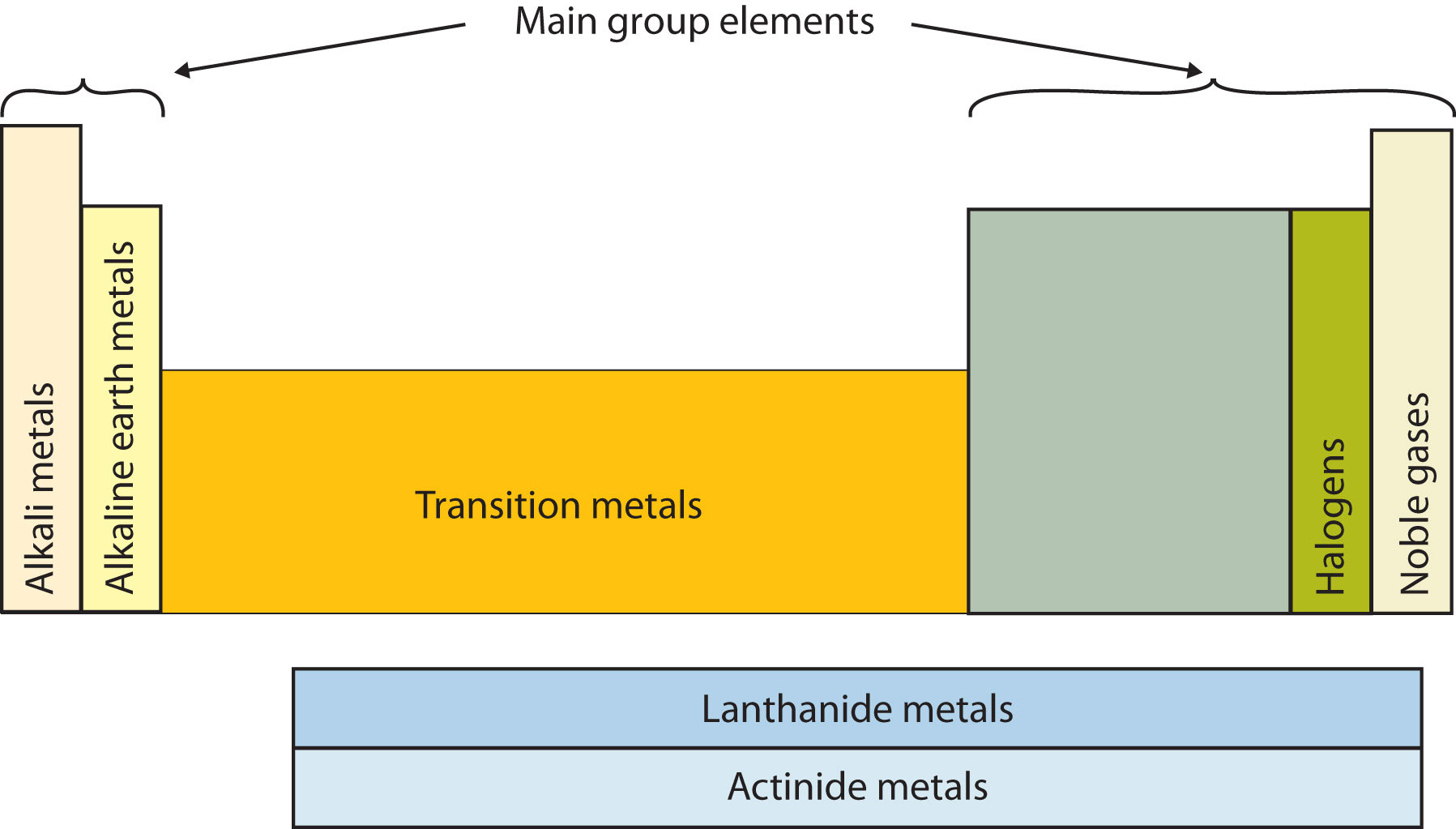
As previously noted, the periodic table is arranged so that elements with similar chemical behaviors are in the same group. Chemists often make general statements about the properties of the elements in a group using descriptive names with historical origins. For example, the elements of Group 1A are known as the alkali metals, Group 2A are the alkaline earth metals, Group 7A are the halogens, and Group 8A are the noble gases.
Group 1A: The Alkali Metals
The alkali metals are lithium, sodium, potassium, rubidium, cesium, and francium. Hydrogen is unique in that it is generally placed in Group 1A, but it is not a metal. The compounds of the alkali metals are common in nature and daily life. One example is table salt (sodium chloride); lithium compounds are used in greases, in batteries, and as drugs to treat patients who exhibit manic-depressive, or bipolar, behavior. Although lithium, rubidium, and cesium are relatively rare in nature, and francium is so unstable and highly radioactive that it exists in only trace amounts, sodium and potassium are the seventh and eighth most abundant elements in Earth’s crust, respectively.
Group 2A: The Alkaline Earth Metals
The alkaline earth metals are beryllium, magnesium, calcium, strontium, barium, and radium. Beryllium, strontium, and barium are rare, and radium is unstable and highly radioactive. In contrast, calcium and magnesium are the fifth and sixth most abundant elements on Earth, respectively; they are found in huge deposits of limestone and other minerals.
Group 7A: The Halogens
The halogens are fluorine, chlorine, bromine, iodine, and astatine. The name halogen is derived from the Greek words for “salt forming,” which reflects that all the halogens react readily with metals to form compounds, such as sodium chloride and calcium chloride (used in some areas as road salt).
Compounds that contain the fluoride ion are added to toothpaste and the water supply to prevent dental cavities. Fluorine is also found in Teflon coatings on kitchen utensils. Although chlorofluorocarbon propellants and refrigerants are believed to lead to the depletion of Earth’s ozone layer and contain both fluorine and chlorine, the latter is responsible for the adverse effect on the ozone layer. Bromine and iodine are less abundant than chlorine, and astatine is so radioactive that it exists in only negligible amounts in nature.
Group 8A: The Noble Gases
The noble gases are helium, neon, argon, krypton, xenon, and radon. Because the noble gases are composed of only single atoms, they are called monoatomic. At room temperature and pressure, they are unreactive gases. Due to their lack of reactivity, they were often referred to as inert gases or rare gases for many years. However, the first chemical compounds containing the noble gases were prepared in 1962. Although the noble gases are relatively minor constituents of the atmosphere, natural gas contains substantial amounts of helium. Because of its low reactivity, argon is often used as an unreactive (inert) atmosphere for welding and in light bulbs. The red light emitted by neon in a gas discharge tube is used in neon signs, also known as neon lights.
Clinical chemistry is the area of chemistry concerned with the analysis of body fluids to determine the health status of the human body. Clinical chemists measure a variety of substances, ranging from simple elements such as sodium and potassium to complex molecules such as proteins and enzymes, in blood, urine, and other body fluids. The absence or presence, or abnormally low or high amounts, of a substance can be a sign of some disease or an indication of health. Many clinical chemists use sophisticated equipment and complex chemical reactions in their work, so they not only need to understand basic chemistry, but also be familiar with special instrumentation and how to interpret test results.
Most of the elemental composition of the human body consists of main group elements. The first element appearing on the list that is not a main group element is iron, at 0.006 percentage by mass. Because iron has relatively massive atoms, it would appear even lower on a list organized in terms of percent by atoms rather than percent by mass.
Iron is a transition metal. Transition metals have interesting chemical properties. The chemistry of iron makes it a key component in the proper functioning of red blood cells.
Red blood cells are cells that transport oxygen from the lungs to cells of the body and then transport carbon dioxide from the cells to the lungs. Without red blood cells, animal respiration as we know it would not exist. The critical part of the red blood cell is a protein called hemoglobin. Hemoglobin combines with oxygen and carbon dioxide, transporting these gases from one location to another in the body. Hemoglobin is a relatively large molecule, with a mass of about 65,000 u.
The crucial atom in the hemoglobin protein is iron. Each hemoglobin molecule has four iron atoms, which act as binding sites for oxygen. It is the presence of this particular transition metal in your red blood cells that allows you to use the oxygen you inhale.
Other transition metals have important functions in the body, despite being present in low amounts. Zinc is needed for the body’s immune system to function properly, as well as for protein synthesis and tissue and cell growth. Copper is also needed for several proteins to function properly in the body. Manganese is needed for the body to metabolize oxygen properly. Cobalt is a necessary component of vitamin B-12, a vital nutrient. These last three metals are present in the body in very small quantities. However, even these small quantities are required for the body to function properly.
- How are the elements organized into the periodic table?
- Looking at the periodic table, where do the following elements appear?
- the metals
- the nonmetals
- the halogens
- The transition metals
- The noble gases
- Answer
-
- Elements are organized in order of increasing atomic number.
-
- The left three-quarters of the periodic table (to the left of the zigzag band)
- The right quarter of the periodic table (to the right of the zigzag band)
- The next-to-last column of the periodic table
- The middle section of the periodic table
- The last column of the periodic table
Key Takeaways
- The chemical elements are arranged in a chart called the periodic table.
- Some characteristics of the elements are related to their position on the periodic table.
This page titled 4.1: The Periodic Table and Valence Electrons was last modified on Thu, 31 Jul 2025 00:06:31 GMT and is shared under a CC BY 3.0 license and was authored, remixed, and/or curated by Sol Parajon Puenzo (Cañada College) via source content that was edited to the style and standards of the LibreTexts platform.
The book could not be loaded just now.