Opening the book…
- Define concentration and use the terms concentrated and dilute to describe the relative concentration of a solution.
- Complete dilution calculations.
- Determine the resulting concentration of a diluted solution.
Solution Concentration
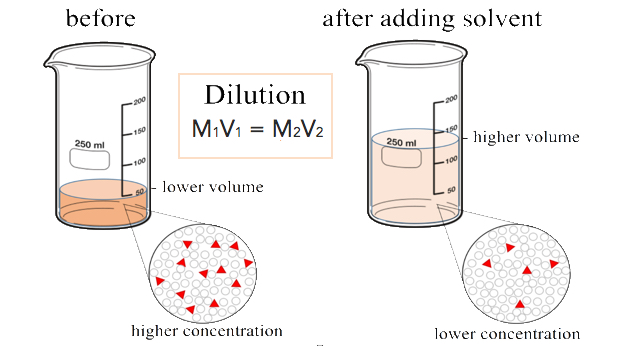
There are several ways to express the amount of solute present in a solution. The concentration of a solution is a measure of the amount of solute that has been dissolved in a given amount of solvent or solution. A concentrated solution is one that has a relatively large amount of dissolved solute. A dilute solution is one that has a relatively small amount of dissolved solute. However, these terms are relative, and we need to be able to express concentration in a more exact, quantitative manner. Still, concentrated and dilute are useful as terms to compare one solution to another (see figure below). Also, be aware that the terms "concentrate" and "dilute" can be used as verbs. If you were to heat a solution, causing the solvent to evaporate, you would be concentrating it, because the ratio of solute to solvent would be increasing. If you were to add more water to an aqueous solution, you would be diluting it because the ratio of solute to solvent would be decreasing.
Looking Closer: The Dose Makes the Poison
Why is it that we can drink 1 qt of water when we are thirsty and not be harmed, but if we ingest 0.5 g of arsenic, we might die? There is an old saying: the dose makes the poison. This means that what may be dangerous in some amounts may not be dangerous in other amounts.
Take arsenic, for example. Some studies show that arsenic deprivation limits the growth of animals such as chickens, goats, and pigs, suggesting that arsenic is actually an essential trace element in the diet. Humans are constantly exposed to tiny amounts of arsenic from the environment, so studies of completely arsenic-free humans are not available; if arsenic is an essential trace mineral in human diets, it is probably required on the order of 50 ppb or less. A toxic dose of arsenic corresponds to about 7,000 ppb and higher, which is over 140 times the trace amount that may be required by the body. Thus, arsenic is not poisonous in and of itself. Rather, it is the amount that is dangerous: the dose makes the poison.
Similarly, as much as water is needed to keep us alive, too much of it is also risky to our health. Drinking too much water too fast can lead to a condition called water intoxication, which may be fatal. The danger in water intoxication is not that water itself becomes toxic. It is that the ingestion of too much water too fast dilutes sodium ions, potassium ions, and other salts in the bloodstream to concentrations that are not high enough to support brain, muscle, and heart functions. Military personnel, endurance athletes, and even desert hikers are susceptible to water intoxication if they drink water without replenishing the salts lost in sweat. As this example shows, even the right substances in the wrong amounts can be dangerous!
Dilutions
When additional water is added to an aqueous solution, the concentration of that solution decreases. Dilution is adding more solvent (water) to a solution. Dilution is important in health care because some drugs must be diluted to a proper concentration before being administered. The number of moles of the solute does not change, but the total volume of the solution increases.
An useful equation to use when doing dilutions is
\[C_1 \times V_1 = C_2 \times V_2\]
The concentration can be in any other unit as long as \(C_1\) and \(C_2\) are in the same unit.
Suppose that you have \(100. \: \text{mL}\) of a \(2.0 \: \text{M}\) solution of \(\ce{HCl}\). You dilute the solution by adding enough water to make the solution volume \(500. \: \text{mL}\). The new molarity can easily be calculated by using the above equation and solving for \(C_2\).
\[C_2 = \frac{C_1 \times V_1}{V_2} = \frac{2.0 \: \text{M} \times 100. \: \text{mL}}{500. \: \text{mL}} = 0.40 \: \text{M} \: \ce{HCl}\]
The solution has been diluted by a factor of five, since the new volume is five times as great as the original volume. Consequently, the molarity is one-fifth of its original value. Another common dilution problem involves deciding how much a highly concentrated solution is required to make a desired quantity of solution with a lower concentration. The highly concentrated solution is typically referred to as the stock solution.
Dilution Equations
Any units of concentration and volume can be used, as long as both concentrations and both volumes have the same unit. For example, if we are using M (molarity), then we can express the equation as follows:
Molarityinitial × volumeinitial = Molarityfinal × volumefinal or
M1V1 = M2V2
If we are using percent, the dilution equation is as follows:
%initial × volumeinitial = %final × volumefinal or
%1V1 = %2V2
Note that using the number 1 or the word initial is equivalent in all cases. Same for 2 or final.
Nitric acid \(\left( \ce{HNO_3} \right)\) is a powerful and corrosive acid. When ordered from a chemical supply company, its molarity is \(16 \: \text{M}\). How much of the stock solution of nitric acid needs to be used to make \(8.00 \: \text{L}\) of a \(0.50 \: \text{M}\) solution?
Solution
Step 1: List the known quantities and plan the problem.
Known
- Stock \(\ce{HNO_3} \: \left( C_1 \right) = 16 \: \text{M}\)
- \(V_2 = 8.00 \: \text{L}\)
- \(C_2 = 0.50 \: \text{M}\)
Unknown
- Volume of stock \(\ce{HNO_3} \: \left( V_1 \right) = ? \: \text{L}\)
The unknown in the equation is \(V_1\), the necessary volume of the concentrated stock solution.
Step 2: Solve.
\[V_1 = \frac{C_2 \times V_2}{V_1} = \frac{0.50 \: \text{M} \times 8.00 \: \text{L}}{16 \: \text{M}} = 0.25 \: \text{L} = 250 \: \text{mL}\]
Step 3: Think about your result.
\(250 \: \text{mL}\) of the stock \(\ce{HNO_3}\) solution needs to be diluted with water to a final volume of \(8.00 \: \text{L}\). The dilution from \(16 \: \text{M}\) to \(0.5 \: \text{M}\) is a factor of 32.
A 125 mL sample of 0.900 M NaCl is diluted to 1,125 mL. What is the final concentration of the diluted solution?
Solution
Because the volume units are the same, and we are looking for the molarity of the final solution, we can use (concentration × volume)initial = (concentration × volume)final:
(0.900 M × 125 mL) = (concentration × 1,125 mL)
We solve by isolating the unknown concentration by itself on one side of the equation. Dividing by 1,125 mL gives
\(\mathrm{concentration = \dfrac{0.900\: M\times125\: mL}{1,125\: mL}=0.100\: M}\)
as the final concentration.
a. A nurse uses a syringe to inject 5.00 mL of 0.550 M heparin solution (heparin is an anticoagulant drug) into a 250 mL IV bag, for a final volume of 255 mL. What is the concentration of the resulting heparin solution?
b. A 0.885 M solution of KBr whose initial volume is 76.5 mL has more water added until its concentration is 0.500 M. What is the new volume of the solution?
- Answer
-
a. 0.0108 M
b. 135.4 mL
In a hospital emergency room, a physician orders an intravenous (IV) delivery of 100 mL of 0.5% KCl for a patient suffering from hypokalemia (low potassium levels). Does an aide run to a supply cabinet and take out an IV bag containing this concentration of KCl?
Not likely. It is more probable that the aide must make the proper solution from an IV bag of sterile solution and a more concentrated, sterile solution, called a stock solution, of KCl. The aide is expected to use a syringe to draw up some stock solution and inject it into the waiting IV bag and dilute it to the proper concentration. Thus the aide must perform a dilution calculation.
 Figure \(\PageIndex{5}\):Preparing IV Solution © Thinkstock. Medical personnel commonly must perform dilutions for IV solutions.
If the stock solution is 10.0% KCl and the final volume and concentration need to be 100 mL and 0.50%, respectively, then it is an easy calculation to determine how much stock solution to use:
(10%)V1 = (0.50%)(100 mL)
V1 = 5 mL
Of course, the addition of the stock solution affects the total volume of the diluted solution, but the final concentration is likely close enough even for medical purposes.
Medical and pharmaceutical personnel are constantly dealing with dosages that require concentration measurements and dilutions. It is an important responsibility: calculating the wrong dose can be useless, harmful, or even fatal!
This page titled 10.7: Solutions and Dilutions was last modified on Thu, 31 Jul 2025 00:06:41 GMT and is shared under a CC BY license and was authored, remixed, and/or curated by Sol Parajon Puenzo (Cañada College) via source content that was edited to the style and standards of the LibreTexts platform.
The book could not be loaded just now.