Opening the book…
- Identify the general structure of the introduced functional groups
- Determine the structural feature that classifies alcohols and amines as primary, secondary, or tertiary.
There are a lot of possible organic compounds! Even just carbon and hydrogen can be combined in many ways, depending on how many carbons are in the chain or ring, whether there are any branches coming off the chain, and whether there are any double or triple bonds (compared to only single bonds). Chemists classify organic compounds based on bonding patterns in their structures. These patterns are important because structure determines function. That is, these patterns in structure determine what properties a compound will have and the types of chemical reactions in which it can participate. Therefore, by grouping organic compounds based on their structures, we are also classifying them based on their physical and chemical properties.
Hydrocarbons
If an organic molecule contains only carbon and hydrogen, then it is a hydrocarbon. Hydrocarbons are further classified based on what types of bonds they contain as shown in the table below.
| Hydrocarbon Category | Type of bonds |
|---|---|
|
Alkane |
All single bonds |
| Alkene | At least one double bond |
| Alkyne | At least one triple bond |
| Aromatic | Contains alternating single and double bonds |
Notice that there is only one letter that is different in the first three names! You will find that suffixes are very important in organic chemistry. You should also remember that hydrogen can only form single bonds, so the double and triple bonds in alkenes and alkynes refer to C=C or C≡C bonds. Because this is only an introduction to organic chemistry, we will not deal with compounds that contain both double and triple bonds.
Alkanes are saturated hydrocarbons, meaning they have the maximum number of hydrogen atoms. Alkenes and alkynes are unsaturated hydrocarbons. Because they have at least one double or triple bond, they have fewer hydrogen atoms per carbon atom than alkanes do. The concept of saturated and unsaturated molecules will come up again in the Biochemistry chapter when we discuss saturated and unsaturated fatty acids.
The additional functional group that contains only carbon and hydrogen is an aromatic ring which is a six-carbon ring with alternative double bonds. The aromatic ring is also shown as a ring with a circle in the middle representing the double bonds. Aromatic rings (see figure below) are found in many compounds including steroids and medications.

Functional Groups
Functional groups are groups of atoms with similar reactivity that we use to classify organic compounds. Remember that the hydrocarbons discussed in the previous section are just one subgroup of organic chemicals. Organic compounds commonly contain other elements in addition to carbon and hydrogen, such as oxygen and nitrogen. As you will see in the table below, functional groups are a pattern of certain elements bonded together with certain bonds (single, double, or triple). Because functional groups are only a portion of a molecule, we use a generic symbol to represent the rest of the molecule. Just like you commonly use x as a variable in algebra, we use R as a variable group in organic chemistry. So, H-O-R means that there is a hydrogen atom singly bonded to an oxygen atom and that oxygen atom is singly bonded to something else which has not been specified. R- will usually represent a chain of carbons and hydrogens. The example H-O-R could represent H-O-CH3 or H-O-CH2CH3 or H-O-CH2CH2CH3, etc. If the functional group connects to the rest of the structure in multiple places, then the symbol R can be modified with primes. Use R if there is one attachment, R’ for a second attachment, and R’’ for a third chain attached to the functional group.
The table below lists the functional groups you will be expected to recognize for this course. Each functional group has a name that represents a structure that is commonly found as a portion of some organic molecules. Remember that these functional groups give the molecule certain properties, e.g. the ability to dissolve in water rather than a non-polar solvent, and the ability to participate in certain chemical reactions, e.g. the addition of a chlorine atom. Finally, you will see a suffix listed for each functional group. You will see these suffixes again later in this chapter when you learn how to name organic molecules. The suffix of the name indicates the functional group found in the molecule. Thus, when you see the name of a new molecule you can quickly get an idea of some of its properties based on its suffix.
| Functional Group Name | Structure | Suffix(es) | Example |
|---|---|---|---|
| Alcohol |
R-OH R cannot be H |
-ol |
Ethanol CH3CH2OH |
| Ether |
R-O-R' R/R' cannot be H |
-oxy -ane (two parts) |
Methoxyethane CH3-O-CH2CH3 |
| Amine |
|
-amine |
Ethanamine CH3CH2NH2 |
| Aldehyde |
or abbreviated CHO |
-al |
Ethanal
|
| Ketone |
R/R' cannot be H |
-one |
Propanone
|
| Carboxylic Acid |
or abbreviated COOH |
-ic acid (two words) |
Propanoic acid
|
| Ester |
R' cannot be H |
-yl -oate (two words) |
Ethyl ethanoate
|
| Amide |  |
-amide |
Ethanamide
|


Draw the structures of 9 compounds. Each of the compounds should be an example of the functional group below with the correct # of carbon atoms specified.
a. An alkene with 4 carbons.
b. An alcohol with 3 carbons.
c. An alcohol with 5 carbons in total (at least 1 carbon should be in a branch).
e. An amine with 3 carbons. Label as primary, secondary, or tertiary.
f. A ketone with 6 carbons.
g. An aldehyde with 4 carbons.
h. A carboxylic acid with 3 carbons.
i. An ester with 5 carbons.
j. An amide with 3 carbons.
- Answer
-
Answers may vary. Check during class.
Alcohols
An alcohol is an organic compound with a hydroxyl (OH) functional group on an aliphatic carbon atom. Because OH is the functional group of all alcohols, we often represent alcohols by the general formula ROH, where R is an alkyl group. Alcohols are common in nature. Most people are familiar with ethyl alcohol (ethanol), the active ingredient in alcoholic beverages, but this compound is only one of a family of organic compounds known as alcohols. The family also includes such familiar substances as cholesterol and the carbohydrates. Methanol (CH3OH) and ethanol (CH3CH2OH) are the first two members of the homologous series of alcohols.
Methanol is quite poisonous to humans. Ingestion of as little as 15 mL of methanol can cause blindness, and 30 mL (1 oz) can cause death. However, the usual fatal dose is 100 to 150 mL. The main reason for methanol’s toxicity is that we have liver enzymes that catalyze its oxidation to formaldehyde, the simplest member of the aldehyde family:

Formaldehyde reacts rapidly with the components of cells, coagulating proteins in much the same way that cooking coagulates an egg. This property of formaldehyde accounts for much of the toxicity of methanol.
Nomenclature of Alcohols
Alcohols with one to four carbon atoms are frequently called by common names, in which the name of the alkyl group is followed by the word alcohol:

According to the International Union of Pure and Applied Chemistry (IUPAC), alcohols are named by changing the ending of the parent alkane name to -ol. Here are some basic IUPAC rules for naming alcohols:
- The longest continuous chain (LCC) of carbon atoms containing the OH group is taken as the parent compound—an alkane with the same number of carbon atoms. The chain is numbered from the end nearest the OH group.
- The number that indicates the position of the OH group is prefixed to the name of the parent hydrocarbon, and the -e ending of the parent alkane is replaced by the suffix -ol. (In cyclic alcohols, the carbon atom bearing the OH group is designated C1, but the 1 is not used in the name.) Substituents are named and numbered as in alkanes.
- If more than one OH group appears in the same molecule (polyhydroxy alcohols), suffixes such as -diol and -triol are used. In these cases, the -e ending of the parent alkane is retained.
Figure \(\PageIndex{1}\) shows some examples of the application of these rules.
Figure \(\PageIndex{1}\): IUPAC Rules for Alcohols. The names and structures of some alcohols demonstrate the use of IUPAC rules.
Classification of Alcohols
Some of the properties of alcohols depend on the number of carbon atoms attached to the specific carbon atom that is attached to the OH group. Alcohols can be grouped into three classes on this basis.
- A primary (1°) alcohol is one in which the carbon atom (in red) with the OH group is attached to one other carbon atom (in blue). Its general formula is RCH2OH.

- A secondary (2°) alcohol is one in which the carbon atom (in red) with the OH group is attached to two other carbon atoms (in blue). Its general formula is R2CHOH.

- A tertiary (3°) alcohol is one in which the carbon atom (in red) with the OH group is attached to three other carbon atoms (in blue). Its general formula is R3COH.

Table \(\PageIndex{3}\) names and classifies some of the simpler alcohols. Some of the common names reflect a compound’s classification as secondary (sec-) or tertiary (tert-). These designations are not used in the IUPAC nomenclature system for alcohols. Note that there are four butyl alcohols in the table, corresponding to the four butyl groups: the butyl group (CH3CH2CH2CH2) discussed before, and three others:

| Condensed Structural Formula | Class of Alcohol | Common Name | IUPAC Name |
|---|---|---|---|
| CH3OH | — | methyl alcohol | methanol |
| CH3CH2OH | primary | ethyl alcohol | ethanol |
| CH3CH2CH2OH | primary | propyl alcohol | 1-propanol |
| (CH3)2CHOH | secondary | isopropyl alcohol | 2-propanol |
| CH3CH2CH2CH2OH | primary | butyl alcohol | 1-butanol |
| CH3CH2CHOHCH3 | secondary | sec-butyl alcohol | 2-butanol |
| (CH3)2CHCH2OH | primary | isobutyl alcohol | 2-methyl-1-propanol |
| (CH3)3COH | tertiary | tert-butyl alcohol | 2-methyl-2-propanol |
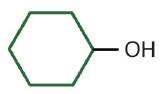 |
secondary | cyclohexyl alcohol | cyclohexanol |
Amines
Amines are organic derivatives of ammonia in the same way that alcohols and ethers are organic derivatives of water. Amines are often represented by the general formula RNH2, where R is an alkyl group.
Classification of Amines
Amines are classified according to the number of carbon atoms bonded directly to the nitrogen atom. A primary (1°) amine has one alkyl (or aryl) group on the nitrogen atom, a secondary (2°) amine has two, and a tertiary (3°) amine has three (Figure \(\PageIndex{1}\)).

Note
The classification of amines is not the same than alcohols. To classify alcohols, we look at the number of carbon atoms bonded to the carbon atom bearing the OH group, not the oxygen atom itself. Thus, although 2-propanamine looks similar to 2-propanol, the former is a primary amine, while the latter is a secondary alcohol.

Name and classify each compound.
- CH3CH2CH2NH2

- CH3CH2NHCH2CH3
- CH3CH2CH2NHCH3
Solution
- There is only one alkyl group attached to the nitrogen atom, so the amine is primary. A group of three carbon atoms (a propyl group) is attached to the NH2 group through an end carbon atom, so the name is 1-propanamine.
- There are two methyl groups and one ethyl group on the nitrogen atom. The compound is N,N-dimethylethanamine, a tertiary amine.
- There are two ethyl groups attached to the nitrogen atom; the amine is secondary, so the compound is N-ethylethanamine.
- The nitrogen atom has a methyl group and a propyl group, so the compound is N-methyl-1-propanamine, a secondary amine.
Name and classify each compound.


- CH3CH2CH2CH2NH2
- CH3CH2CH2NHCH2CH2 CH3
Draw the structure for each compound and classify.
- N,N-dimethyl-2-propanamine
- N-propyl-1-propanamine
Solution
- The name indicates that there are an isopropyl group (in red) and two methyl groups (in green) attached to the nitrogen atom; the amine is tertiary.

- The name indicates that there are two propyl groups attached to the nitrogen atom; the amine is secondary. (The third bond on the nitrogen atom goes to a hydrogen atom.) CH3CH2CH2NHCH2CH2CH3
This page titled 6.7: Classifying Organic Molecules was last modified on Thu, 31 Jul 2025 00:06:37 GMT and is shared under a CC BY-NC-SA 4.0 license and was authored, remixed, and/or curated by Sol Parajon Puenzo (Cañada College) .
The book could not be loaded just now.