Opening the book…
- To name alkenes given formulas and write formulas for alkenes given names.
- To identify the physical properties of alkenes and describe trends in these properties.
Alkenes occur widely in nature. Ripening fruits and vegetables give off ethylene, which triggers further ripening. Fruit processors artificially introduce ethylene to hasten the ripening process; exposure to as little as 0.1 mg of ethylene for 24 h can ripen 1 kg of tomatoes. Unfortunately, this process does not exactly duplicate the ripening process, and tomatoes picked green and treated this way don’t taste much like vine-ripened tomatoes fresh from the garden.


The bright red color of tomatoes is due to lycopene—a polyene.
Other alkenes that occur in nature include 1-octene, a constituent of lemon oil, and octadecene (C18H36) found in fish liver. Dienes (two double bonds) and polyenes (three or more double bonds) are also common. Butadiene (CH2=CHCH=CH2) is found in coffee. Lycopene and the carotenes are isomeric polyenes (C40H56) that give the attractive red, orange, and yellow colors to watermelons, tomatoes, carrots, and other fruits and vegetables. Vitamin A, essential to good vision, is derived from a carotene. The world would be a much less colorful place without alkenes.
As noted before, alkenes are hydrocarbons with carbon-to-carbon double bonds (R2C=CR2) and alkynes are hydrocarbons with carbon-to-carbon triple bonds (R–C≡C–R). Collectively, they are called unsaturated hydrocarbons because they have fewer hydrogen atoms than does an alkane with the same number of carbon atoms, as is indicated in the following general formulas:
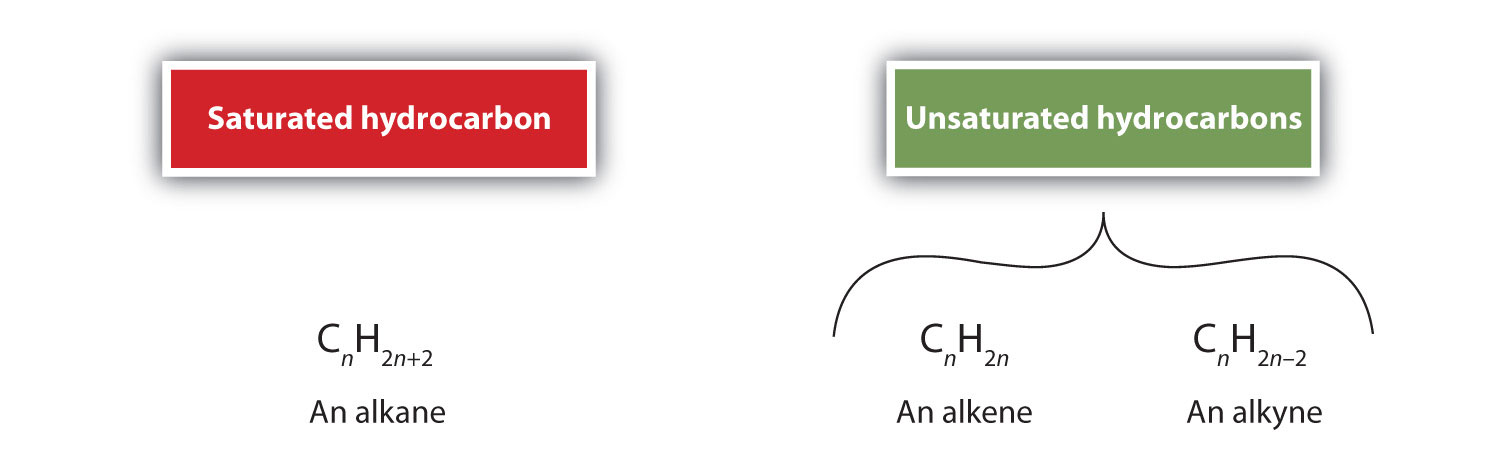
The Simplest Alkenes and Alkynes
The simplest Alkene is ethene, as the condensed formula looks like this, CH2=CH2 , it stands for:

The double bond is shared by the two carbons and does not involve the hydrogen atoms, although the condensed formula does not make this point obvious. Note that the molecular formula for ethene is C2H4, whereas that for ethane is C2H6.
The first two alkenes in Table \(\PageIndex{1}\), ethene and propene, are most often called by their common names—ethylene and propylene, respectively (Figure \(\PageIndex{1}\)). Ethylene is a major commercial chemical. The US chemical industry produces about 25 billion kilograms of ethylene annually, more than any other synthetic organic chemical. More than half of this ethylene goes into the manufacture of polyethylene, one of the most familiar plastics. Propylene is also an important industrial chemical. It is converted to plastics, isopropyl alcohol, and a variety of other products.

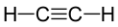
The simplest alkyne—a hydrocarbon with a carbon-to-carbon triple bond—has the molecular formula C2H2 and is called ethyne, but is well-known by its common name—acetylene (Figure \(\PageIndex{1}\)). HCCH structure is:

Nomenclature
Alkenes
Here are some basic rules for naming alkenes from the International Union of Pure and Applied Chemistry (IUPAC):
- The longest chain of carbon atoms containing the double bond is considered the parent chain. It is named using the same stem as the alkane having the same number of carbon atoms but ends in -ene to identify it as an alkene. Thus the compound CH2=CHCH3 is propene.
- If there are four or more carbon atoms in a chain, we must indicate the position of the double bond. The carbons atoms are numbered so that the first of the two that are doubly bonded is given the lower of the two possible numbers.The compound CH3CH=CHCH2CH3, for example, has the double bond between the second and third carbon atoms. Its name is 2-pentene (not 3-pentene).
- Substituent groups are named as with alkanes, and their position is indicated by a number. Thus, the structure below is 5-methyl-2-hexene. Note that the numbering of the parent chain is always done in such a way as to give the double bond the lowest number, even if that causes a substituent to have a higher number. The double bond always has priority in numbering.

Alkynes
The IUPAC system for naming alkynes employs the ending -yne instead of the -ane used for naming the corresponding saturated hydrocarbons. Thus the compound with the molecular formula C2H2 ; H–C≡C–H is ethyne.
Name each compound.


Solution
- The longest chain containing the double bond has five carbon atoms, so the compound is a pentene (rule 1). To give the first carbon atom of the double bond the lowest number (rule 2), we number from the left, so the compound is a 2-pentene. There is a methyl group on the fourth carbon atom (rule 3), so the compound’s name is 4-methyl-2-pentene.
- The longest chain containing the double bond has five carbon atoms, so the parent compound is a pentene (rule 1). To give the first carbon atom of the double bond the lowest number (rule 2), we number from the left, so the compound is a 2-pentene. There is a methyl group on the third carbon atom (rule 3), so the compound’s name is 3-methyl-2-pentene.
Draw the structure for each compound.
- 3-methyl-2-pentene
- cyclohexene
Solution
a. First, write the parent chain of five carbon atoms: C–C–C–C–C. Then add the double bond between the second and third carbon atoms:

Now, place the methyl group on the third carbon atom and add enough hydrogen atoms to give each carbon atom a total of four bonds.

b Consider what each of the three parts of the name means. Cyclo means a ring compound, hex means 6 carbon atoms, and -ene means a double bond.

Physical Properties of Alkenes
The physical properties of alkenes are similar to those of the alkanes. The following table shows that the boiling points of straight-chain alkenes increase with increasing molar mass, just as with alkanes. For molecules with the same number of carbon atoms and the same general shape, the boiling points usually differ only slightly, just as we would expect for substances whose molar mass differs by only 2 u (equivalent to two hydrogen atoms). Like other hydrocarbons, the alkenes are insoluble in water but soluble in organic solvents.
Some representative alkenes—their names, structures, and physical properties—are given in Table \(\PageIndex{1}\).
| IUPAC Name | Molecular Formula | Condensed Structural Formula | Melting Point (°C) | Boiling Point (°C) |
|---|---|---|---|---|
| ethene | C2H4 | CH2=CH2 | –169 | –104 |
| propene | C3H6 | CH2=CHCH3 | –185 | –47 |
| 1-butene | C4H8 | CH2=CHCH2CH3 | –185 | –6 |
| 1-pentene | C5H10 | CH2=CH(CH2)2CH3 | –138 | 30 |
| 1-hexene | C6H12 | CH2=CH(CH2)3CH3 | –140 | 63 |
| 1-heptene | C7H14 | CH2=CH(CH2)4CH3 | –119 | 94 |
| 1-octene | C8H16 | CH2=CH(CH2)5CH3 | –102 | 121 |
Although there is only one alkene with the formula C2H4 (ethene) and only one with the formula C3H6 (propene), there are several alkenes with the formula C4H8.
Name each compound.
- CH3CH2CH2CH2CH2CH=CHCH3


- Answer
-
a. 2-octene or oct-2-ene. b. 4-methyl-3-heptene or 4-methylhept-3-ene. c. 4-octyne or oct-4-yne. d. 2-methyl-4-octyne or 2-methylocty-4-ne
Draw the structure for each compound.
- 2-ethyl-1-hexene
- cyclopentene
- 3-methylpentyne
Key Takeaway
- Alkenes are hydrocarbons with a carbon-to-carbon double bond.
- The physical properties of alkenes are much like those of the alkanes: their boiling points increase with increasing molar mass, and they are insoluble in water.
This page titled 6.8: Alkenes and Alkynes was last modified on Thu, 31 Jul 2025 00:06:37 GMT and is shared under a CC BY-NC-SA 4.0 license and was authored, remixed, and/or curated by Sol Parajon Puenzo (Cañada College) .
The book could not be loaded just now.