Opening the book…
↵
- Explain what an enzyme inhibitor is.
- Distinguish between reversible and irreversible inhibitors.
- Distinguish between competitive and noncompetitive inhibitors.
Previously, we noted that enzymes are inactivated at high temperatures and by changes in pH. These are nonspecific factors that would inactivate any enzyme. The activity of enzymes can also be regulated by more specific inhibitors. Many compounds are poisons because they bind covalently to particular enzymes or kinds of enzymes and inactivate them (Table \(\PageIndex{1}\)).
| Poison | Formula | Example of Enzyme Inhibited | Action |
|---|---|---|---|
| arsenate | \(\ce{AsO4^{3−}}\) | glyceraldehyde 3-phosphate dehydrogenase | substitutes for phosphate |
| iodoacetate | \(\ce{ICH2COO^{−}}\) | triose phosphate dehydrogenase | binds to cysteine \(\ce{SH}\) group |
| diisopropylfluoro-phosphate (DIFP; a nerve poison) | 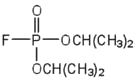 |
acetylcholinesterase | binds to serine \(\ce{OH}\) group |
Inhibitors
Figure \(\PageIndex{3}\) illustrates the effects of two different types of inhibition on the different components of enzyme kinetics. Enzymes can be slowed down or even prevented from catalyzing reactions in many ways including preventing the substrate from entering the active site or preventing the enzyme from altering conformation to catalyze the reaction. The inhibitors that do this can do so either reversibly or irreversibly. The irreversible inhibitors are also called inactivators, and either bind to the enzyme with such high afinity as to be virtually irreversible, or they actually form covalent bonds with the enzyme. Reversible inhibitors are generally grouped into two basic types: competitive and non-competitive.
Finasteride (trade names include Propecia and Proscar) is an irreversible inhibitor that binds very tightly to the enzyme 5-a-re- ductase, used in converting testosterone to dihydrotestosterone. It is used in the treatment of male pattern baldness, benign pro- static hyperplasia, and prostate cancer.
Aspirin is an example of an irreversible inhibitor that actually forms a covalent bond with the enzyme. The aspirin (acetylsalicylic acid) transfers its acetyl group onto a serine residue on cyclooxygenase-2 (COX-2). This stops the production of in ammation-producing prostaglandins and thromboxanes by COX-2.
Methotrexate is a competitive inhibitor of dihydrofolate reductase (DHFR), an enzyme that synthesizes tetrahydrofolate, which is a precursor for purine synthesis, and therefore for DNA and RNA. It has a very similar molecular structure for folic acid, the natural substrate of DHFR. Methotrexate is used as an anti-cancer drug because it affects rapidly reproducing cells (which need to make DNA sooner than other cells) more than non-cancerous cells.
Irreversible Inhibition: Poisons
An irreversible inhibitor inactivates an enzyme by bonding covalently to a particular group at the active site. The inhibitor-enzyme bond is so strong that the inhibition cannot be reversed by the addition of excess substrate. The nerve gases, especially Diisopropyl fluorophosphate (DIFP), irreversibly inhibit biological systems by forming an enzyme-inhibitor complex with a specific OH group of serine situated at the active sites of certain enzymes. The peptidases trypsin and chymotrypsin contain serine groups at the active site and are inhibited by DIFP.

Reversible Inhibition
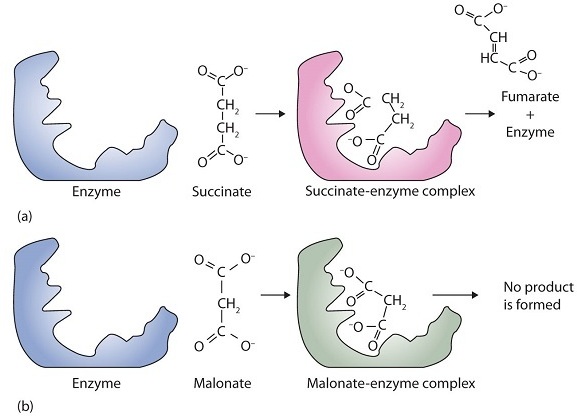
A reversible inhibitor inactivates an enzyme through noncovalent, more easily reversed, interactions. Unlike an irreversible inhibitor, a reversible inhibitor can dissociate from the enzyme. Reversible inhibitors include competitive inhibitors and noncompetitive inhibitors. (There are additional types of reversible inhibitors.) A competitive inhibitor is any compound that bears a structural resemblance to a particular substrate and thus competes with that substrate for binding at the active site of an enzyme. The inhibitor is not acted on by the enzyme but does prevent the substrate from approaching the active site.
The degree to which a competitive inhibitor interferes with an enzyme’s activity depends on the relative concentrations of the substrate and the inhibitor. If the inhibitor is present in relatively large quantities, it will initially block most of the active sites. But because the binding is reversible, some substrate molecules will eventually bind to the active site and be converted to product. Increasing the substrate concentration promotes displacement of the inhibitor from the active site. Competitive inhibition can be completely reversed by adding substrate so that it reaches a much higher concentration than that of the inhibitor.
Studies of competitive inhibition have provided helpful information about certain enzyme-substrate complexes and the interactions of specific groups at the active sites. As a result, pharmaceutical companies have synthesized drugs that competitively inhibit metabolic processes in bacteria and certain cancer cells. Many drugs are competitive inhibitors of specific enzymes.
A classic example of competitive inhibition is the effect of malonate on the enzyme activity of succinate dehydrogenase (Figure \(\PageIndex{1}\)). Malonate and succinate are the anions of dicarboxylic acids and contain three and four carbon atoms, respectively. The malonate molecule binds to the active site because the spacing of its carboxyl groups is not greatly different from that of succinate. However, no catalytic reaction occurs because malonate does not have a CH2CH2 group to convert to CH=CH. This reaction will also be discussed in connection with the Krebs cycle and energy production.
Competitive inhibition
Competitive inhibition is perhaps the simplest to understand. The inhibitor molecule competes directly with the substrate for the active site of an unbound enzyme. If an inhibitor binds to the active site, the substrate is unable to do so until the inhibitor has vacated the site. Thus, one could potentially overwhelm competitive inhibition with sufficiently larger concentrations of substrate so that the probability that the enzyme bumps into a substrate to bind becomes exceeding large compared to the probability of bumping into an inhibitor. Normal, uninhibited Vmax is then achieved despite the presence of the competitive inhibitor, which has only affected the Km, that is, the concentration of substrate needed to reach Vmax/2. This is the kinetic signature of competitive inhibitors: with increasing inhibitor concentrations, KM is increased but Vmax is unaffected.

Non-competitive inhibition involves inhibiting the enzyme by altering its ability to complete the catalyzed reaction through binding of the enzyme at a position that is not the active site. When the inhibitor binds to the enzyme, it causes a change, usually conformational, that may either prevent the enzyme from binding the substrate, or prevent the enzyme from acting upon a bound substrate. In either case, increasing the availability of substrate will not ultimately overcome the inhibitory effect. Thus, \(V_{max}\) is reduced not because some proportion of the enzymes are no longer usable, but because the available enzymes have the same access to substrate as it would without inhibitor (that is, it is not in competition with an inhibitor), the \(K_m\) is not affected.
Non-competitive Regulation
Non-competitive regulation is one example of allosteric regulation of enzymes. Allosteric interactions occur when the binding of a ligand (not necessarily a substrate) to a protein influences the binding of another ligand to the protein at a separate binding site. These kinds of interactions can be either positive (activating) or negative (inhibitory), and either homotropic (both ligands are identical) or heterotropic (ligands are different). Interestingly, sometimes the regulator ligand may actually be a product of the catalyzed reaction. In this kind of feedback mechanism, the progress of a reaction is self-regulating.

Many of the enzymes in metabolic pathways are regulated by a naturally occurring non-competitive inhibitor. One example is phosphofructokinase (PFK), which is involved in glycolysis, which produces ATP for the cell. However, if there are high enough levels of ATP in the cell that other cellular processes aren’t using, then it can bind to phosphofructokinase outside of its active site (it binds fructose-6-phosphate) and turn it off. This blocks glycolysis and production of excess ATP when the cell does not need it. As ATP is used up, there is less available to inhibit PFK, and glycolysis starts back up.
There are two models for such allosteric interactions.
- The symmetry model, also known as the concerted model, or MWC model (Monod, Wyman, and Changeux, 1965), proposes that the allosteric enzyme is an oligomer of several subunits, each of which are symmetrically related, and can be in either a “tensed” or “relaxed” state, but all of the subunits are in the same state and at equilibrium. When a ligand binds, it changes the state of the subunit(s) to which it binds, and to maintain equilibrium, that in turn causes the state of the other subunits to match, thus altering binding properties for a subsequent ligand.
- The sequential model, or the KNF model (Koshland, Nemethy, and Filmer, 1966), proposes something quite different: although it also supposes subunits in either tensed or relaxed states, it does not require all subunits to be connected in such a way as to mandate that all subunits be in the same state, and therefore conformational changes in one subunit need not be propagated to all. Instead, using an induced-fit model of ligand binding rather than the more rigid basic lock and key mechanism, it suggests that when a ligand binds to the enzyme, it induces a slight conformational change in the active site that increases its affinity for the ligand. The conformational change may slightly alter the conformation of other subunits of the enzyme, but may not constitute a state change between relaxed and tensed, depending on how tightly the subunits are interacting. However, the change is enough to increase substrate affinity in adjacent subunits.
Most cell/molecular courses stop the discussion of enzyme inhibitors at competitive vs non-competitive based on their kinetic profiles. However, it should be noted that if you take a biochemistry course, you may encounter the terms uncompetitive inhibitor and mixed inhibitor. These terms are defined not just by the enzyme kinetics, but the mechanism of interaction:
- Uncompetitive inhibitors bind only to the enzyme-substrate (ES) complex, and not to the enzyme before it has encountered substrate. This leads to decreased Vmax and decreased Km.
- Mixed inhibition means that the inhibitor can bind to either the enzyme alone or the enzyme-substrate complex. Because the affinities of the inhibitor for the two forms of the enzyme are different, and because part of it depends on substrate concentration while the other kind of binding does not, generally, Vmax decreases and Km increases. Non-competitive inhibition is a special case of mixed inhibition in which the catalytic activity of the enzyme is diminished or abolished, but the ability to bind substrate is unaltered.
Other Mechanisms of Inhibition
While important, especially pharmaceutically, the use of enzyme inhibitors is not the only way to regulate enzymes. There are numerous examples of one type of enzyme activating or inhibiting another. The most common general example are the protein kinases. These enzymes phosphorylate (transfer phosphate group to) other enzymes and thereby activate them. Kinases are generally fast and very specific, and this is an efficient method for activating large numbers of particular enzymes quickly. Conversely, protein phosphatases are enzymes (also quite fast, but much less specific than kinases) that remove the phosphate groups from phosphorylated proteins, thereby turning off those enzymes. Keep in mind that this is a generalization, and that not all phosphorylations are activating. In addition to enzymatic inhibition of enzymes, there is also inhibition by binding and sequestration of the substrates. In fact, the antibiotic vancomycin works just this way, binding to the substrate peptide for transpeptidase and preventing the enzyme from recognizing it. Transpeptidase normally helps stabilize the cell wall of certain bacteria by altering some of the proteins, and without its activity, the protection of the cell wall is compromised and the bacteria may be more easily killed.
Well over half of the enzymes discovered so far do not act in the simplistic Michaelis-Menten one-substrate-one-product mechanism, but rather operate with two substrates and two products, usually with the transfer of an active group. These types of reactions are sometimes known as Bi Bi reactions. There are two major classes of these reactions: the sequential reactions, in which all substrates bind with the enzyme before the reaction proceeds, and the ping pong reactions, in which one or more products are created and released before all of the substrates have been bound. In fact, unlike sequential reactions, the two substrates do not interact with one another while bound to the enzyme.
Chemotherapy is the strategic use of chemicals (that is, drugs) to destroy infectious microorganisms or cancer cells without causing excessive damage to the other, healthy cells of the host. From bacteria to humans, the metabolic pathways of all living organisms are quite similar, so the search for safe and effective chemotherapeutic agents is a formidable task. Many well-established chemotherapeutic drugs function by inhibiting a critical enzyme in the cells of the invading organism.
An antibiotic is a compound that kills bacteria; it may come from a natural source such as molds or be synthesized with a structure analogous to a naturally occurring antibacterial compound. Antibiotics constitute no well-defined class of chemically related substances, but many of them work by effectively inhibiting a variety of enzymes essential to bacterial growth.
Penicillin, one of the most widely used antibiotics in the world, was fortuitously discovered by Alexander Fleming in 1928, when he noticed antibacterial properties in a mold growing on a bacterial culture plate. In 1938, Ernst Chain and Howard Florey began an intensive effort to isolate penicillin from the mold and study its properties. The large quantities of penicillin needed for this research became available through development of a corn-based nutrient medium that the mold loved and through the discovery of a higher-yielding strain of mold at a United States Department of Agriculture research center near Peoria, Illinois. Even so, it was not until 1944 that large quantities of penicillin were being produced and made available for the treatment of bacterial infections.
Penicillin functions by interfering with the synthesis of cell walls of reproducing bacteria. It does so by inhibiting an enzyme—transpeptidase—that catalyzes the last step in bacterial cell-wall biosynthesis. The defective walls cause bacterial cells to burst. Human cells are not affected because they have cell membranes, not cell walls.
Several naturally occurring penicillins have been isolated. They are distinguished by different R groups connected to a common structure: a four-member cyclic amide (called a lactam ring) fused to a five-member ring. The addition of appropriate organic compounds to the culture medium leads to the production of the different kinds of penicillin.
The penicillins are effective against gram-positive bacteria (bacteria capable of being stained by Gram’s stain) and a few gram-negative bacteria (including the intestinal bacterium Escherichia coli). They are effective in the treatment of diphtheria, gonorrhea, pneumonia, syphilis, many pus infections, and certain types of boils. Penicillin G was the earliest penicillin to be used on a wide scale. However, it cannot be administered orally because it is quite unstable; the acidic pH of the stomach converts it to an inactive derivative. The major oral penicillins—penicillin V, ampicillin, and amoxicillin—on the other hand, are acid stable.
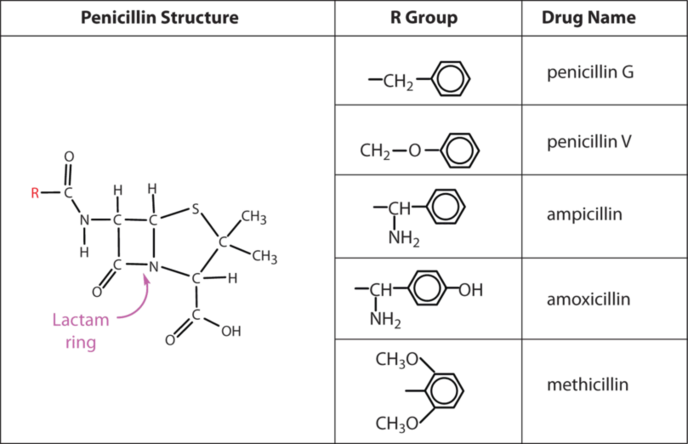
Some strains of bacteria become resistant to penicillin through a mutation that allows them to synthesize an enzyme—penicillinase—that breaks the antibiotic down (by cleavage of the amide linkage in the lactam ring). To combat these strains, scientists have synthesized penicillin analogs (such as methicillin) that are not inactivated by penicillinase.
Some people (perhaps 5% of the population) are allergic to penicillin and therefore must be treated with other antibiotics. Their allergic reaction can be so severe that a fatal coma may occur if penicillin is inadvertently administered to them. Fortunately, several other antibiotics have been discovered. Most, including aureomycin and streptomycin, are the products of microbial synthesis. Others, such as the semisynthetic penicillins and tetracyclines, are made by chemical modifications of antibiotics; and some, like chloramphenicol, are manufactured entirely by chemical synthesis. They are as effective as penicillin in destroying infectious microorganisms. Many of these antibiotics exert their effects by blocking protein synthesis in microorganisms.
Initially, antibiotics were considered miracle drugs, substantially reducing the number of deaths from blood poisoning, pneumonia, and other infectious diseases. Some seven decades ago, a person with a major infection almost always died. Today, such deaths are rare. Seven decades ago, pneumonia was a dreaded killer of people of all ages. Today, it kills only the very old or those ill from other causes. Antibiotics have indeed worked miracles in our time, but even miracle drugs have limitations. Not long after the drugs were first used, disease organisms began to develop strains resistant to them. In a race to stay ahead of resistant bacterial strains, scientists continue to seek new antibiotics. The penicillins have now been partially displaced by related compounds, such as the cephalosporins and vancomycin. Unfortunately, some strains of bacteria have already shown resistance to these antibiotics.
Some reversible inhibitors are noncompetitive. A noncompetitive inhibitor can combine with either the free enzyme or the enzyme-substrate complex because its binding site on the enzyme is distinct from the active site. Binding of this kind of inhibitor alters the three-dimensional conformation of the enzyme, changing the configuration of the active site with one of two results. Either the enzyme-substrate complex does not form at its normal rate, or, once formed, it does not yield products at the normal rate. Because the inhibitor does not structurally resemble the substrate, the addition of excess substrate does not reverse the inhibitory effect.
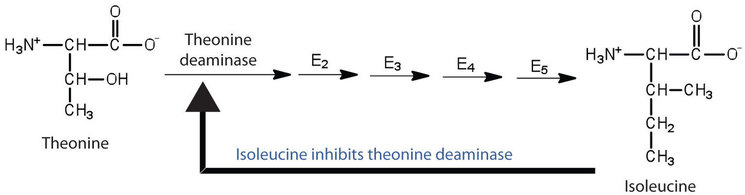
Feedback inhibition is a normal biochemical process that makes use of noncompetitive inhibitors to control some enzymatic activity. In this process, the final product inhibits the enzyme that catalyzes the first step in a series of reactions. Feedback inhibition is used to regulate the synthesis of many amino acids. For example, bacteria synthesize isoleucine from threonine in a series of five enzyme-catalyzed steps. As the concentration of isoleucine increases, some of it binds as a noncompetitive inhibitor to the first enzyme of the series (threonine deaminase), thus bringing about a decrease in the amount of isoleucine being formed (Figure \(\PageIndex{2}\)).
Summary
An irreversible inhibitor inactivates an enzyme by bonding covalently to a particular group at the active site. A reversible inhibitor inactivates an enzyme through noncovalent, reversible interactions. A competitive inhibitor competes with the substrate for binding at the active site of the enzyme. A noncompetitive inhibitor binds at a site distinct from the active site.
This page titled 12.10: Enzyme Inhibition was last modified on Thu, 31 Jul 2025 00:06:39 GMT and is shared under a CC BY-NC-SA 4.0 license and was authored, remixed, and/or curated by Sol Parajon Puenzo (Cañada College) .
The book could not be loaded just now.