Opening the book…
- To identify the physical properties of alkanes and describe trends in these properties.
Most of the hydrocarbons in petroleum belong to a family of compounds called the alkanes, in which all carbon atoms are linked by single bonds.
Alkanes are organic compounds that consist entirely of single-bonded carbon and hydrogen atoms and lack any other functional groups. Alkanes have the general formula CnH2n+2 and can be subdivided into the following three groups: the linear straight-chain alkanes, branched alkanes, and cycloalkanes. Alkanes are also saturated hydrocarbons. Alkanes are the simplest and least reactive hydrocarbon species, containing only carbon and hydrogen. They are commercially very important, being the principal constituent of gasoline and lubricating oils, and are extensively employed in organic chemistry; though the role of pure alkanes (such as hexanes) is delegated mostly to solvents. The distinguishing feature of an alkane, which sets it apart from other compounds that also exclusively contain carbon and hydrogen, is its lack of unsaturation. That is to say, it contains no double or triple bonds, which are highly reactive in organic chemistry. Though not totally devoid of reactivity, their lack of reactivity under most laboratory conditions makes them a relatively uninteresting, though very important, component of organic chemistry. As you will learn later, the energy confined within the carbon-carbon bond and the carbon-hydrogen bond is quite high, and their rapid oxidation produces a large amount of heat, typically in the form of fire.
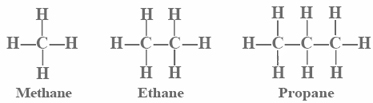
Ball-and-stick models of alkane molecules, which contain up to three carbon atoms, are shown in Figure. Methane (a) has four C—H bonds arranged tetrahedrally around a single carbon atom. Ethane (b) has a slightly more complicated structure—each carbon is still surrounded tetrahedrally by four bonds, but only three are C―H bonds, while the fourth is a C—C bond. Ethane may be thought of as two methyl groups connected by a single C—C bond. (The methyl group, CH3—, has the same structure as methane except that one hydrogen has been removed.) Thus, the formula for ethane is CH3CH3 or C2H6.
The third member of the alkane family is propane. As can be seen in part c, the three carbon atoms are in a chain. The two methyl groups at the ends of the chain are linked together by a methylene group, —CH2—. The formula is CH3CH2CH3 or C3H8. Again, the tetrahedral arrangement of C—H or C—C bonds around each carbon atom is maintained.
Most of us lack the artistic skill to make good three-dimensional sketches of the molecular structures of alkanes or other organic compounds. Consequently, projection formulas, which indicate how the atoms are connected but do not show tetrahedral angles of 109.5°, are commonly used. Projection formulas for the three members of the alkane family are
Nomenclature of Alkanes
Most of the hydrocarbons in petroleum belong to a family of compounds called the alkanes, in which all carbon atoms are linked by single bonds. The names of all alkanes end with -ane. A stem name (Table \(\PageIndex{1}\)) indicates the number of carbon atoms in the longest continuous chain (LCC). The first ten members of the series (in terms of number of carbon atoms) are named as follows:
| Stem | Number |
|---|---|
| meth- | 1 |
| eth- | 2 |
| prop- | 3 |
| but- | 4 |
| pent- | 5 |
| hex- | 6 |
| hept- | 7 |
| oct- | 8 |
| non- | 9 |
| dec- | 10 |
Alkanes with unbranched opened carbon chains are simply named by the number of carbons in the chain.
- CH4 = methane = one hydrogen-saturated carbon
- C2H6 = ethane = two hydrogen-saturated carbons
- C3H8 = propane = three hydrogen-saturated carbons
- C4H10 = butane = four hydrogen-saturated carbons
Alkanes with five or more carbon atoms are named by adding the suffix -ane to the appropriate numerical multiplier, except the terminal -a is removed from the basic numerical term. Hence, C5H12 is called pentane, C6H14 is called hexane, C7H16 is called heptane and so forth.
Straight-chain alkanes are sometimes indicated by the prefix n- (for normal) to distinguish them from branched-chain alkanes having the same number of carbon atoms. Although this is not strictly necessary, the usage is still common in cases where there is an important difference in properties between the straight-chain and branched-chain isomers: e.g. n-hexane is a neurotoxin while its branched-chain isomers are not.
The IUPAC nomenclature is a system that most organic chemists have agreed to provide guidelines to allow them to learn from each other's works. Nomenclature, in other words, provides a foundation of language for organic chemistry.
Physical Properties of Alkanes
Because alkanes have relatively predictable physical properties and undergo relatively few chemical reactions other than combustion, they serve as a basis of comparison for the properties of many other organic compound families. Let’s consider their physical properties first.
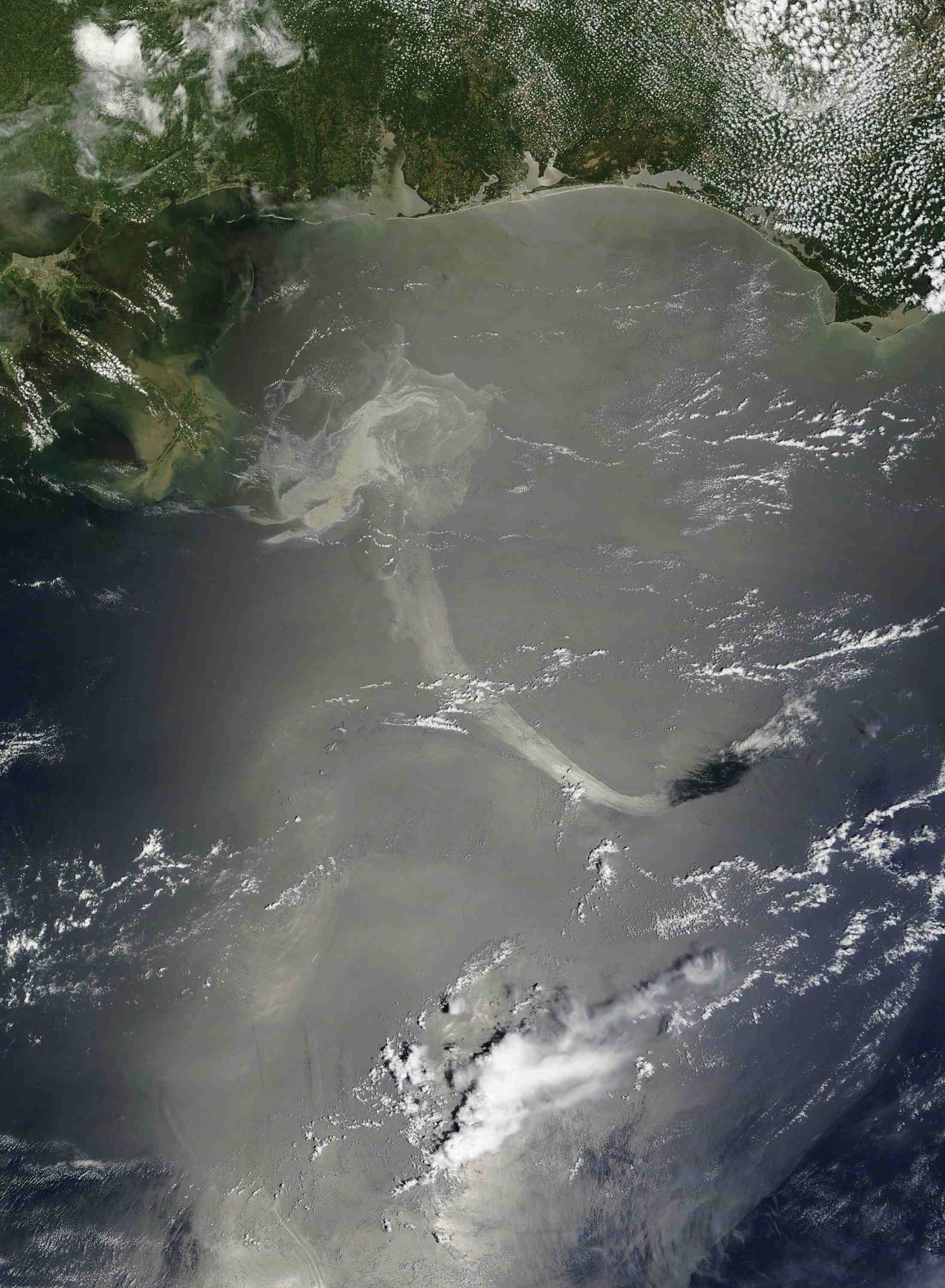
Table \(\PageIndex{2}\) describes some of the properties of some of the first 10 straight-chain alkanes. Because alkane molecules are nonpolar, they are insoluble in water, which is a polar solvent, but are soluble in nonpolar and slightly polar solvents. Consequently, alkanes themselves are commonly used as solvents for organic substances of low polarity, such as fats, oils, and waxes. Nearly all alkanes have densities less than 1.0 g/mL and are therefore less dense than water (the density of H2O is 1.00 g/mL at 20°C). These properties explain why oil and grease do not mix with water but rather float on its surface.
| Molecular Name | Formula | Melting Point (°C) | Boiling Point (°C) | Density (20°C)* | Physical State (at 20°C) |
|---|---|---|---|---|---|
| methane | CH4 | –182 | –164 | 0.668 g/L | gas |
| ethane | C2H6 | –183 | –89 | 1.265 g/L | gas |
| propane | C3H8 | –190 | –42 | 1.867 g/L | gas |
| butane | C4H10 | –138 | –1 | 2.493 g/L | gas |
| pentane | C5H12 | –130 | 36 | 0.626 g/mL | liquid |
| hexane | C6H14 | –95 | 69 | 0.659 g/mL | liquid |
| octane | C8H18 | –57 | 125 | 0.703 g/mL | liquid |
| decane | C10H22 | –30 | 174 | 0.730 g/mL | liquid |
| *Note the change in units going from gases (grams per liter) to liquids (grams per milliliter). Gas densities are at 1 atm pressure. | |||||
Looking Closer: Gas Densities and Fire Hazards
Table \(\PageIndex{1}\) indicates that the first four members of the alkane series are gases at ordinary temperatures. Natural gas is composed chiefly of methane, which has a density of about 0.67 g/L. The density of air is about 1.29 g/L. Because natural gas is less dense than air, it rises. When a natural-gas leak is detected and shut off in a room, the gas can be removed by opening an upper window. On the other hand, bottled gas can be either propane (density 1.88 g/L) or butanes (a mixture of butane and isobutane; density about 2.5 g/L). Both are much heavier than air (density 1.2 g/L). If bottled gas escapes into a building, it collects near the floor. This presents a much more serious fire hazard than a natural-gas leak because it is more difficult to remove the heavier gas from the room.
Also shown in Table \(\PageIndex{1}\) are the boiling points of the straight-chain alkanes increase with increasing molar mass. This general rule holds true for the straight-chain homologs of all organic compound families. Larger molecules have greater surface areas and consequently interact more strongly; more energy is therefore required to separate them. For a given molar mass, the boiling points of alkanes are relatively low because these nonpolar molecules have only weak dispersion forces to hold them together in the liquid state.
Key Takeaway
- Alkanes are nonpolar compounds that are low-boiling and insoluble in water.
This page titled 6.1: Introduction to Alkanes was last modified on Thu, 31 Jul 2025 00:06:37 GMT and is shared under a CC BY-NC-SA 4.0 license and was authored, remixed, and/or curated by Sol Parajon Puenzo (Cañada College) .
The book could not be loaded just now.