Opening the book…
- Identify the evidence for chemical reactions.
Chemical Change
In a chemical change, new substances are formed. In order for this to occur, the chemical bonds of the substances break, and the atoms that compose them separate and rearrange themselves into new substances with new chemical bonds. When this process occurs, it is referred to as a chemical reaction. A chemical reaction is the process in which one or more substances are changed into one or more new substances.
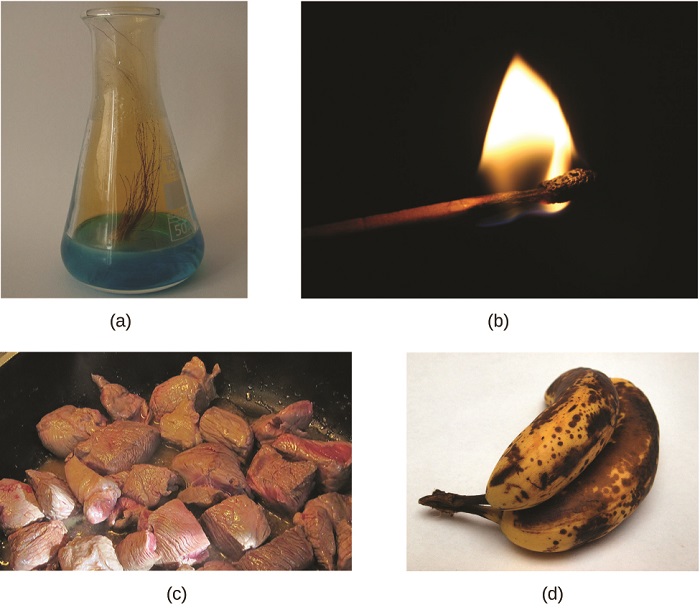
Evidence of Chemical Reactions
To identify a chemical reaction, we look for a chemical change that occurs. A chemical change always produces one or more types of matter that differ from the matter present before the change. The formation of rust is a chemical change because rust is a different kind of matter than the iron, oxygen, and water present before the rust formed. The explosion of nitroglycerin is a chemical change because the gases produced are of a very different kind from the original substance. Other examples of chemical changes include reactions performed in a lab (such as copper reacting with nitric acid), all forms of combustion (burning), and the processes of cooking, digestion, or decay (Figure \(\PageIndex{1}\)).
Video\(\PageIndex{1}\): Evidence of a Chemical Reaction
Law of Conservation of Mass
According to this law, "In a chemical reaction, matter is neither created nor destroyed." The law of conservation of mass is also known as the "law of indestructibility of matter."
For example: during and experiment 10 grams of \(\ce{CaCO3}\) where heated and it produced 4.4 g of \(\ce{CO2}\) and 5.6 g of \(\ce{CaO}\):
- Mass of the reactants, \(\ce{CaCO3}\) : \(10 \,g\)
- Mass of the products, \(\ce{CO2}\) and \(\ce{CaO}\): \(4.4 \,g+ 5.6\, g = 10\, g\).
These observations are in agreement with the law of conservation of mass.

Which of the following is a chemical reaction?
- Freezing liquid Mercury.
- Adding yellow to blue to make green.
- Cutting a piece of paper into two pieces.
- Dropping a sliced orange into a vat of sodium hydroxide.
- Filling a balloon with natural air.
Solution
A, b ,c , & e involve only physical changes. A sliced orange has acid (citric acid) that can react with sodium hydroxide, so the answer is d.
Which of the following is a chemical reaction?
- Painting a wall blue
- A bicycle rusting
- Ice cream melting
- Scratching a key across a desk
- Making a sand castle
- Answer
-
b
Which of the following is not a chemical reaction?
- Shattering glass with a baseball
- Corroding Metal
- Fireworks exploding
- Lighting a match
- Baking a cake
Solution
Shattering glass with a baseball results in the glass broken into many pieces, but no chemical change happens, so the answer is a.
Which of the following is NOT a chemical reaction?
- Frying an egg
- Slicing carrots
- A Macbook falling out of a window
- Creating ATP in the human body
- Dropping a fizzy tablet into a glass of water
- Answer
-
b and c
Chemistry In Action
Although yeast has been used for thousands of years, its true nature has been known only for the last two centuries. Yeasts are single-celled fungi. About 1,000 species are recognized, but the most common species is Saccharomyces cerevisiae, which is used in bread making. Other species are used for the fermentation of alcoholic beverages. Some species can cause infections in humans.
Yeasts live primarily on sugars, such as glucose (\(\ce{C6H12O6}\)). They convert glucose into carbon dioxide (\(\ce{CO2}\)) and ethanol (\(\ce{C2H5OH}\)) in a chemical transformation that is represented as follows:
\[\ce{C6H12O6(s) → 2CO2(g) + 2C2H5OH(ℓ)} \nonumber \]
Bread making depends on the production of carbon dioxide. The gas, which is produced in tiny pockets in bread dough, acts as a leavening agent: it expands during baking and makes the bread rise. Leavened bread is softer, lighter, and easier to eat and chew than unleavened bread. The other major use of yeast, fermentation, depends on the production of ethanol, which results from the same chemical transformation. Some alcoholic beverages, such as champagne, can also be carbonated using the carbon dioxide produced by the yeast.
Yeast is among the simplest life forms on Earth, yet it is absolutely necessary for at least two major food industries. Without yeast to turn dough into bread and juice into wine, these foods and food industries would not exist today.
This page titled 7.1: Introduction to Chemical Reactions was last modified on Thu, 31 Jul 2025 00:06:33 GMT and is shared under a CC BY license and was authored, remixed, and/or curated by Sol Parajon Puenzo (Cañada College) .
The book could not be loaded just now.