Opening the book…
- To be able to explain the difference between accuracy and precision
- To be able to recognize which figures in a measured value are certain (accurate) and which are uncertain
Accuracy and Precision
In everyday speech, the terms accuracy and precision are frequently used interchangeably. However, their scientific meanings are quite different.
- Measurements may be accurate, meaning that the measured value is the same as the true value; when multiple measurements are taken, the average of teh measurements should be the same as the true value.
- Measurements may be precise, meaning that multiple measurements give nearly identical values (i.e., reproducible results); measurements are considered precise when the results are highly reproducible, even if they are not close to the correct value.
Measurements may be both accurate and precise; or they may be neither accurate nor precise. The goal of scientists is to obtain measured values that are both accurate and precise.
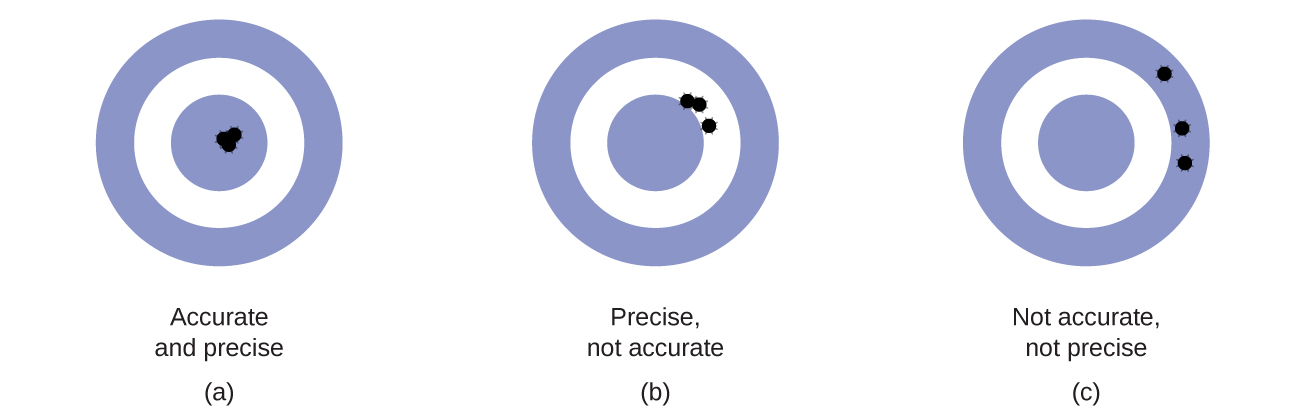
These characterizations can be extended to other contexts, such as the results of an archery competition or darts thrown at a dartboard, to illustrate accuracy and precision. (Figure \(\PageIndex{1}\)).
Assume that three darts are thrown at the dartboard, with the bulls-eye representing the true, or accepted, value of what is being measured. A dart that hits the bulls-eye is highly accurate, whereas a dart that lands far away from the bulls-eye displays poor accuracy. The figure above demonstrates four possible outcomes:
- The darts are grouped together and have hit the bulls-eye. This demonstrates high precision and high accuracy. Scientists always strive to maximize both in their measurements.
- The darts are close to one another, but far from the bulls-eye. This grouping demonstrates measurements that are precise, but not accurate. In a laboratory situation, high precision with low accuracy often results from a systematic error. Either the measurer makes the same mistake repeatedly, or the measuring tool is somehow flawed. A poorly calibrated balance may give the same mass reading every time, but it will be far from the true mass of the object.
- The darts are not grouped very near to each other, and far from the bulls-eye. This grouping demonstrates measurements that are neither accurate nor precise.
Video: What's the difference between accuracy and precision? - Matt Anticole
Suppose a quality control chemist is tasked with verifying the accuracy and precision of two different balances compared with a calibrated Balance (Balance 3). The mass of a sample of gold was measured on balance 1 and found to be 1.896 g. On balance 2, the same sample was found to have a mass of 1.125 g. Which was correct? Careful and repeated measurements, including measurements on the calibrated balance 3, showed the sample to have a mass of 1.895 g. The masses obtained from the three balances are in the following table:
| Balance 1 | Balance 2 | Balance 3 |
|---|---|---|
| 1.896 g | 1.125 g | 1.893 g |
| 1.895 g | 1.158 g | 1.895 g |
| 1.894 g | 1.067 g | 1.895 g |
We can asses accuracy in 2 different ways:
- When a single measurement is taken, it is considered accurate when the measured value is the same as the true value;
- When multiple measurements are taken, we can assess the accuracy of a set of measurements by calculating the average of the measurements as follows:
\[ \text{average} = \dfrac{\text{sum of measurements} }{\text{number of measurements}} \label{Eq1} \]
For Balance 1: (1.896 g + 1.895 g + 1.894 g ) / 3 = 1.895 g
For Balance 2: (1.125 g + 1.158 g + 1.067g) /3 = 1.117 g
Then, we can assess the precision of a set of measurements by how far each measurement is from the others.
For Balance 1: the highest measurement is 0.002 g higher than the lowest measurement; this difference is small. (2 times the minimum possible measurement of the equipment)
For Balance 2, the second measurement is 0.091 g higher than the third measurement, which is a significant difference.
Final Answer
We can conclude that the measurements obtained from balances 1 and 3 are reproducible (precise) and are close to the accepted value (accurate), while those obtained from balance 2 are neither. When a series of measurements is precise but not accurate, the error is usually systematic. Systematic errors can be caused by faulty instrumentation or faulty technique.
Suppose you are a quality control chemist at a pharmaceutical company is tasked with verifying the accuracy and precision of three different machines designed to dispense 10 ounces (296 mL) of cough syrup into storage bottles. You proceed to use each machine to fill five bottles and then carefully determine the actual volume dispensed, obtaining the results tabulated in Table \(\PageIndex{2}\). What can you infer about accuracy and precision for each dispenser? Which one will you use to fill the bottles?
| Dispenser #1 | Dispenser #2 | Dispenser #3 |
|---|---|---|
| 283.3 | 298.3 | 296.1 |
| 284.1 | 294.2 | 295.9 |
| 283.9 | 296.0 | 296.1 |
| 284.0 | 297.8 | 296.0 |
| 284.1 | 293.9 | 296.1 |
- Answer
-
Considering these results, you will report that:
Dispenser #1 is precise (values all close to one another, within a few tenths of a milliliter) but not accurate (none of the values are close to the target value of 296 mL, each being more than 10 mL too low).
Results for dispenser #2 represent improved accuracy (each volume is less than 3 mL away from 296 mL) but worse precision (volumes vary by more than 4 mL).
Finally, dispenser #3 is working well, dispensing cough syrup both accurately (all volumes within 0.1 mL of the target volume) and precisely (volumes differing from each other by no more than 0.2 mL).
This page titled 1.3: Accuracy and Precision was last modified on Thu, 31 Jul 2025 00:06:35 GMT and is shared under a CC BY-NC-SA 4.0 license and was authored, remixed, and/or curated by Sol Parajon Puenzo (Cañada College) .
The book could not be loaded just now.