Opening the book…
What is a chemical bond?
The observation that noble gases have filled valence shells and are usually inert in chemical reactions led to the theory of valency.
During chemical reactions, atoms gain, lose, or share valence electrons to acquire the nearest noble gas configuration.
A chemical bond is an electrostatic attraction that results from the transfer or sharing of valence electrons, holding atoms together. An atom that can transfer or share one valence electron is monovalent, two is divalent, three is trivalent, and four is tetravalent.
Ionic bond
Metals, particularly those on the left side of the periodic table, tend to lose valence electrons, leaving the core shells with the nearest noble gas configuration. The loss of an electron leaves the atom with a positive charge, making it a cation. For example, sodium \(\ce{Na}\) has six electrons in the first two core shells and one in the valence shell as depicted in the figure on the right (copyright; Wdcf, CC BY-SA 3.0, via Wikimedia Commons). It lose one electron becoming \(\ce{Na^+}\) when it reacts with fluorine \(\ce{F}\). 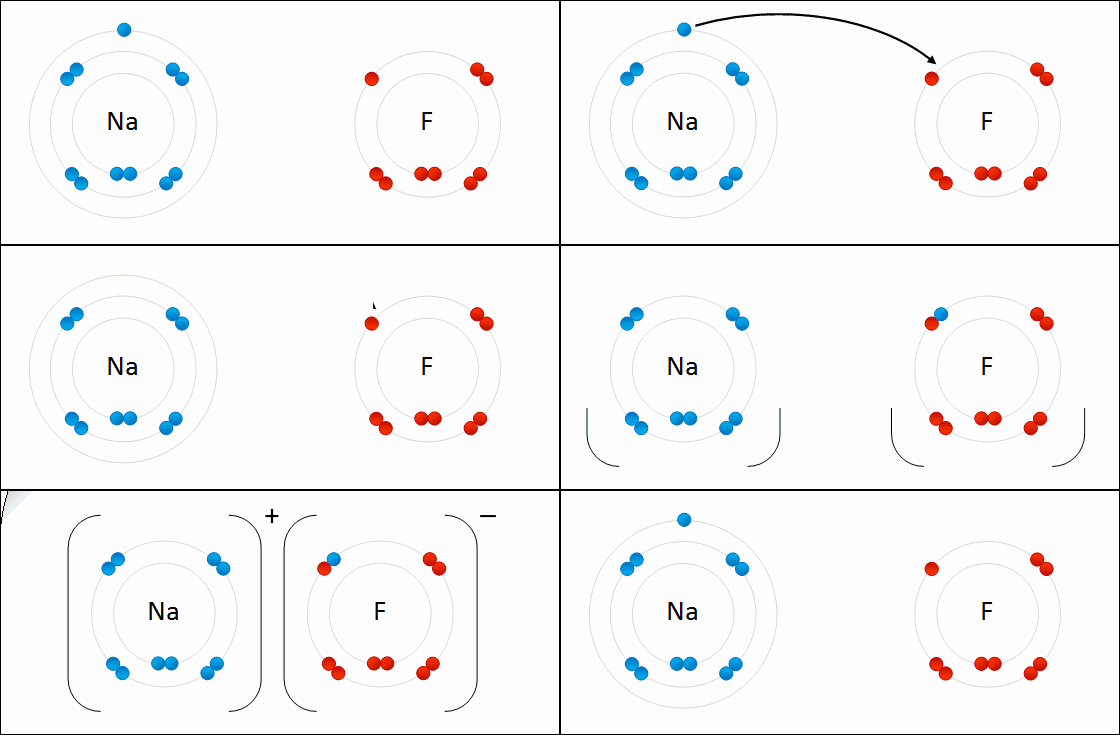
Nonmetals, particularly those on the right side of the periodic table, except noble gases, tend to gain electrons to achieve the electron configuration of the nearest noble gas. The gain of an electron creates a negative charge, making an anion. For example, \(\ce{F}\) become anion \(\ce{F^-}\) after gaining one electron.
Cations, formed by losing electrons, and anions, formed by gaining electrons, are held together by electrostatic attractions, forming an ionic bond.
For example, \(\ce{Na^{+}F^{-}}\) is an ionic compound held by ionic bonds. Atoms may lose or gain more than one electron in ionic bond formation. Still, the number of electrons lost by cations equals the electrons gained by anions, i.e., the positive charge is balanced by an equal negative charge in an ionic compound. For example, \(\ce{Mg^{2+}Cl2^{-}}\), \(\ce{Ca^{2+}O^{2-}}\), \(\ce{Fe^{3+}Cl3^{-}}\) are overall neutral ionic compounds with equal positive and negative charge.
Covalent bond
 Reacting atoms, especially nonmetal atoms, can share some of their valence electrons to achieve the electron configuration of the nearest noble gas. For example, two hydrogen atoms can share their valence electron, shown as dot on the symbol of the element, by the following reaction \(\ce{H\cdot + \cdot H -> H\!:\!H}\), as illustrated in the figure on the right (copyright; Jacek FH, CC BY-SA 3.0, via Wikimedia Commons).
A shared pair of valence electrons holding the two atoms together is a covalent bond.
The shared pair of electrons, shown as dots between the bonded atoms, is a bonding pair, e.g., two dots in \(\ce{H\!:\!H}\). Valence pairs of non-shared electrons are nonbonding electron pair or lone pairs in the molecule. For example, chlorine shares one of its seven valence electrons to form a covalent bond with hydrogen, leaving six valence electrons as three lone pairs in the molecule, as shown in the following reaction. \[\ce{:\!\overset{\Large{\cdot\cdot}}{\underset{\Large{\cdot\cdot}}{Cl}}\cdot + \cdot H -> :\!\overset{\Large{\cdot\cdot}}{\underset{\Large{\cdot\cdot}}{Cl}}\!:\!H}\nonumber\] The covalent bond, i.e., the bonding pair is usually represented by a line between the nuclei to distinguish it from lone pairs, e.g., \(\ce{H\!:\!H}\) is usually written as \(\ce{H-H}\) showing one covalent bond and \(\ce{:\!\overset{\Large{\cdot\cdot}}{\underset{\Large{\cdot\cdot}}{Cl}}\!:\!H}\) is usually written as \(\ce{:\!\overset{\Large{\cdot\cdot}}{\underset{\Large{\cdot\cdot}}{Cl}}-H}\), showing one covalent bond and three lone pairs on chlorine.
Octet rule
Valence shell of main group elements is \(ns\) \(np\) that can accommodate a maximum of eight electrons, two in \(ns\) and six in the three \(np\) orbitals. Noble gases have eight electrons in their valence shell, resulting in a stable electron configuration. A rule of thumb, called the octet rule, is formulated based on these observations.
The octet rule states that main-group elements tend to gain, lose, or share valence electrons to attain an octet of eight valence electrons, including the shared electrons.
Modifications of the octet rule
There are two modified forms of the octet rule.
- First row elements have 1\(s\) valence shell and can take a maximum of two electrons, called the duet rule. The duet rule applies to \(\ce{H}\) that makes one covalent bond, achieving the electron configuration of noble gas \(\ce{He}\).
- Transition metals of \((n-1)d \) \(ns\) \(np\) valence shell that can take eighteen electrons, called the 18-electron rule.
Exceptions to the octet rule
Exceptions to the octet rule include the following.
- Odd-electron molecules: In some compounds, the total number of valence electrons of the combining atoms is odd, while the octet is an even number. Such compounds will have odd-valence electrons in some atom. For example, \(\ce{N}\) has seven valence electrons and \(\ce{O}\) has six. If they combine to make \(\ce{NO}\), one of the two atoms must have odd-number valence electrons, e.g., \(\ce{ :\!\overset{\Large\cdot}{N}=\overset{\Large\cdot\cdot}{O}\!: }\)
- Incomplete octet: Some elements have fewer than four valence electrons and may form stable compounds with fewer than eight valence electrons, called an incomplete octet. For example, boron makes a stable compound, like \(\ce{ \small {F}-{\underset{\underset{\huge{\ce{F}}} |}{\ce{B}}}-F}\) with three covalent bonds and no lone pair, i.e., incomplete valence shell with only six valence electrons. Similarly, beryllium forms \(\ce{H-Be-H}\) with two covalent bonds and no lone pair, i.e., an incomplete valence shell with only four valence electrons. Although such compounds exist, they are usually reactive and tend to gain more electrons to complete their octet.
- Expanded octet: Second-row elements, including \(\ce{C}\), \(\ce{N}\), \(\ce{O}\), etc., can not have more than eight valence electrons, but third-row and higher elements may do so. For example \(\ce{P}\) in \(\ce{\small HO-\!\!\!\!{\overset{\overset{\huge\!\!\enspace{\ce{O}}}|\!\!|\enspace}{\underset{\underset{\huge\,\,{\ce{OH}}} |}{\ce{P}}}}\!\!\!\!-OH}\) has five covalent bonds, i.e., ten valence electrons and \(\ce{S}\) in \(\ce{\small HO-\!\!{\overset{\overset{\huge\!\!\enspace{\ce{O}}}|\!\!|\enspace}{\underset{\underset{\huge\!\!\enspace{\ce{O}}}|\!\!|\enspace}{\ce{S}}}}\!\!-OH}\) has six covalent bonds, i.e., twelve valence electrons (note: two lone pairs on each oxygen in theses two structcures are omitted for simplicity). Atoms with more than an octet of valence electrons in compounds are said to be in a hypervalent state, or an expanded octet state. Although it is explained by the involvement of inner \((n-1)d \) orbitals in the bonding, in addition to \(ns\) \(np\) valence orbitals, it is controversial whether there is an expanded octet or whether such compounds still obey the octet rule. This debate will be discussed later.
In summary, the octet rule strictly applies to second row elements, including \(\ce{C}\), \(\ce{N}\), \(\ce{O}\), etc., and halogens.
Lewis structures
Lewis structures are a convenient way of writing covalent compounds based on valence electrons and the octet rule. They show shared pairs of electrons as lines and unused valence electrons as lone pairs (pairs of dots).
Lewis's symbols for elements show valence electrons as dots around the symbol, as shown in Table 1.3.1.
- In any order, up to four valence electrons are shown as single dots on four sides (top, bottom, left, and right) of the element symbol. For example, one valence of hydrogen may be shown as \(\ce{\cdot H}\), \(\ce{H\cdot}\), \(\ce{\overset{\Large\cdot}{H}}\), or \(\ce{\underset{\Large\cdot}{H}}\) and \(\ce{\cdot\overset{\Large\cdot}{\underset{\Large\cdot}{C}}\cdot}\) represents four valence electrons of carbon as dots.
- Fifth to eighth valence electrons are paired, one each, with any of the single dots, in any order. For example, six valence electrons of oxygen may be shown as \(\ce{:\!\overset{\Large\cdot\cdot}{\underset{\Large\cdot}{O}}\cdot}\), \(\ce{:\!\overset{\Large\cdot}{\underset{\Large\cdot}{O}}\!:}\), \(\ce{:\!\overset{\Large\cdot}{\underset{\Large\cdot\cdot}{O}}\cdot}\), or \(\ce{\cdot\overset{\Large\cdot\cdot}{\underset{\Large\cdot\cdot}{O}}\cdot}\), etc. and \(\ce{:\!\overset{\Large\cdot\cdot}{\underset{\Large\cdot\cdot}{Ne}}\!:}\) represents eight valence electrons of neon.
- Helium is an exception that has a full valence shell with two electrons that are shown as a pair of dots.
|
Group \(\rightarrow\) Rows \(\downarrow\) |
1 | 2 | 13 | 14 | 15 | 16 | 17 | 18 |
| 1 |
\(\ce{H\cdot}\) |
\(\ce{He\!:}\) |
||||||
| 2 | \(\ce{Li\cdot}\) | \(\ce{\cdot{\ce{Be}}\cdot}\) | \(\ce{\cdot\overset{\Large{\cdot}}{B}\cdot}\) | \(\ce{\cdot\overset{\Large{\cdot}}{\underset{\Large{\cdot}}{C}}\cdot}\) | \(\ce{:\!\overset{\Large\cdot}{\underset{\Large\cdot}{N}}\cdot}\) | \(\ce{\cdot\overset{\Large{\cdot\cdot}}{\underset{\Large{\cdot\cdot}}{O}}\cdot}\) | \(\ce{\cdot\overset{\Large\cdot\cdot}{\underset{\Large\cdot\cdot}{F}}\!:}\) | \(\ce{:\!\overset{\Large\cdot\cdot}{\underset{\Large\cdot\cdot}{Ne}}\!:}\) |
|
3 |
\(\ce{Na\cdot}\) | \(\ce{\cdot{\ce{Mg}}\cdot}\) | \(\ce{\cdot\overset{\Large{\cdot}}{Al}\cdot}\) | \(\ce{\cdot\overset{\Large{\cdot}}{\underset{\Large{\cdot}}{Si}}\cdot}\) | \(\ce{:\!\overset{\Large\cdot}{\underset{\Large\cdot}{P}}\cdot}\) | \(\ce{\cdot\overset{\Large{\cdot\cdot}}{\underset{\Large{\cdot\cdot}}{S}}\cdot}\) | \(\ce{\cdot\overset{\Large\cdot\cdot}{\underset{\Large\cdot\cdot}{Cl}}\!:}\) | \(\ce{:\!\overset{\Large\cdot\cdot}{\underset{\Large\cdot\cdot}{Ar}}\!:}\) |
Lewis structures of simple molecules
The following steps can be used to draw Lewis structures of simple molecules.
- Place the most electropositive element in the middle and the others around it, add a line between atoms depicting a covalent bond, and remove one dot from each bonded atom. Count the shared electrons in both atoms' valence shells. If the octet of every atom is complete (duet for hydrogen), it is a correct Lewis structure. For example,
- methane \(\ce{CH4}\) is drawn as shown in the following reaction \(\ce{4H\cdot + \cdot\overset{\Large{\cdot}}{\underset{\Large{\cdot}}{C}}\cdot-> {H}-\overset{\overset{\Huge{\ce{H}}}|}{\underset{\underset{\Huge{\ce{H}}}|}{C}}-H}\);
- ammonia \(\ce{NH3}\) as \(\ce{3H\cdot + :\!\overset{\Large\cdot}{\underset{\Large\cdot}{N}}\cdot-> {H}-\overset{\!\large\:\cdot\:\!\cdot}{\underset{\underset{\Huge{\ce{H}}}|}{N}}-H}\); and
- water \(\ce{H2O}\) as \(\ce{2H\cdot + \cdot\overset{\Large{\cdot\cdot}}{\underset{\Large{\cdot\cdot}}{O}}\cdot -> {H}-\overset{\!\large\:\cdot\:\!\cdot}{\underset{\!\Large\:\cdot\:\!\cdot}{O}}-H}\).
- Note the exception when hydrogen reacts with other atoms; it is never placed in the middle. Also note that the paired dots in the Lewis symbol remain as lone pairs on the respective atom in the molecule.
- If the octet is incomplete on some atoms and
- There is a single dot (an unpaired electron) on two adjacent atoms, which forms a second covalent bond (a double bond) and removes the dots. For example, formaldehyde \(\ce{H2CO}\) is drawing as shown in the following reaction \(\ce{2H\cdot + \cdot\overset{\Large{\cdot}}{\underset{\Large{\cdot}}{C}}\cdot + \cdot\overset{\Large{\cdot}}{\underset{\Large{\cdot\cdot}}{O}}\!: -> {H}-\overset{\Large\cdot}{\underset{\underset{\Huge{\ce{H}}}|}{C}}-\overset{\Large\cdot}{\underset{\Large\:\cdot\:\!\cdot}{O}}\!: -> {H}-{\underset{\underset{\Huge{\ce{H}}}|}{\ce{C}}}={\underset{\!\!\Large\:\cdot\:\!\cdot}{\ce{O}}}\!:}\)
- If there are two single dots on two adjacent atoms, make two more covalent bonds between them, resulting in a triple bond, and remove the dots. For example, cyanic acid \(\ce{HCN}\) is drawn as in the following reaction \(\ce{H\cdot + \cdot\overset{\Large{\cdot}}{\underset{\Large{\cdot}}{C}}\cdot + \cdot\overset{\Large\cdot}{\underset{\Large\cdot}{N}}\!: -> {H}-\overset{\Large\cdot}{\underset{\Large\cdot}{C}}-\overset{\Large\cdot}{\underset{\Large\cdot}{N}}\!: -> H-C\!\equiv\!{N}\!:}\)
Drawing Lewis structures of relatively complex molecules and covalent-bonded ions
The following steps, explained with examples, can be used to draw the Lewis structures of relatively complex molecules and ionic species.
- Add the valence electrons of all atoms in the molecule and adjust for the charge: remove one electron for each positive charge or add one for each negative charge. For example \(\ce{C2H6}\) has 4x2 + 1x6 = 14 electrons; \(\ce{CO2}\) has 4+2x6 = 16 electrons; \(\ce{[NH4]^{+}}\) has 7 + 1x4 -1 = 10 electrons, and \(\ce{[NO3]^{-}}\) has 7 + 6x3 +1 = 24 electrons.
- Note: valence electrons are equal to the first digit of group number in the periodic table, e.g., \(\ce{H}\) is in group 1 has one valence electron, \(\ce{C}\) in group 14 has 4, \(\ce{N}\) in group 15 has 5, and \(\ce{O}\) in group 16 has 6 valence electrons.
- Place the most electropositive atom in the middle (except \(\ce{H}\) which is always peripheral) and the rest around it and join them by a line representing a covalent bond, i.e., a pair of bonded electrons. For example \(\ce{C2H6}\) becomes \(\ce{H-\overset{\overset{\Huge{\ce{H}}}|}{\underset{\underset{\Huge{\ce{H}}}|}{C}}-\overset{\overset{\Huge{\ce{H}}}|}{\underset{\underset{\Huge{\ce{H}}}|}{C}}-H}\); \(\ce{CO2}\) become \(\ce{O-C-O}\); \(\ce{[NH4]^{+}}\) become \(\left[\ce{H-\overset{\overset{\Huge{\ce{H}}}|}{\underset{\underset{\Huge{\ce{H}}}|}{N}}-H}\right]^{+}\), and \(\ce{[NO3]^{-}}\) become \(\left[\ce{O-{\overset{\overset{\Huge{\ce{O}}} |}{\ce{N}}}-O}\right]^{-}\). Note: charged species are placed within square brackets, and the charge is shown as a superscript to the right square bracket.
- Count the valence electrons consumed in the covalent bonds in the previous step, and distribute the remaining from the total, first to the peripheral atoms and then to the central atom to complete their octet (\(\ce{H}\) is an exception that follows the duet rule). For example \(\ce{C2H6}\) has no valence electrons left and remains the same \(\ce{H-\overset{\overset{\Huge{\ce{H}}}|}{\underset{\underset{\Huge{\ce{H}}} |}{C}}-\overset{\overset{\Huge{\ce{H}}}|}{\underset{\underset{\Huge{\ce{H}}}|}{C}}-H}\); \(\ce{CO2}\) become \(\ce{:\!\overset{\Large{\cdot\cdot}}{\underset{\Large{\cdot\cdot}}{O}}-C-\overset{\Large{\cdot\cdot}}{\underset{\Large{\cdot\cdot}}{O}}\!:}\) after distributiong 12 remaining electrons; \(\ce{[NH4]^{+}}\) has no electrons left and remains the same \(\left[\ce{H-\overset{\overset{\Huge{\ce{H}}}|}{\underset{\underset{\Huge{\ce{H}}}|}{N}}-H}\right]^{+}\), and \(\ce{[NO3]^{-}}\) become \(\left[\ce{:\!\overset{\Large{\cdot\cdot}}{\underset{\Large{\cdot\cdot}}{O}}-\!\!\!\overset{\LARGE{\cdot\cdot}}{\overset{\overset{\huge{:\,\Huge\ce{O}\,:}}|}{N}}\!\!\!-\overset{\Large{\cdot\cdot}}{\underset{\Large{\cdot\cdot}}{O}}\!:}\right]^{-}\) after distributing the remaining 18 elecrons.
- If the octet of every atom (duet for hydrogen) is complete, it is a correct Lewis structure. For example, the following are the correct Lewis structures at this stage: \(\ce{C2H6}\) is \(\ce{H-\overset{\overset{\Huge{\ce{H}}}|}{\underset{\underset{\Huge{\ce{H}}}|}{C}}-\overset{\overset{\Huge{\ce{H}}}|}{\underset{\underset{\Huge{\ce{H}}}|}{C}}-H}\); and \(\ce{[NH4]^{+}}\) is \(\left[\ce{H-\overset{\overset{\Huge{\ce{H}}}|}{\underset{\underset{\Huge{\ce{H}}}|}{N}}-H}\right]^{+}\).
- If an octet is incomplete for an atom, convert a lone pair from its peripheral atom into a second covalent bond (double bond). For example, octet of \(\ce{N}\) is incompelte in \(\left[\ce{:\!\overset{\Large{\cdot\cdot}}{\underset{\Large{\cdot\cdot}}{O}}-\!\!\!\overset{\LARGE{\cdot\cdot}}{\overset{\overset{\huge{:\,\Huge\ce{O}\,:}}|}{N}}\!\!\!-\overset{\Large{\cdot\cdot}}{\underset{\Large{\cdot\cdot}}{O}}\!:}\right]^{-}\) and is completed by converting a lone pair from any \(\ce{O}\) into a double bond as in \(\left[\ce{:\!\overset{\Large{\cdot\cdot}}{\underset{\Large{\cdot\cdot}}{O}}-\!\!\!\overset{\LARGE{\cdot\cdot}}{\overset{\overset{\huge{:\,\Huge\ce{O}\,:}}|}{N}}\!\!\!=\overset{\Large{\cdot\cdot}}{\underset{\Large{\cdot\cdot}}{O}}\!:}\right]^{-}\). \(\ce{C}\) in \(\ce{:\!\overset{\Large{\cdot\cdot}}{\underset{\Large{\cdot\cdot}}{O}}-C-\overset{\Large{\cdot\cdot}}{\underset{\Large{\cdot\cdot}}{O}}\!:}\) has octet in complete. Converting a lone pair from one of the \(\ce{O}\) into a double bond as \(\ce{:\!{\underset{\Large{\cdot\cdot}}{\ce{O}}}=C-\overset{\Large{\cdot\cdot}}{\underset{\Large{\cdot\cdot}}{O}}\!:}\) still leaves the octet incomplete.
- If the octet remains incomplete after the previous step, convert another lone pair from the same peripheral atom into another covalent bond (triple bond) or from another peripheral atom to create a second double bond. For example, Converting a lone pair of the second oxygen in \(\ce{:\!{\underset{\Large{\cdot\cdot}}{\ce{O}}}=C-\overset{\Large{\cdot\cdot}}{\underset{\Large{\cdot\cdot}}{\ce{O}}}\!:}\) into a second double bond competes the Lewis structure with octet of all atoms completed as \(\ce{:\!{\underset{\Large{\cdot\cdot}}{\ce{O}}}=C={\underset{\Large{\cdot\cdot}}{\ce{O}}}\!:}\)
- If an octet is incomplete for an atom, convert a lone pair from its peripheral atom into a second covalent bond (double bond). For example, octet of \(\ce{N}\) is incompelte in \(\left[\ce{:\!\overset{\Large{\cdot\cdot}}{\underset{\Large{\cdot\cdot}}{O}}-\!\!\!\overset{\LARGE{\cdot\cdot}}{\overset{\overset{\huge{:\,\Huge\ce{O}\,:}}|}{N}}\!\!\!-\overset{\Large{\cdot\cdot}}{\underset{\Large{\cdot\cdot}}{O}}\!:}\right]^{-}\) and is completed by converting a lone pair from any \(\ce{O}\) into a double bond as in \(\left[\ce{:\!\overset{\Large{\cdot\cdot}}{\underset{\Large{\cdot\cdot}}{O}}-\!\!\!\overset{\LARGE{\cdot\cdot}}{\overset{\overset{\huge{:\,\Huge\ce{O}\,:}}|}{N}}\!\!\!=\overset{\Large{\cdot\cdot}}{\underset{\Large{\cdot\cdot}}{O}}\!:}\right]^{-}\). \(\ce{C}\) in \(\ce{:\!\overset{\Large{\cdot\cdot}}{\underset{\Large{\cdot\cdot}}{O}}-C-\overset{\Large{\cdot\cdot}}{\underset{\Large{\cdot\cdot}}{O}}\!:}\) has octet in complete. Converting a lone pair from one of the \(\ce{O}\) into a double bond as \(\ce{:\!{\underset{\Large{\cdot\cdot}}{\ce{O}}}=C-\overset{\Large{\cdot\cdot}}{\underset{\Large{\cdot\cdot}}{O}}\!:}\) still leaves the octet incomplete.
Formal charge
Formal charge \(F_c\) on an atom in a covalent compound is calculated as the difference in the valence electrons \(V_e\) of the isolated neutral atom and the valence electrons assigned to it in the compound. Bonding electrons are equally distributed between the bonded atoms for formal charge calcualtion, i.e., \[F_{c} = V_{e} - \left( N_{b} + \frac{B_{e}}{2}\right)\nonumber\] Note: the total number of bonding electrons \(B_e\) is divided by two, assuming a covalent bond is an equally shared pair of electrons. The sum of the formal charges of all atoms in a species equals the overall charge on the species. A zero formal charge is not shown, but a nonzero formal charge is shown, usually as a superscript on the atom's symbol.
Calculate formal charge on \(\ce{H}\) and \(\ce{N}\) atoms in \(\left[\ce{H-\overset{\overset{\Huge{\ce{H}}}|}{\underset{\underset{\Huge{\ce{H}}}|}{N}}-H}\right]^{+}\) and show it on the structure.
Solution
| Given for every \(\ce{H}\): | \(V_e\) = 1 | \(N_b\) = 0 | \(B_e\) = 2 | \(F_{c}\) = ? |
Calculations: \(F_{c} = V_{e} - \left( N_{b} + \frac{B_{e}}{2}\right) = 1 - \left( 0 + \frac{2}{2}\right) = 0\)
| Given for \(\ce{N}\): | \(V_e\) = 5 | \(N_b\) = 0 | \(B_e\) = 8 | \(F_{c}\) = ? |
Calculations: \(F_{c} = V_{e} - \left( N_{b} + \frac{B_{e}}{2}\right) = 5 - \left( 0 + \frac{8}{2}\right) = +1\)
Structure with formal charges: \(\ce{H-\overset{\!\!\!\!\overset{\Huge{\ce{H}}}|}{\underset{\underset{\Huge{\ce{H}}}|}{N}^{+}}\!\!\!-H}\)
Note: zero formal charge is not shown, and the sum of formal charges on all atoms equals the overall charge on the given species.
Calculate formal charge on \(\ce{O}\) labelled (I), (II) and (III) and \(\ce{N}\) atoms in \(\left[\ce{(II):\!\overset{\Large{\cdot\cdot}}{\underset{\Large{\cdot\cdot}}{\ce{O}}}-\!\!\!\!\!\!\!\!\!\!\!\overset{\LARGE{\cdot\cdot}}{\overset{\overset{\Huge{\;\; :\,\ce{O}\,:(I)}}|}{N}}\!\!\!\!\!\!\!\!\!\!=\underset{\Large{\cdot\cdot}}{O}\!:{III}}\right]^{-}\) and show it on the structure.
Solution
| Given for \(\ce{O}\) labeled (I) and (II): | \(V_e\) = 6 | \(N_b\) = 6 | \(B_e\) = 2 | \(F_{c}\) = ? |
Calculations: \(F_{c} = V_{e} - \left( N_{b} + \frac{B_{e}}{2}\right) = 6 - \left( 6 + \frac{2}{2}\right) = -1\)
| Given for \(\ce{O}\) labeled (III): | \(V_e\) = 6 | \(N_b\) = 4 | \(B_e\) = 4 | \(F_{c}\) = ? |
Calculations: \(F_{c} = V_{e} - \left( N_{b} + \frac{B_{e}}{2}\right) = 6 - \left( 4 + \frac{4}{2}\right) = 0\)
| Given for \(\ce{N}\): | \(V_e\) = 5 | \(N_b\) = 0 | \(B_e\) = 8 | \(F_{c}\) = ? |
Calculations: \(F_{c} = V_{e} - \left( N_{b} + \frac{B_{e}}{2}\right) = 5 - \left( 0 + \frac{8}{2}\right) = +1\)
Structure with formal charges: \(\ce{:\!\!\!\overset{\Large{\cdot\cdot}}{\underset{\Large{\cdot\cdot}}{\;\;\ce{O^{-}}}}\!\!-\!\!\!\overset{\LARGE{\;\;\cdot\cdot \normalsize-}}{\overset{\overset{\Huge{:\,\ce{O}\,:}}|}{\;\;N^{+}}}\!=\underset{\Large{\cdot\cdot}}{O}\!:}\) Note: zero formal charge is not shown, and the sum of formal charges on all atoms equals the overall charge on the given species.
Uses of formal charge
Charges on atoms are always destabilizing compared to the corresponding neutral atoms. Therefore, in situations where more than one correct Lewis structure can be drawn, the structure with zero or minimum formal charge is selected as the representative Lewis structure. For example, between the two structure of \(\ce{CO2}\) \(\ce{:\!{\underset{\Large{\cdot\cdot}}{\ce{O}}}=C-\overset{\Large{\cdot\cdot}}{\underset{\Large{\cdot\cdot}}{O}}\!:}\) and \(\ce{:\!\overset{+}{O} \equiv C-\overset{\Large{\;\;\cdot\cdot \small -}}{\underset{\Large{\cdot\cdot}}{O}}\!\!\!:}\) the first one with zero formal charges is selected. Furthermore, in chemical reactions, electrons redistribute, and formal charges change. Tracking these changes helps one better comprehend the reactions. Table 1.3.2 lists the number of bonds and lone pairs expected in neutral atoms and atoms with formal charges of elements commonly found in organic compounds. This knowledge enables the quick determination of formal charges without calculations in most cases. It is essential to memorize this information because, often, the lone pairs are not shown in organic structures; they are understood.
| \(\text Atom^{formal charge}\) | Number of covalent bonds | Number of lone pairs | Depiction |
| \(\ce{C}\) | 4 | 0 | \(\ce{-\overset{|}{\underset{|}{C}}-}\) |
| \(\ce{C^+}\) | 3 | 0 | \(\ce{-\overset{+}{\underset{|}{C}}-}\) |
| \(\ce{C^-}\) | 3 | 1 |
\(\ce{-\!\!\!\overset{\!\huge{\;\;\;\cdot\cdot\,\small -}}{\underset{|}{C}}\!\!\!\!-}\) |
| \(\ce{N}\) | 3 | 1 | \(\ce{-\overset{\!\huge{\;\cdot\cdot\,}}{\underset{|}{N}}\!-}\) |
| \(\ce{N^+}\) | 4 | 0 | \(\ce{-\!\!\overset{|}{\underset{|}{\;\;\ce{N^+}}}\!\!-}\) |
| \(\ce{N^-}\) | 2 | 2 |
\(\ce{-\!\!\!\overset{\!\huge{\;\;\;\cdot\cdot\,\small -}}{\underset{\!\huge\:\cdot\cdot}{N}}\!\!\!\!-}\) |
| \(\ce{O}\) | 2 | 2 | \(\ce{-\overset{\!\huge\:\cdot\:\!\cdot}{\underset{\!\huge\:\cdot\:\!\cdot}{O}}-}\) |
| \(\ce{O^+}\) | 3 | 1 | \(\ce{-\!\!\!\overset{\!\huge{\;\;\cdot\cdot\,\small +}}{\underset{|}{O}}\!\!\!-}\) |
| \(\ce{O^-}\) | 1 | 3 | \(\ce{-\!\!\!\overset{\!\huge{\;\;\cdot\cdot\,\small -}}{\underset{\!\huge\:\cdot\cdot}{O}}\!\!\!\!\!\Large:}\) |
| Halogens \(\ce{X}\) | 1 | 3 | \(\ce{-\overset{\huge{\cdot\cdot}}{\underset{\!\huge\:\cdot\cdot}{X}}\!\!\Large:}\) |
| Halide ions \(\ce{X^-}\) | 0 | 4 |
\(\ce{\Large:\!\!\!\!\normalsize\!\!\!\overset{\!\huge{\;\;\;\cdot\cdot\,\small -}}{\underset{\!\huge\:\cdot\cdot}{X}}\!\!\!\!\!\!\!\Large:}\) |
| \(\ce{H}\) | 1 | 0 | \(\ce{-H}\) |
| \(\ce{H^-}\) | 0 | 1 |
\(\ce{\overset{\!\huge{\;\;\cdot\cdot\,\small -}}{H}}\) |
As described in the next section, the bonding electrons are not equally shared when the bonded atoms are different. Therefore, the formal charge is not real because it is based on the assumption that the bonding electrons are equally shared. Still, the formal charge helps to locate the atom that is expected to carry the significant portion of the charge.
Dative covalent bonds
It is not necessary that both atoms donate one electron; sometimes, both electrons are donated by one of the two bonded atoms, resulting in a dative covalent bond or a coordinate covalent bond. The lone-pair donor atom is called a donor, and the other atom is a receptor in a dative covalent bond. For example, \(\ce{N}\) in \(\ce{H3N\!:}\) donates a lone pair to \(\ce{B}\) of \(\ce{BH3}\), making a dative covalent bond in the following reaction.
\[\ce{H-\overset{\overset{\Huge{\ce{H}}}|}{\underset{\underset{\Huge{\ce{H}}}|}{N}}\!: \;+\; \overset{\overset{\Huge{\ce{H}}}|}{\underset{\underset{\Huge{\ce{H}}}|}{B}}-H -> H-\overset{\!\!\!\!\overset{\Huge{\ce{H}}}|}{\underset{\underset{\Huge{\ce{H}}}|}{N}^{+}}\!\!\!\!-\!\!-\overset{\!\!\!\!\overset{\Huge{\ce{H}}}|}{\underset{\underset{\Huge{\ce{H}}}|}{B}^{-}}\!\!\!\!-H}\nonumber\]
Note: The dative bond completes the octet of \(\ce{B}\) in \(\ce{BH3}\), which was electron-deficient with six valence electrons. Also note that the formal charge of the donor atom increases by +1, and the formal charge of the recipient decreases by -1.
This page titled 1.3: Chemical bonds was last modified on Mon, 17 Aug 2026 23:27:16 GMT and is shared under a Public Domain license and was authored, remixed, and/or curated by Muhammad Arif Malik.
The book could not be loaded just now.